
Lacquer forms a hard film on top of the wood and suits busy, high-traffic floors where you want the least upkeep. Oil, including hardwax oil, soaks into the wood and gives a natural, low-sheen look that you can repair in patches, but it needs re-treating more often. For most Dubai villas and apartments, the real choice is between a natural, repairable surface and a tougher, more uniform one. This guide shows how to decide, room by room and property by property.
TL;DR
- Lacquer (and polyurethane) sits on the surface as a protective film: better for heavy traffic, commercial areas and owners who want minimal maintenance.
- Oil and hardwax oil penetrate the wood: a more natural look and feel, and scratched areas can be spot-repaired without redoing the whole floor.
- Oiled floors need re-treatment more often, but each treatment is quicker and easier than refinishing a lacquered floor.
- Sheen matters as much as the finish type: a matte or low-sheen surface hides small scratches and everyday wear better than gloss.
- Not sure what is on your floor now? Identify it before any refinishing, because the wrong product over the existing finish can fail.
Table of Contents
- What oil and lacquer actually are
- Oil vs lacquer at a glance
- Appearance: natural depth or a uniform finish
- Durability: how each finish handles real life
- Maintenance and repair: where the two finishes differ most
- Choosing a finish in Dubai’s conditions
- Which finish for which property
- Our perspective
- How to tell what finish your floor has now
- Switching from one finish to the other
- Get the finish decided and applied properly
- FAQ
What oil and lacquer actually are
The phrase “oil vs lacquer” hides a few different products, so it helps to separate them first.
Surface finishes (lacquer, polyurethane, varnish). These are film-forming coatings. They remain on top of the wood and create a protective layer, much like a clear skin. Lacquers and polyurethanes differ in chemistry and how they cure, but from an owner’s point of view they behave similarly: a continuous layer you see and feel, available in matte, satin and gloss.
Penetrating finishes (natural oil, hardwax oil). These soak into the pores of the wood and harden there. The surface feels much closer to bare timber, because there is little or no film on top. Hardwax oil combines oils with waxes, which gives a more protective, longer-lasting result than a plain traditional oil.
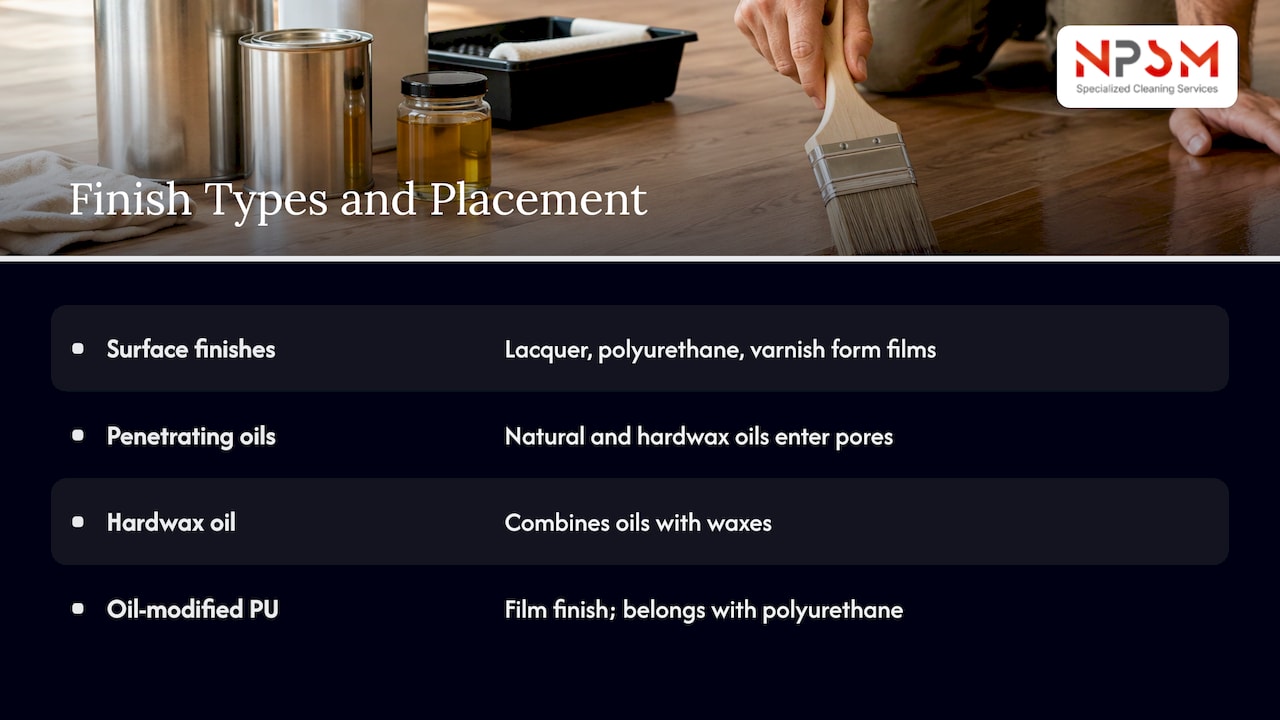
Oil-modified polyurethane. This is a polyurethane with an oil base. It is a film finish, so for decision-making purposes treat it as part of the lacquer and polyurethane family, not the oil family.
So when people ask whether hardwax oil is better than polyurethane, the honest answer is that they are built for different priorities. One favors natural feel and easy repair, the other favors a tough, even surface.
Oil vs lacquer at a glance
| Factor | Oil / hardwax oil | Lacquer / polyurethane |
|---|---|---|
| How it works | Penetrates the wood | Forms a film on the surface |
| Look and feel | Natural, close to bare wood, usually matte or low sheen | Uniform; matte, satin or gloss |
| Water and stain protection | Good with hardwax oil, depends on product and upkeep | Generally high while the film is intact |
| Scratch and wear resistance | Moderate; wear shows gradually | Generally higher in heavy traffic |
| Spot repair | Easy; treat only the damaged area | Harder; the repair area tends to stay visible |
| Re-treatment | More frequent, but quick | Less frequent, but heavier work when it comes |
| Best for | Bedrooms, living areas, boutique and premium interiors | Kitchens, corridors, offices, hotels, retail |
Treat the table as a starting point. Product quality, the number of coats, the wood species and the quality of the sanding beneath all change the real result.
Appearance: natural depth or a uniform finish
Oil brings out the grain. Because the finish sits in the wood rather than on it, the floor looks and feels like timber, with a soft, natural matte quality. Over the years, an oiled floor develops character: you may see lighter and darker areas where the surface has seen more or less wear, and that patina is part of the appeal for many owners of luxury villas and penthouses.
Lacquer gives a consistent look from the first day to the last day of its life. If you want a floor that looks the same in the entrance hall and the dining room, and that stays that way, lacquer is the more predictable option. It is also the finish that gives you the most choice of sheen, from ultra-matt to high gloss.
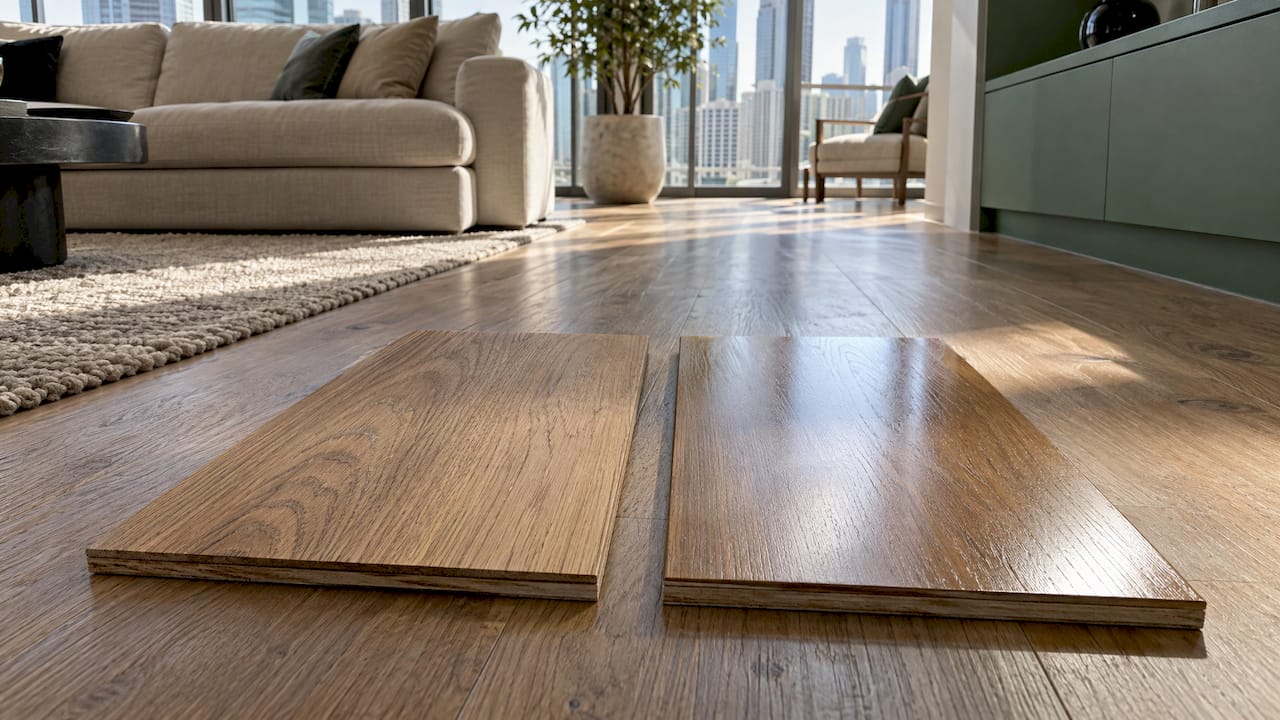
Sheen deserves its own decision. Gloss reflects the most light and shows every micro-scratch, dust line and footprint. Matte reflects the least, so small scratches and normal wear are far less noticeable. In a home with children, pets or frequent guests, a matte or satin finish is usually the practical pick, whether oiled or lacquered. Dubai’s strong daylight through large glass facades makes this even more relevant: low-angle sun on a glossy floor reveals every flaw.
Durability: how each finish handles real life
A film finish does its best work where the floor takes a beating. The coating is a physical barrier against water, spills and abrasion, which is why lacquer and polyurethane are the standard choice for corridors, offices, restaurants and retail floors. Catalyzed (two-component) lacquers sit at the tougher end of that range.
Oil protects differently. It strengthens and seals the wood from within, but the surface layer is thinner, so abrasion and spills are handled less forgivingly. Hardwax oil closes much of the gap compared with older traditional oils, but in the busiest zones it will still need attention sooner than a good lacquer.
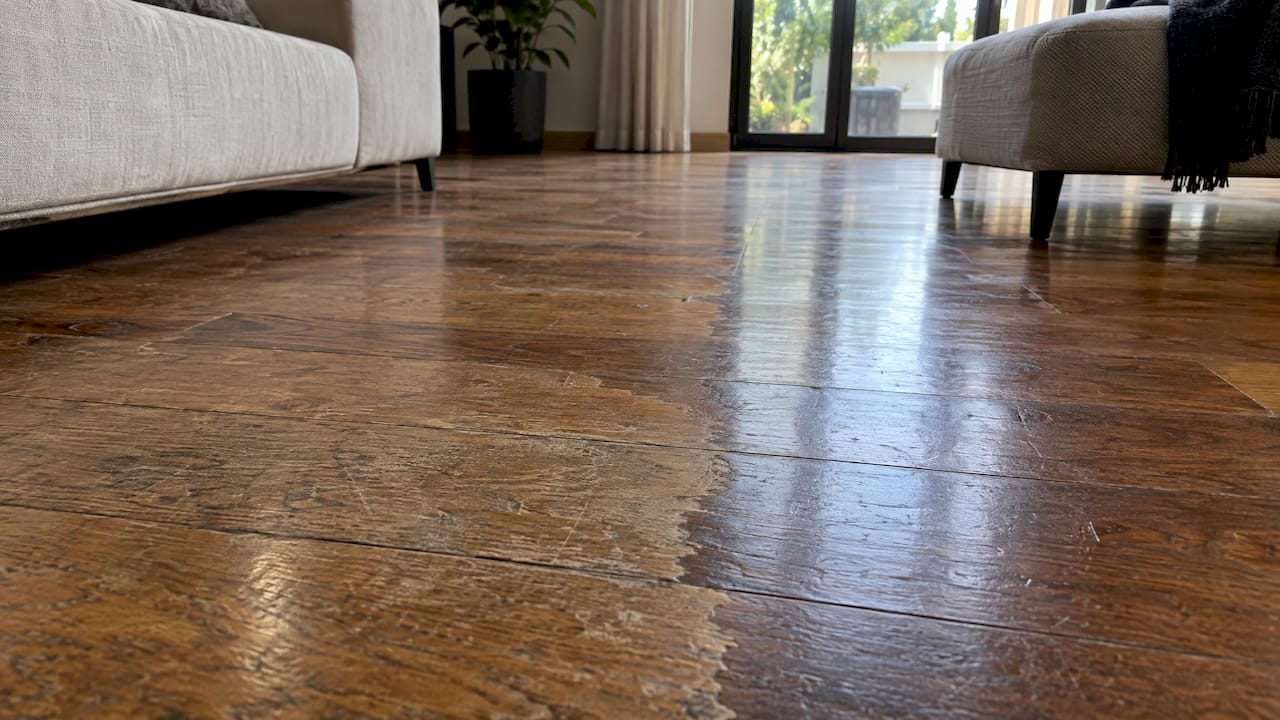
There is one more difference that owners often miss: how wear shows. A lacquer that is worn through in a high-traffic path leaves a visible line where the film ends and bare wood begins. Oil wears more evenly, so the floor simply looks a little drier and flatter until it is refreshed.
Activity floors are a special case. Lacquer offers consistent slip resistance and is the usual choice for sports and activity surfaces, while oiled floors are more suited to residential, public and general commercial settings. If you are refinishing a gym, dance studio or hotel function hall, lacquer is the sensible direction.
Maintenance and repair: where the two finishes differ most
Daily care is the same for both. Sweep or vacuum with a soft brush head, wipe spills straight away with a dry or slightly damp cloth, and avoid wet mops and steam mops, which can damage the finish and the wood over time. Our guide to wooden floor maintenance tips for Dubai homes covers the routine in more detail.
The difference appears when something goes wrong or time passes:
- Oiled floors can be spot-treated. A scratch, a dull path in front of the sofa or a ring from a glass can be cleaned, lightly abraded and re-oiled locally, and it blends in. Overall, oiled floors need re-treatment more often than lacquered ones, but each treatment is quick and straightforward.
- Lacquered floors last longer between treatments, but a localized repair is harder because the patch stays visible against the surrounding film. Deep damage often means sanding a full room or run of rooms back and recoating the entire area.
That trade-off should be the center of your decision. If you value being able to fix a mark next week without a major job, oil serves you well. If you want to forget about the floor for years, lacquer is the better partner. In both cases, if scratches are mainly in the finish layer rather than the wood, a professional can often lightly abrade and recoat instead of replacing the floor. Our article on fixing scratched wood floors without replacement explains what is realistic.
Choosing a finish in Dubai’s conditions
Dubai is hard on wood in specific ways. Floors live in air-conditioned interiors with big temperature and humidity differences between inside and outside, sunlight through large glazing, and sometimes humid periods near the coast. Wood moves with moisture, so stable indoor humidity and moisture protection under and around the floor matter for solid timber, especially solid oak parquet. Whatever the finish, a stable indoor climate protects it.
A few practical points follow from that:
- Sun exposure. Floors near floor-to-ceiling glass see the most light. A finish will not stop timber from slowly changing tone in strong sun, so rugs and window treatments help, and oiled floors are easier to refresh evenly afterward.
- Engineered vs solid wood. Engineered boards have a thinner top layer of real wood, so the number of times they can be sanded is limited. That makes a long-lasting finish and careful maintenance more valuable. See engineered vs solid wood floors and our notes on polishing engineered wood floors.
- Cleaning habits. Many households use cleaning staff and standard mops. A lacquered floor tolerates the occasional slightly-too-wet cloth better than an oiled one does, though neither should be soaked.
- Ventilation during application. Lacquers are solvent-based or high in volatile compounds and highly flammable while applied. In an occupied villa or a hotel, this affects how the work is scheduled and ventilated, which is one more reason to leave application to professionals.
If you are still choosing the timber itself, our overview of the best wood flooring types for Dubai homes and investments is a good companion read.
Which finish for which property
Villas and luxury homes. Living rooms, master bedrooms and formal areas often suit oil or hardwax oil for its natural look and repairability. Kitchens, entrance halls and family rooms with heavy traffic lean toward lacquer or polyurethane. Mixed approaches are common: one house, two finishes, chosen per zone, as long as the sheen and tone are matched sensibly.
Apartments and penthouses. Lower footfall and a premium look make oil attractive, particularly for owner-occupiers who want to keep the floor looking natural. For apartments you rent or hold as an investment, a durable lacquer reduces the number of interventions between tenancies. See our note on refinishing before listing a property.
Holiday homes. Turnover is high and cleaning is rushed, so a hard-wearing film finish in satin or matte is usually the lower-risk choice.
Hotels, offices and retail. Continuous traffic, rolling luggage, chair castors and strict cleaning schedules favor lacquer or polyurethane. Planning refinishing in off-peak windows, area by area, keeps the property operating.
Property and facility managers. Think in lifecycle terms: how often can you close an area, how much does a visible patch repair matter and who does the daily cleaning. A clear specification of finish type and sheen per area makes later maintenance consistent.
Our perspective
In our work on Dubai wood floors, the most expensive mistake is not choosing oil over lacquer or the other way round. It is choosing a finish without looking at how the room is actually used.
We start from the floor in front of us: the species, whether it is solid or engineered, how much sanding it has left, what finish is on it now, and where the traffic and sunlight fall. Then we match the finish to the way you live or the way your guests and staff move through the space. A penthouse bedroom and a hotel corridor should not get the same answer.
We tailor our wooden floor work to each floor type and property, and we use professional-grade equipment and eco-friendly products. For many owners, the best value is restoring and refinishing what they already have, rather than replacing expensive timber. A well-prepared surface, sanded evenly and finished with care, matters as much as the product on top.
If you cannot decide, ask us to look at the floor. A short assessment usually settles the question faster than any comparison chart.
Qadir
How to tell what finish your floor has now
Before any refinishing, find out what is already there. Oiled timber feels like bare wood and tends to look dry or flat where it has worn. A lacquered floor feels smooth and slightly plastic, and water beads on it. Water that darkens the wood or soaks in suggests an oil or an unsealed surface.
A simple test is to clean a hidden spot, such as inside a closet, and apply a little mineral oil. If it soaks in, the floor likely has a thin wiping finish or oil. If it beads, you probably have a film finish such as varnish or lacquer. Do not use solvent tests without gloves and good ventilation. Because mistakes here can ruin a floor, most owners are better served by having a professional check a test area during a site visit.
This matters because finishes do not always bond to each other. Putting oil over an intact lacquer film will not penetrate, and putting a new film over a waxy or oily surface can peel. Proper preparation, usually sanding back to clean wood, avoids both problems.
Switching from one finish to the other
Going from oil to lacquer, or lacquer to oil, generally means sanding the floor back to clean timber so the new finish can bond or penetrate properly. That removes a thin layer of wood, so it is worth planning around how many sandings an engineered or solid floor has left. Our article on floor refinishing for Dubai luxury interiors explains how wear develops and when refinishing makes sense, and our guide to wood floor protection in Dubai covers what to do between treatments.
If you are only refreshing, a light abrasion and a maintenance coat of the same type often gives a good result without a full sanding.
Get the finish decided and applied properly
We handle wooden floor polishing, restoration, sanding and parquet restoration for villas, apartments, hotels, offices and retail spaces across Dubai. Whether you want to keep an oiled look or move to a harder-wearing film finish, we assess the floor first and recommend what fits the room. Explore our wooden floor polishing services in Dubai or see the full range on our floor polishing and restoration page. Pricing depends on floor type, area and condition, so we quote after assessing the job.
FAQ
Is hardwax oil better than polyurethane?
Neither is better in every case. Hardwax oil gives a natural, low-sheen look and allows spot repairs, while polyurethane forms a tougher surface film that suits heavy traffic and needs less frequent attention. Choose by how the room is used and how much maintenance you accept.
Should I oil my hardwood floors?
Oil is a good choice when you want a natural appearance and the ability to repair marks locally, for example in bedrooms, living rooms and premium residential spaces. You should expect to re-treat it more often than lacquer. It is also suited to many commercial settings, but less so to sports and activity floors.
What is the best finish for wood floors in Dubai?
There is no single best. For high-traffic areas, kitchens, offices and hotels, a lacquer or polyurethane finish in matte or satin is usually the practical option. For lower-traffic living spaces where you want a natural look, hardwax oil works well. Stable indoor humidity helps either finish last.
How do I know if my wood floor is sealed or oiled?
Water beading on the surface and a smooth, film-like feel point to a sealed floor, while a bare-wood feel and water that soaks in point to oil. A hidden-spot test with mineral oil can help: soaking in suggests a thin or oil-type finish, beading suggests a film. A professional can confirm this during a site visit before refinishing.
Can I change from oil to lacquer later?
Yes, but the floor normally needs to be sanded back to clean wood first so the new finish bonds properly. Check how much wear layer your boards have left, especially if they are engineered, before committing to the change.