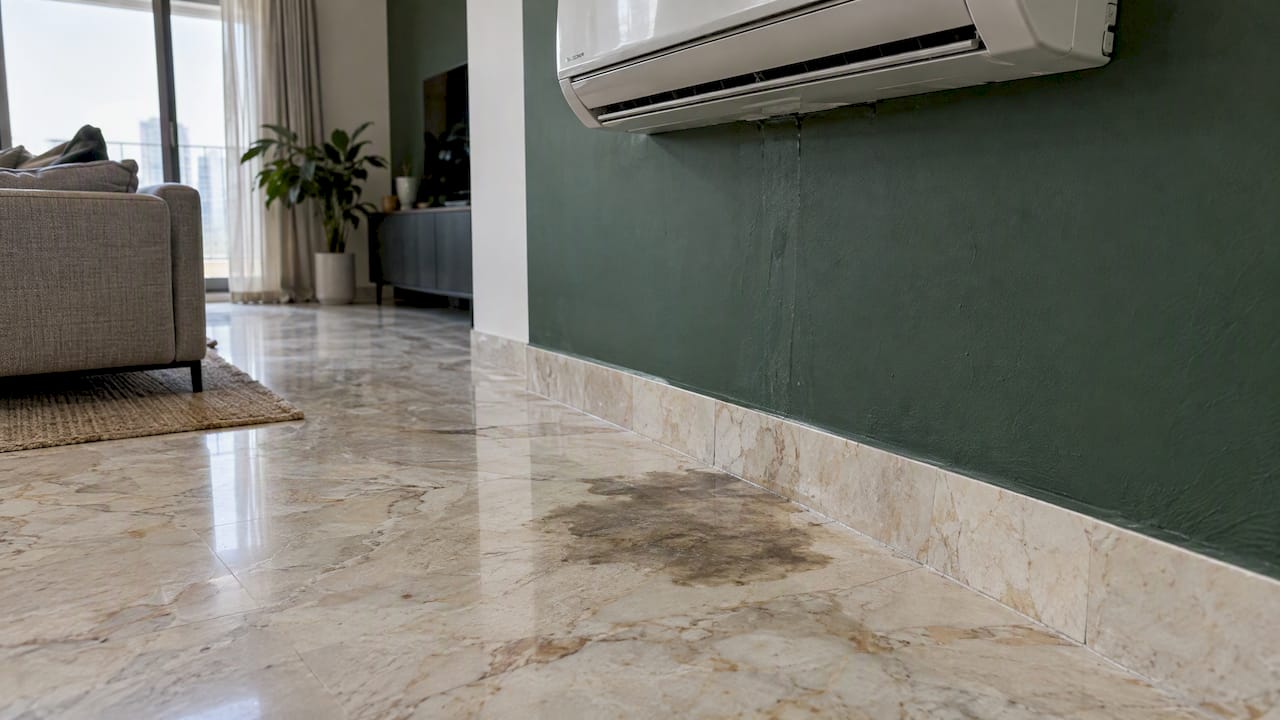

An AC water mark on marble can often be removed, but only if you first work out what kind of mark it is. A dark patch under a split unit is usually a stain that has soaked in, a pale ring is often mineral residue, and a dull, rough spot is an etch, which cleaning cannot lift. In Dubai villas, apartments and offices, all three show up because air conditioners run almost all year and condensate has to go somewhere. This guide shows how to identify the mark, what is safe to try yourself, when polishing and restoration is the only real fix, and how to stop the water coming back.
TL;DR
- Dark and smooth means the water has soaked in (a stain). Pale, rough and dull means the surface has been etched. A white crust or ring is usually mineral residue that sits on top.
- Start with the gentlest method: warm water, a pH-neutral stone cleaner, a soft cloth, then dry the area fully. Never reach for vinegar, lemon, bleach or bathroom sprays.
- Etching cannot be cleaned away. It needs honing and polishing by a stone specialist.
- Fix the source first. A blocked AC drain line or a leaking joint will simply re-mark the floor.
- Photograph the mark, note how long it has been there, and call a restoration team before you try a third or fourth home remedy.
Table of Contents
- Why AC water marks marble so easily in Dubai
- Stain, residue or etch: tell them apart in a minute
- What you can safely try yourself
- What not to use on marble
- When AC water damage needs professional restoration
- Our perspective: fix the water first, then the marble
- Stop AC water marks coming back
- Marble restoration across Dubai, one call away
- FAQ
Why AC water marks marble so easily in Dubai
Marble is a calcium-based stone. It is porous, it reacts to acids, and it reacts to minerals left behind when water evaporates. Dubai gives it three problems at once.
Condensation is constant. A split unit or fan coil pulls moisture out of humid air and sends it to a drain. When the drain line blocks, the tray overflows, or a pipe joint weeps, the water runs down a wall or drips from a ceiling cassette onto the floor. Because the AC runs for most of the year here, a slow leak can go unnoticed for weeks.
The water carries minerals. Condensate itself is fairly clean, but it often picks up dust, algae film and residue from the tray and pipework on its way out. Add tap or desalinated water used for mopping, and each evaporation cycle leaves a thin film behind.
Humidity slows drying. In coastal communities such as Dubai Marina, JBR, Palm Jumeirah and Downtown, indoor air is damp for long stretches. Water that would vanish in an hour sits in the stone, darkens it, and gives any dissolved material time to settle in. Our page on how Dubai’s humidity damages marble floors explains the wider pattern behind dull, patchy floors.
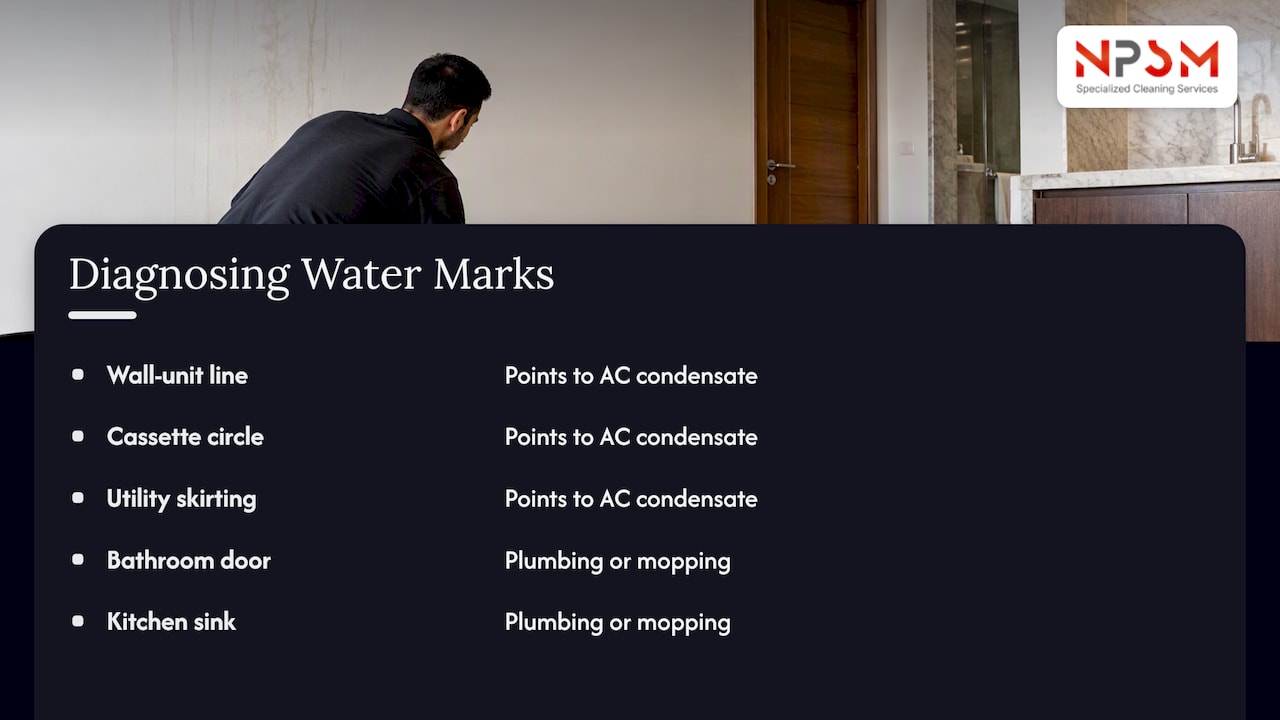
Where you see the mark helps with diagnosis. Marks in a line beneath a wall unit, in a circle under a ceiling cassette, or along a skirting board near a utility room point to AC condensate. Marks near a bathroom door or kitchen sink point to plumbing or mopping.
Stain, residue or etch: tell them apart in a minute
This is the step most owners skip, and it decides everything. A poultice that draws out a stain does nothing for an etch, and polishing powder rubbed on a stain just spreads it. Use the table below, then confirm with the simple touch and light test after it.
| What you see and feel | What it probably is | What fixes it |
|---|---|---|
| White or grey ring or crust, slightly raised, wipes with a damp cloth | Mineral residue sitting on the surface | Gentle cleaning, then buffing |
| Darker patch, smooth to the fingertip, edges soft | Stain: water or dirt absorbed into the stone | Drying out, then a poultice if it persists |
| Pale, dull patch, slightly rough, lighter than the surrounding stone | Etch: the polished surface has been physically altered | Honing and re-polishing by a specialist |
| Yellow or brown halo or streak | Rust or organic stain, often from metal fixings or trapped moisture | Specialist stain treatment |
| Black or green spots at edges or grout lines | Mold or algae from lasting damp | Fix the moisture, then professional cleaning |
The touch and light test
Run a fingertip across the mark. A stain is usually smooth: the surface is intact, just colored. An etch often feels slightly rough or looks like the shine has been wiped off in that spot. Then crouch and look along the floor toward a window. A stain still reflects light normally but looks darker. An etch breaks the reflection into a matte patch.
Now dry the area with a soft cloth and wait an hour. A mark that fades as the stone dries was moisture darkening and may disappear by itself once the source is fixed. A mark that stays is either a true stain or an etch.
If you are still unsure, our guides on telling etching from staining and the seven most common marble floor stains in the UAE have photos and cues worth comparing against your floor.
What you can safely try yourself
If the mark looks like residue or a light, recent stain, these steps are low risk. Do them in order and stop as soon as the mark clears.
- Stop the water. Check the AC drain, tray and joints. Mop up standing water with a dry towel, not a wet mop.
- Dry the stone. Open windows briefly if the air is dry enough, or run a fan across the area. Give it a few hours. Some dark patches fade without any treatment.
- Clean gently. Use warm water with a pH-neutral, stone-specific cleaner, or a few drops of mild liquid dish soap. Apply with a soft cloth in small circles.
- Rinse and dry. Wipe with clean water, then dry immediately with a soft cloth. Leaving soapy water to evaporate creates a new film.
- Buff residue rings. For stubborn mineral rings on polished marble, the Natural Stone Institute suggests buffing with dry 0000 steel wool. Test a hidden corner first and use very light pressure, as this can dull a finish if you press hard.
- Try a poultice for a stain that has soaked in. A stone poultice is an absorbent powder mixed with a suitable cleaning liquid into a paste, spread about a quarter to half an inch thick, covered with plastic, and left for roughly one to two days until it dries. It draws the stain out as it dries. Stubborn stains can need several rounds. A poultice works on stains only, never on etching.
Our own step-by-step page, safe DIY steps for removing marble water stains in Dubai, walks through the cleaning sequence in more detail.
A note on honed and matte marble
Polished marble sometimes tolerates home repair on very light marks. Honed or matte marble is harder to treat, because any rubbing changes how light sits on the surface and you can end up with a visible patch. If your floor is honed, be more cautious and call earlier.
What not to use on marble
Most damage we see after a failed DIY attempt comes from the cleaner, not the original stain. Avoid these:
- Vinegar, lemon juice and other acids. Marble reacts with acid on contact. Vinegar is the most common home remedy for hard water marks on glass and tiles, and it is exactly what etches marble. A stain you could have lifted becomes a permanent dull patch.
- Bathroom and kitchen sprays, limescale removers and rust removers. Many are acidic. Some toilet and rust products can contain hydrofluoric acid, which is dangerous to you as well as to the stone.
- Abrasive powders and scouring creams. They scratch the polish and leave a cloudy area bigger than the original mark.
- Bleach mixed with ammonia. Never combine them. The mixture releases toxic gas.
- Steam and very hot water. Heat opens the pores and pushes moisture and dissolved minerals deeper.
- Generic multi-surface sprays. They are not made for calcium-based stone and often leave streaks or slowly dull the finish.
Use only products labeled for marble or natural stone, and test them in an inconspicuous spot.
When AC water damage needs professional restoration
Home care has limits. Call a stone restoration team when:
- The mark is an etch. Cleaning removes dirt from the surface, but it cannot restore a finish that has been physically altered. The Natural Stone Institute advises contacting a stone dealer or professional restorer to refinish or repolish etched areas you cannot fix with polishing powder.
- The stain has survived several poultice applications.
- The dullness is widespread, or the floor looks patchy because of earlier wrong cleaning.
- The marble is honed or matte, where spot repair rarely blends in.
- There are signs of lasting moisture: a musty smell, peeling paint, black spots at the edges, or marks that keep returning.
- The floor is in a handover, rental turnover, or hotel or office setting where an even finish matters more than a quick patch.
What restoration involves
A specialist first assesses the stone: type, finish, how deep the marks go, and whether moisture is still present. For localized etching, the team hones the affected area and re-polishes it so it matches the surrounding shine. For widespread damage or patchy floors, the whole surface is ground and honed with diamond abrasives in progressively finer grits, then polished and often sealed. Stain removal is treated as its own step before polishing, because polishing over a stain can trap it.
The benefit is that you keep the original stone. Replacing marble in a Dubai villa means new material, demolition, dust and weeks of disruption. Restoration usually takes days, not weeks, and most work is done on site.
What it costs
Our marble polishing and restoration service starts from AED 30 per sqm. The final figure depends on the condition of the floor, the amount of grinding needed, stain treatment, sealing, stairs or other detailed areas, and access. That is why we inspect before we quote. Spot repairs, full-floor restoration, staircases and countertops are priced differently, and a photo of your floor with the location of the marks is the fastest way to a realistic estimate.
Our perspective: fix the water first, then the marble
We restore marble across Dubai homes, hotels and offices, and AC-related marks are among the most frustrating jobs because they are so often repeat visits. The pattern is familiar. An owner spots a mark, tries vinegar or a bathroom spray because it worked on a shower screen, and turns a removable stain into an etch. Months later, the same spot is back because the drain line was never cleared.
Our approach follows three rules. First, diagnose before touching anything: stain, residue and etch need different treatments. Second, use the least aggressive method that works, with neutral cleaners and honing only where the surface has truly changed. Third, never polish a floor until the moisture source is fixed, because fresh polish over a leaking joint just gives you a new mark in a new place.
We also tell clients when a floor does not need us. If a dark patch fades as the stone dries and the cause is gone, the best advice is to leave it alone and keep it dry. Restoration is for damage that cleaning cannot reverse, and we would rather explain that clearly than sell an unnecessary polish.
— Qadir
Stop AC water marks coming back
A restored floor is only as safe as the AC above it. These habits cost little and prevent most repeat damage.

Service the AC before summer. Have the drain lines cleared and the trays and joints inspected before the hottest months, when units run hardest. Blocked condensate drains are the most common cause of overflow. Keep filters clean too, since dirty filters restrict airflow and make systems work harder.
Watch for early signs. A musty smell, bubbling paint, a damp patch on a wall or ceiling, or a dark mark that returns in the same place all point to a hidden moisture source. Check those areas before the floor shows damage.
Monitor humidity. An inexpensive hygrometer tells you if indoor humidity stays high. Consistently reading above about 60 percent is a cue to look for the cause, whether that is a leak, poor ventilation or an AC set too high for the room.
Dry spills immediately. Wipe any water off marble with a soft cloth straight away, including mop water. Water in the UAE can leave a mineral film as it evaporates, so do not let it air dry on polished stone.
Clean on a routine. Dust-mop traffic lanes daily, and damp-mop weekly with a pH-neutral stone cleaner, drying as you go. Dust and grit act like sandpaper and wear down the polish that protects the stone.
Seal the stone. A penetrating sealer slows liquid absorption and gives you more time to wipe up a spill. It does not stop etching, so it never replaces fixing the leak.
Put a mat or tray under vulnerable spots. Under portable units, plant pots near vents, and beside utility closets, a simple waterproof tray catches the slow drips that do the most damage.
For property managers and facility teams, add AC drain checks to your planned maintenance schedule and ask tenants to report drips as soon as they see them. A five-minute check costs far less than a floor-wide restoration after a unit leaks unnoticed over a long weekend.
Marble restoration across Dubai, one call away
If your marble shows a mark that cleaning has not shifted, we inspect it, explain whether it is a stain, residue or etch, and give you a clear scope before any work starts. Our marble polishing and restoration services in Dubai cover stain removal, floor polishing and buffing, full restoration and repair, staircases, and countertops and tables, for villas, apartments, hotels and commercial properties. If you are ready to book or want a quote, start from our Floor Polishing & Restoration services page or send photos through the contact details on floorpolishing.ae.
If the damaged surface is a table or countertop rather than a floor, our guide on fixing a marble table is a good next read. For luxury homes on Palm Jumeirah, see our marble polishing service there.
FAQ
Can AC water stains be removed from marble?
Often yes, if the mark is a surface residue or a stain that has not soaked deeply. Dry the area, clean with a pH-neutral stone cleaner, and try a poultice for deeper stains. If the surface is etched, cleaning cannot fix it and the stone needs honing and polishing by a specialist.
Can marble be permanently stained?
Some marks can become effectively permanent if they are left for a long time or treated with the wrong product. Etching is a physical change to the finish, so it stays until the surface is re-polished. Deep stains from rust or oil can also resist home treatment, but a restoration team can usually remove or greatly reduce them.
What can I use to remove hard water or AC water marks from marble?
Use warm water with a pH-neutral stone cleaner or a few drops of mild dish soap, rinse, and dry with a soft cloth. Do not use vinegar, lemon, limescale removers or bathroom sprays, because acid etches marble on contact. For a stain that has soaked in, use a stone-safe poultice rather than stronger chemicals.
How do I know if I should call a professional?
Call when the mark feels rough or looks pale and dull, when it has survived a few gentle attempts, or when the floor looks patchy or widely dull. Also call if the stone is honed, or if a damp smell or peeling paint suggests a lasting moisture problem. A short inspection will confirm what you are dealing with before you spend anything on repairs.
How do I stop AC water stains returning on my marble floor?
Fix the source first: have the AC drain lines cleared, trays and joints checked, and filters cleaned before summer. Wipe up any water straight away, keep humidity under control, and consider sealing the stone. Polish only after the leak is resolved, or the mark will reappear.