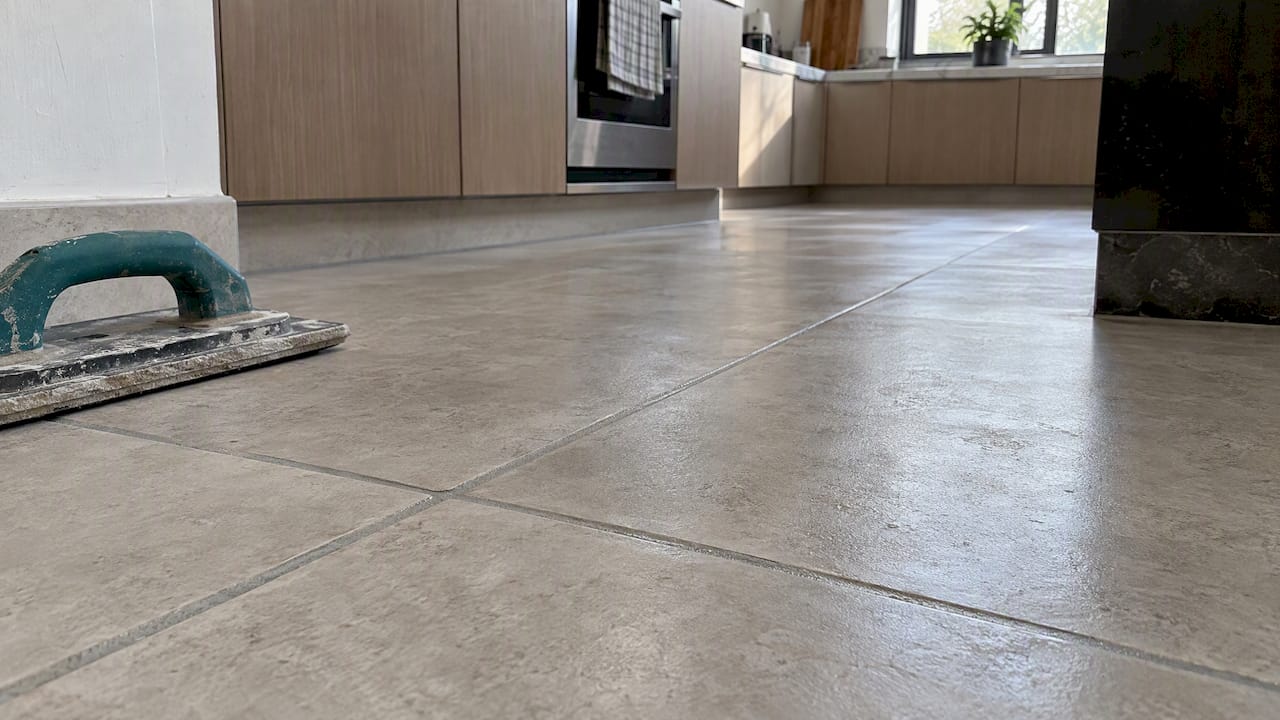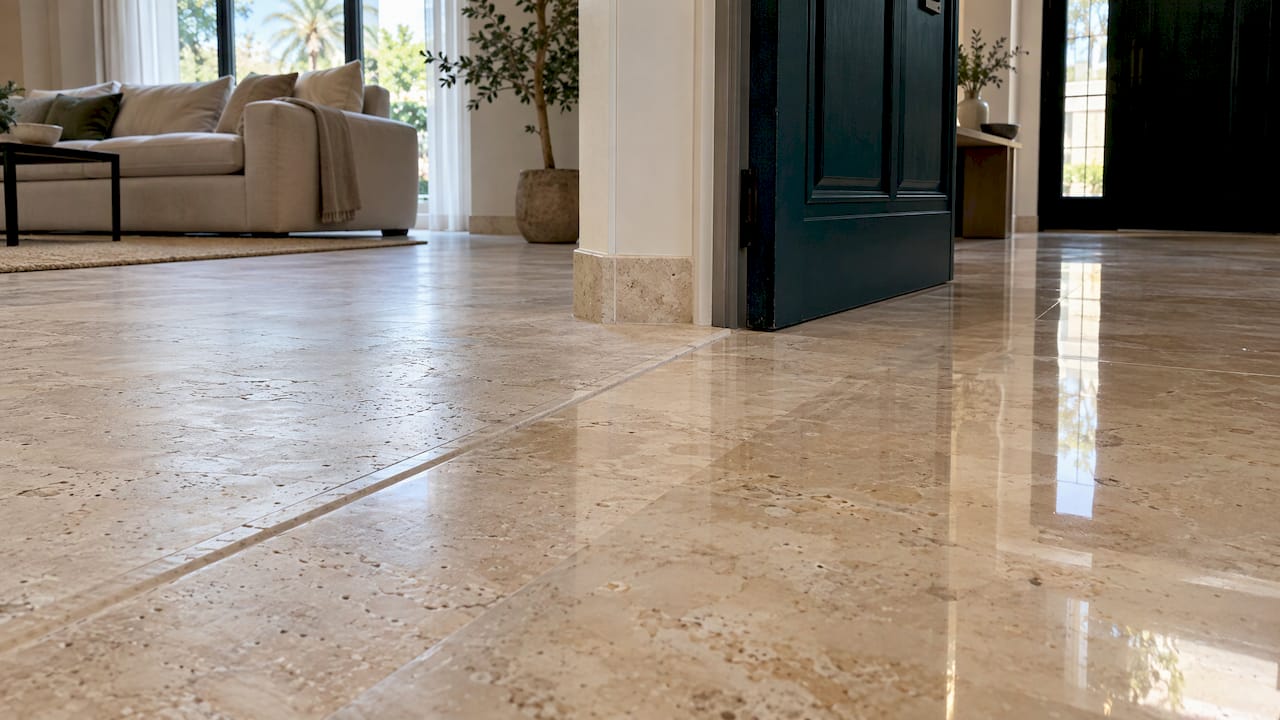

Honed travertine has a smooth, soft matte surface with more grip underfoot. Polished travertine has a reflective, glossy surface that looks more formal but is slicker when wet and shows wear sooner. For most Dubai floors that see foot traffic, sand, humidity or water, honed is the safer everyday choice. Polished suits dry, controlled, low-traffic interiors where the gloss is the point.
The two finishes come from the same stone. The difference is how far the surface is ground and refined. That one decision changes how the floor looks in daylight, how it behaves when wet, how it ages and how you maintain it.
TL;DR
- Honed travertine is matte and satin-soft, offers better grip and hides everyday wear. It suits entrances, kitchens, bathrooms, terraces and busy commercial areas.
- Polished travertine is glossy and mirror-like, and it brings out the color and veining of the stone. It suits dry, low-traffic areas such as a formal lounge or a feature wall.
- Both finishes are calcium carbonate stone, so acids etch them. Sealing and pH-neutral cleaners matter whichever finish you pick.
- Filled travertine is easier to keep clean than unfilled. The filling and the finish are two separate choices.
- A worn or tired travertine floor can usually be re-honed or re-polished in place, so the finish is not locked in for life.
Table of Contents
- What actually separates honed from polished travertine
- Honed vs polished travertine at a glance
- Slip resistance: the biggest practical difference
- Staining and etching: both finishes are vulnerable
- Scratches, sand and wear in a Dubai setting
- Filled or unfilled: a separate choice from the finish
- Which finish for which area of your property
- Maintenance: what each finish asks of you
- Can you change the finish later?
- Cost and value: what to weigh
- A quick decision guide
- Our perspective
- Get your travertine floor assessed
- FAQ
What actually separates honed from polished travertine
Travertine is a natural limestone formed in mineral springs. It has the characteristic holes and channels that give it a warm, earthy look. After the slabs are cut, the surface is ground with abrasives, and the finish depends on how far that grinding goes.
Honed means the surface is ground flat and smooth with progressively finer abrasives, then stopped before it becomes reflective. The result is a matte or satin look. Light scatters across the surface instead of bouncing off it, so the stone looks calm and natural.
Polished means the process continues through much finer abrasives until the surface reflects light. The stone looks deeper in color, the pattern is sharper and the floor can mirror a chandelier. On limestone-type stone like travertine, polished finishes are generally harder to hold than on dense stones such as granite, because travertine is softer and more porous.
A point that often gets missed: the quality of the finish matters as much as its name. A honed floor that was not ground flat will wear unevenly, and traffic patterns appear where the surface was not fully honed. A polished floor with an uneven base will show waves in reflected light. Whoever does the work, whether at installation or restoration, should be judged on flatness first.
Honed vs polished travertine at a glance
| Factor | Honed | Polished |
|---|---|---|
| Look | Matte to satin, soft and natural | Glossy, reflective, formal |
| Slip resistance when wet | Better grip | Noticeably slicker |
| Showing scratches | Hides light scratches well | Shows scratches and dull traffic lanes |
| Showing water marks and etching | Less obvious, though still possible | Very visible as dull patches |
| Staining | Fairly porous, needs sealing | Also needs sealing, marks stand out more |
| Everyday cleaning | Easy with the right products | Easy, but needs more care to keep the shine |
| Best for | Entrances, bathrooms, kitchens, terraces, commercial traffic | Dry, low-traffic lounges, feature areas |
| Restoration | Re-honing in place | Re-honing, then re-polishing in stages |
Slip resistance: the biggest practical difference
This is the question most people ask first, and the answer is straightforward. A glossy, smooth surface gives less friction than a matte one, and water makes that gap bigger. Polished travertine is the slicker of the two when wet, and most suppliers advise against it for showers, around bathtubs, pool surrounds and outdoor areas. Honed travertine is the usual recommendation for those spots.
Two cautions keep this honest:
- Honed does not mean non-slip. Soap film, pool chemicals, cleaning products that leave residue and standing water can make any smooth stone slippery. The finish helps, but it does not replace a slip-resistance rating for the location.
- For hotels, resorts, pool decks, commercial kitchens and public areas, ask for a documented slip-resistance classification suited to the use of the space, rather than relying on the word “honed”.
In a Dubai villa, this matters in several places at once: the entrance hall where people walk in with damp feet from the car park or garden, the master bathroom, the kitchen, the covered terrace, and the pool deck. In all of these, honed is the sensible default. If you love the shine and want it in a dry formal reception room, polished can work there as long as people know it is not forgiving when wet.
Staining and etching: both finishes are vulnerable
Travertine is calcium carbonate. That has two consequences that apply to both finishes.
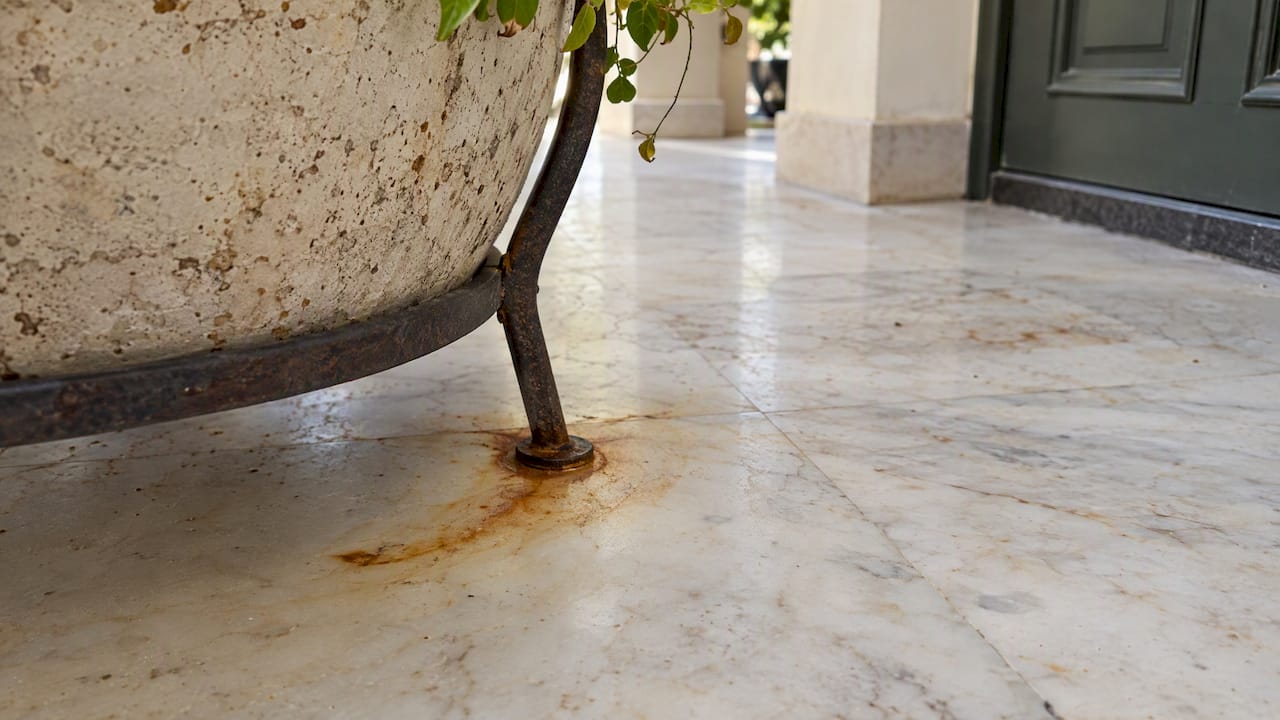
It absorbs liquids. Honed travertine stays fairly porous, so oil, coffee, juice and cosmetics can leave marks, and a penetrating sealer is the standard defense. Polished travertine is somewhat denser at the surface, but it is still a porous natural stone, and once a stain gets in, it is more visible against the gloss.
It reacts to acids. Lemon juice, vinegar, soft drinks, limescale removers and many bathroom sprays dissolve a little of the surface. This leaves an etch mark, a dull patch that is not a stain and cannot be wiped away. On a honed floor, an etch mark blends in more easily. On a polished floor, it stands out as a dull spot in the shine, often within minutes of the spill.
This is one of the main reasons polished travertine demands more discipline. If the floor is in a family kitchen or a hotel breakfast area, etching will happen sooner or later. A honed finish is far more forgiving of that reality.
If you are dealing with marks on a stone floor right now, our guide to removing marble water stains in Dubai explains safe steps that also apply to similar calcium-based stone.
Scratches, sand and wear in a Dubai setting
Dubai adds a particular enemy: fine desert sand carried indoors on shoes. Sand is harder than travertine, so it acts like sandpaper on the floor each time someone walks across it.
On a polished floor, that abrasion shows up as a dull haze along the main walking routes: the entrance, the path to the kitchen, the hotel lobby between the door and the reception desk. The contrast between the shiny corners and the dull lane makes the damage look worse than it is.
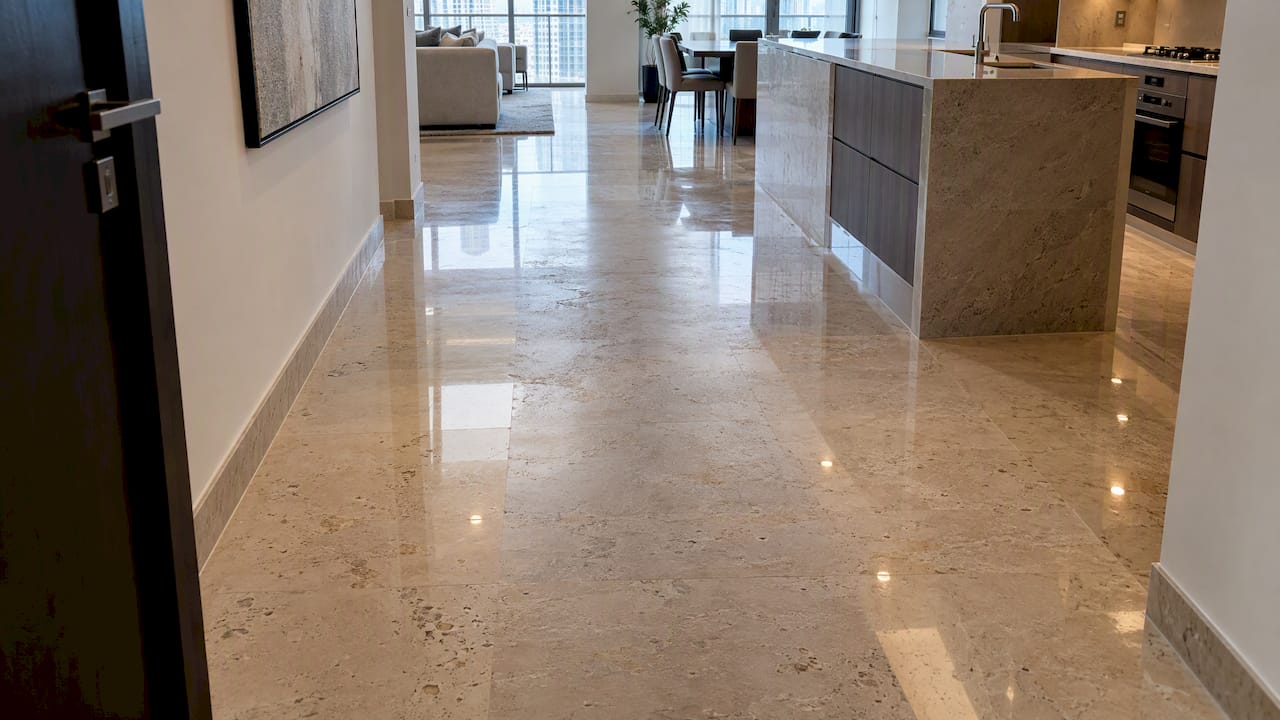
On a honed floor, the same abrasion happens, but because the surface was never mirror-like, the change is far less visible. The floor ages evenly.
Practical steps that work for either finish:
- Put good mats inside and outside every external door, and clean them often.
- Dry-mop or vacuum with a soft head before any wet cleaning, so grit is not dragged across the stone.
- Use felt pads under furniture and avoid dragging chairs.
- Clean with a pH-neutral stone cleaner, not general-purpose or acidic products.
- Reseal on a schedule suited to the traffic. High-traffic commercial floors need attention more often than a guest-bedroom floor.
For property managers, the lesson is to match the finish to the traffic pattern. A polished lobby with no entrance matting will need re-polishing far sooner than a honed one.
Filled or unfilled: a separate choice from the finish
Travertine’s natural holes can be left open (unfilled) or packed with grout, cement-based filler or resin (filled). Both finishes can come either way, and this choice affects cleaning more than the finish itself.
- Filled and honed is the most common indoor floor choice. The surface is flat and smooth, dirt has fewer places to hide and mopping is easy.
- Unfilled gives the rustic, textured look, but the cavities collect dirt, and liquids find an easy way in. It needs more diligent cleaning and sealing.
- Filled and polished gives the most formal result, but the filler can wear or discolor differently from the stone around it, so older floors sometimes need refilling during restoration.
When a travertine floor looks pitted, dark in the holes or uneven, the cause is often worn or missing filler, not the finish. That is something a restoration specialist can address by cleaning out the cavities, refilling and re-honing the surface. Our page on travertine floor restoration in Dubai walks through the fill, hone and polish sequence.
Which finish for which area of your property
Here is how we would normally match finishes to spaces in Dubai properties.
| Area | Recommended finish | Why |
|---|---|---|
| Villa entrance and corridors | Honed, filled | Sand, shoe traffic, damp feet |
| Kitchen | Honed, filled | Spills, oil, acids, grip |
| Bathrooms and wet rooms | Honed, filled | Water and soap make polished stone slick |
| Formal living or majlis | Honed or polished | Polished works if traffic is light and mats are used |
| Covered terrace, pool surround | Honed or brushed/tumbled | Wet and exposed; avoid polished |
| Hotel lobby and reception | Honed for the traffic lanes, polished only with strict upkeep | High traffic, luggage wheels, sand |
| Hotel bathrooms | Honed | Wet-area safety and guest comfort |
| Office reception | Polished or honed | Polished for image, honed for lower maintenance |
| Staircases | Honed | Grip matters most on steps |
For hotels and managed buildings, bathrooms deserve special attention. Our hotel bathroom tile restoration guide covers how to keep wet-area stone looking luxurious without compromising safety.
Maintenance: what each finish asks of you
The daily routine is nearly the same: dry sweep or vacuum, damp mop with a pH-neutral stone cleaner, wipe spills quickly. Avoid vinegar, lemon-based products, limescale removers and bleach sprays, which are common in home cleaning cupboards and harmful to travertine.
Where the finishes diverge:
- Honed needs sealing to resist stains, and it benefits from an oil-repellent sealer in kitchens. Its main long-term issue is a slight darkening and a loss of the soft, even look if it is allowed to get dirty. Regular cleaning and resealing keep it consistent.
- Polished needs everything honed needs, plus protection of the gloss. Once etching and traffic haze appear, wiping does not fix them. The shine has to be rebuilt by machine, typically by honing out the damage and polishing again.
Always test any new cleaner or sealer in a hidden spot first and follow the product label. Manufacturers’ instructions differ, and what works for one sealer can ruin another.
If your floor is dull but you are not sure why, read our guide on dull floor tiles in Dubai to work out whether the problem is surface wear, a failed coating or something deeper.
Can you change the finish later?
Yes, in most cases. This is one of the best arguments for not agonizing over the decision.
Polished to honed. A polished floor that has become dull, scratched or slippery can be re-honed to a uniform matte. This is often done on floors where owners realize the gloss is a problem in a wet or busy area.
Honed to polished. A honed floor can be taken through finer diamond stages to a polish. This works best when the stone is in good condition and the filler is sound. It will change the maintenance routine, so make sure the area suits a glossy surface.
Worn honed floor to fresh honed floor. Uneven wear, etch marks and stains can be ground out and the surface re-honed to a consistent finish, then sealed.
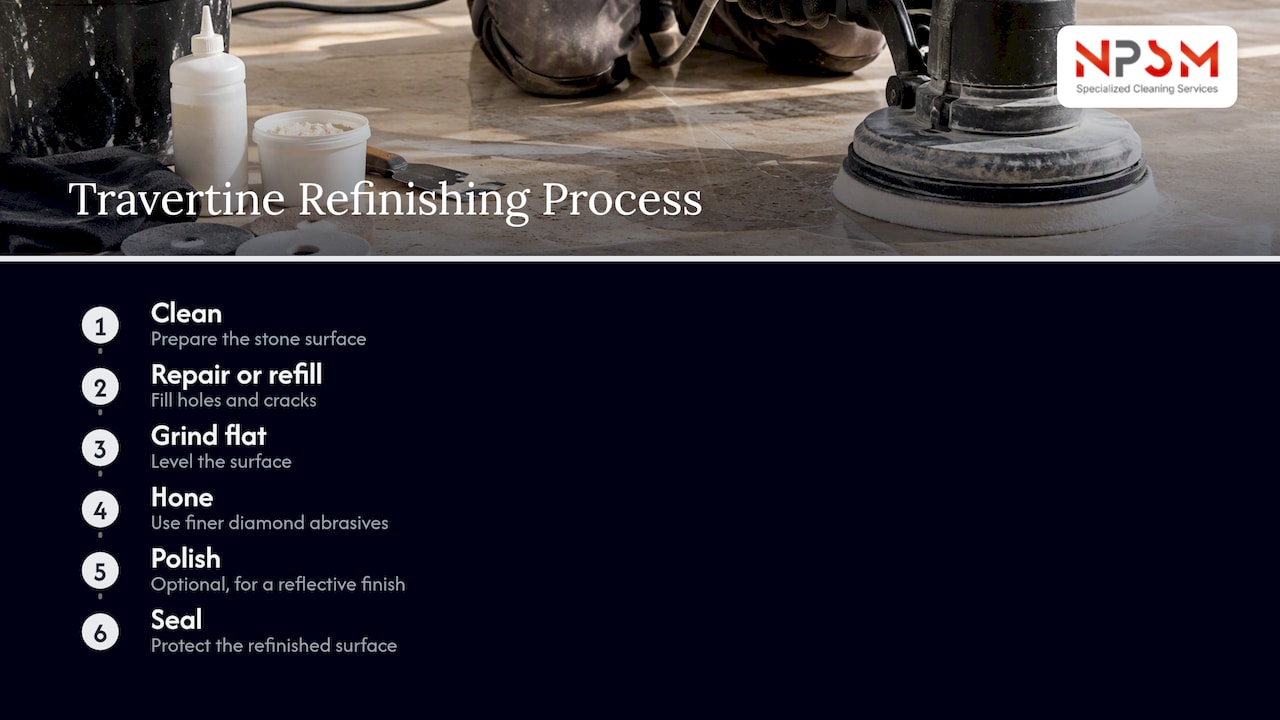
The process generally involves cleaning, repairing or refilling holes and cracks, grinding flat, honing through a sequence of finer diamond abrasives, optional polishing, and sealing. Skipping steps leaves visible scratch marks or an uneven sheen, which is why the grit sequence matters. Our comparison of marble polishing, grinding and crystallization explains how these methods differ, and much of it applies to travertine too. If you are weighing the same choice on marble, see polished vs honed marble.
Cost and value: what to weigh
There is no universal price for the finish itself. What you pay depends on floor area, the condition of the stone, how much filling or repair is needed and how many stages the work involves. For reference, our marble polishing and restoration service starts from 30 AED per sqm, and travertine pricing is quoted after we inspect the floor. The surface condition and the amount of refilling usually move the figure more than the choice between honed and polished.
In terms of value, restoring existing travertine is usually far less disruptive and wasteful than ripping it out. Floors can be refreshed in place, and the result increases the appeal of a villa or apartment ahead of a sale or a rental handover. Choose the finish that you will actually keep looking good, not just the one that looks best on day one.
A quick decision guide
Choose honed if:
- the area gets wet, or people walk in barefoot or in socks;
- you have children, older relatives or guests who need secure footing;
- the space is high-traffic, commercial or exposed to sand;
- you want lower visual maintenance and a natural, relaxed look.
Choose polished if:
- the room is dry, formal and low-traffic;
- you want maximum depth of color and a reflective effect;
- you are prepared for mats, soft cleaning habits and periodic re-polishing;
- the floor is not in a place where a spill of juice or a cleaner is likely.
When in doubt, choose honed. It forgives more, and it can always be polished later if you decide you want the shine.
Our perspective
Most of the travertine floors we are called to restore in Dubai were not ruined by age. They were ruined by a mismatch: a high-gloss finish in a busy hallway, an acidic cleaner used for years, or filler that was never maintained.
Our view is simple. A good honed finish, properly flattened, filled and sealed, is the most practical answer for most villas, apartments and commercial spaces here. It copes with sand, humidity and daily use, and it keeps its character. We still polish travertine when the space and the owner’s habits suit it, and we are clear about the upkeep that comes with it.
What matters most is the work behind the finish: a flat surface, a controlled sequence of diamond stages and a sealer chosen for the stone and the room. That is how we approach every floor, and it is why restoration is usually a better investment than replacement.
Qadir
Get your travertine floor assessed
If your travertine is dull, stained, etched, pitted or simply the wrong finish for how you live, we can inspect it and recommend whether to re-hone, re-polish, refill or seal. We work on villas, apartments, hotels, offices and retail spaces across Dubai and the UAE. See our natural stone polishing and restoration services or contact us through our site to arrange a visit.
FAQ
What is the difference between honed and polished travertine?
Honed travertine is ground to a smooth, matte or satin surface that does not reflect light. Polished travertine is taken through finer abrasives until it is glossy and mirror-like. Honed gives more grip and hides wear, while polished gives more shine but shows scratches and etching sooner.
Does honed travertine stain easily?
Honed travertine is porous, so oils, drinks and cosmetics can mark it if they sit on the surface. A penetrating sealer reduces the risk, and wiping spills promptly helps a great deal. Acidic spills can etch it, so use pH-neutral cleaners and avoid vinegar and lemon-based products.
Is honed travertine slippery when wet?
It is less slippery than polished travertine, which is why it is the usual choice for bathrooms, kitchens and outdoor areas. It is not guaranteed non-slip, though, because soap, residue and standing water reduce grip on any smooth stone. For commercial and pool areas, ask for a slip-resistance rating suited to the location.
Is honed better than polished for a Dubai villa?
For most areas, yes. Sand tracked in from outside, humid bathrooms, kitchen spills and pool or terrace use all favor honed. Polished can work in a dry, formal room with entrance mats and careful cleaning, and you can change the finish later if your needs change.
Can polished travertine be turned into honed, or the other way around?
Usually, yes. A professional can re-hone a polished floor to a uniform matte, or take a sound honed floor through finer diamond stages to a polish. The stone’s condition and the filler need to be checked first, and the floor should be resealed afterward.