
TL;DR:
Professional polishing in Dubai requires precise equipment, material knowledge, and climate awareness to prevent costly damage.
DIY rental machines often cause uneven finishes or surface harm, especially on marble, granite, and natural stone surfaces.
Most homeowners assume that if a polishing machine spins and makes noise, it must be working. That assumption costs thousands in damage repairs every year. The truth is, DIY rental machines risk damaging the very floors they are meant to restore, especially on marble, granite, and natural stone surfaces common in Dubai villas. Professional polishing is not just about better equipment. It is about the right combination of grit science, material knowledge, climate awareness, and machine precision. This guide walks you through exactly what separates a stunning result from a costly mistake.
Table of Contents
-
Choosing the right finish: Polished, honed, or ground surfaces
-
The uncomfortable truth: Why DIY rarely matches professional results in Dubai
-
Professional floor polishing services tailored for Dubai homes
Key Takeaways
| Point | Details |
|---|---|
| Professional machines essential | Expert machines and techniques prevent damage and achieve durable luxury finishes in Dubai homes. |
| Stepwise grit progression crucial | Never skipping grit steps ensures flawless, scratch-free outcomes for high-end floors. |
| Finish choice impacts safety | Polished floors offer high-gloss shine; honed is safer for busy or wet areas. |
| Sealers and crystallization prolong results | Penetrating sealers and post-polish crystallization lock in shine for up to three years. |
| DIY risks far outweigh savings | Improper machines or skipped steps can cause lasting damage and reduce property value. |
Why professional polishing machines matter for Dubai homes
Dubai homes carry a unique burden. Fine desert sand drifts through windows and door gaps daily. Humidity swings between dry winters and muggy summers. These two factors alone can accelerate surface wear on any floor, but they especially punish marble, limestone, and wooden floors that were not finished and sealed properly. When a polishing machine is applied without accounting for these realities, you get surface scratches instead of shine.
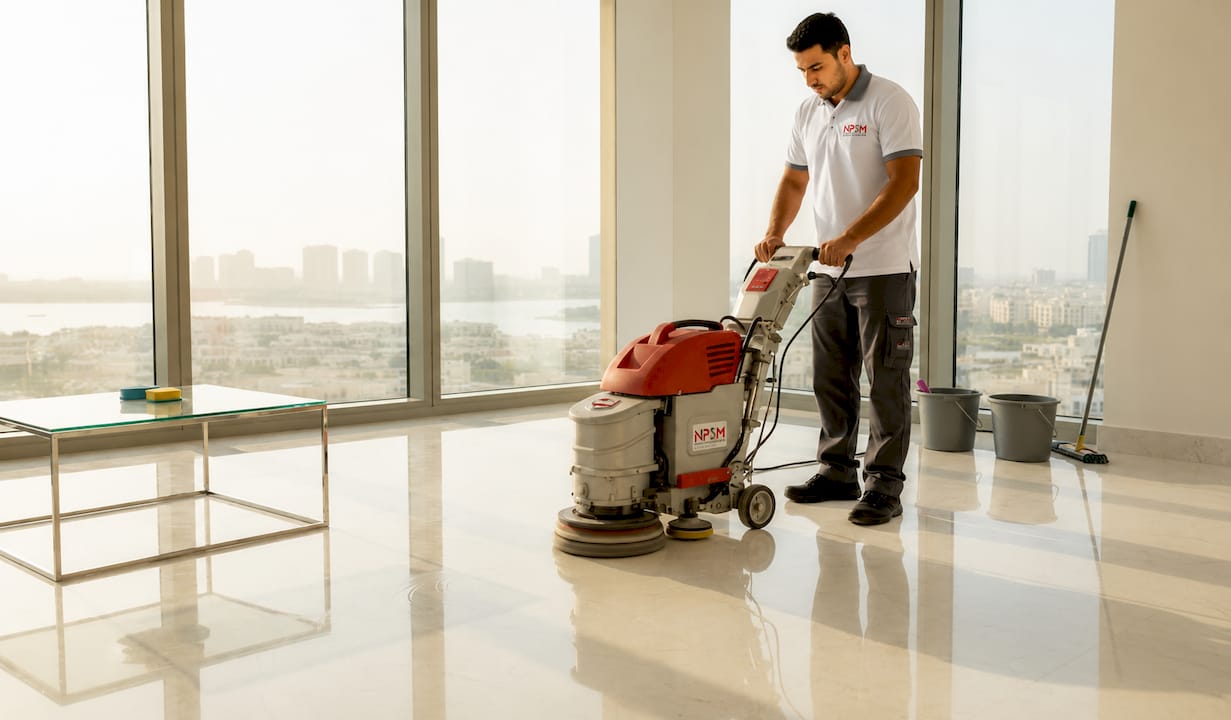
Professional machines are built differently from the tools you rent at a hardware store. They deliver consistent, even pressure across the full plate, which is critical for flat, mirror-like results. They operate at variable speeds that can be dialed in for soft marble versus hard granite. And they are paired with diamond abrasive pads that move through a precise progression of grits, from coarse to ultra-fine.
Here is what a professional polishing workflow covers on a typical Dubai villa floor:
-
Surface inspection to identify acid etching, deep scratches, uneven areas, or grout damage
-
Coarse grit grinding (50 to 100 grit) for heavily damaged or uneven floors
-
Mid-range grit progression (200 to 800 grit) to remove scratches left by coarser pads
-
Fine polishing grits (1500 to 3000 grit) for the final high-clarity mirror finish
-
Wet polishing throughout, which cools the pads and prevents friction burns on stone
-
Crystallization or sealing as the final protective step
“Professional polishing sequences for luxury floors can span from 50-grit to 3000-grit pads, with each stage essential for achieving a flawless, long-lasting result.”
That last step matters more in Dubai than almost anywhere else. Crystallization hardens marble post-polish and sealers create a barrier that blocks moisture and sand particles from penetrating the surface. Without this step, even a beautifully polished floor degrades within months in Dubai’s environment.
Understanding these details helps you recognize the difference between a professional who knows what they are doing and someone who is just running a machine. For deeper marble care tips specific to Dubai villas, the nuances of climate-adapted maintenance become even clearer. And if you want a full picture of professional floor care for luxury properties, the standard goes far beyond surface-level buffing.
How polishing machines work: Key steps from start to shine
Understanding the stages of professional polishing helps you ask better questions when hiring a team and spot shortcuts before they cost you money.
Step 1: Clean and prepare the surface. All dust, grease, and residue must be removed. Any contamination trapped under polishing pads causes micro-scratches that multiply as you work through finer grits. Professionals use industrial vacuums and pH-neutral cleaners that do not leave alkaline or acidic film behind.
Step 2: Assess damage and start with the right grit. Never skip grit steps; if you have deep scratches, you must start at a coarse grit to grind past them before moving finer. Starting too fine on a damaged floor simply polishes the top of the scratch without removing it.
Step 3: Work through the grit sequence. Each stage removes the scratch pattern left by the previous pad. This is where patience and precision separate average results from exceptional ones. Rushing through grit levels is the most common mistake that leads to hazy, uneven finishes.
Step 4: Choose wet or dry polishing. Wet polishing is strongly preferred for stone floors. The water acts as a coolant, preventing heat buildup that can cause micro-fractures in marble or limestone. It also extends the life of diamond pads significantly.
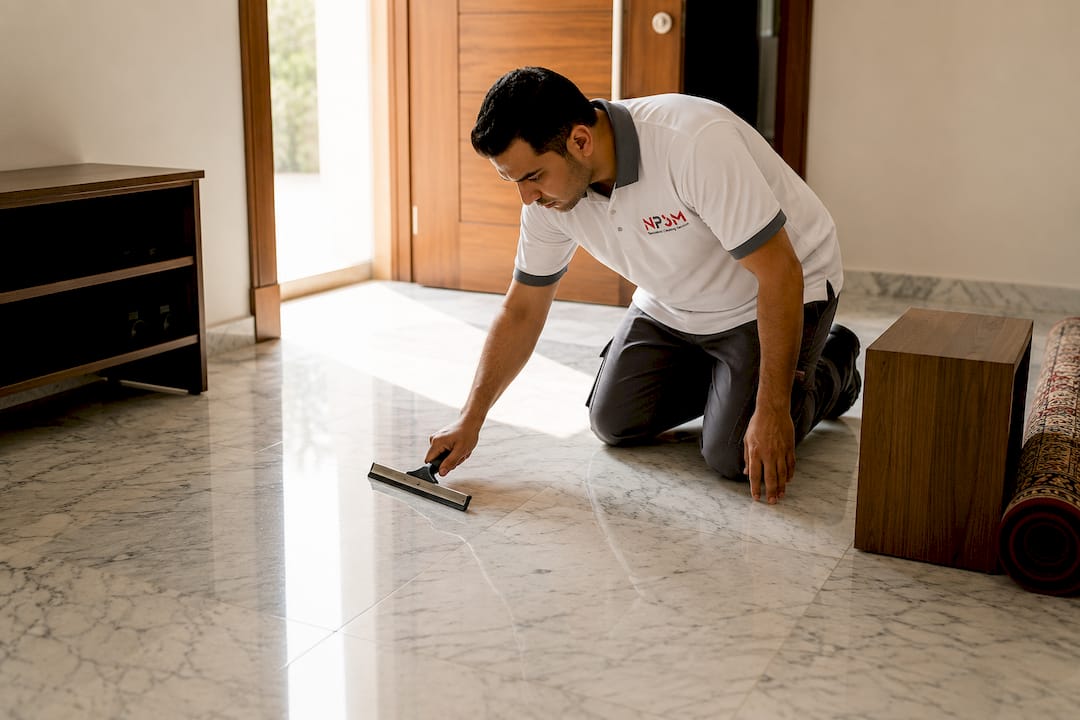
Step 5: Select and apply your final finish. This is the decision that shapes how your floor looks and how easy it is to maintain.
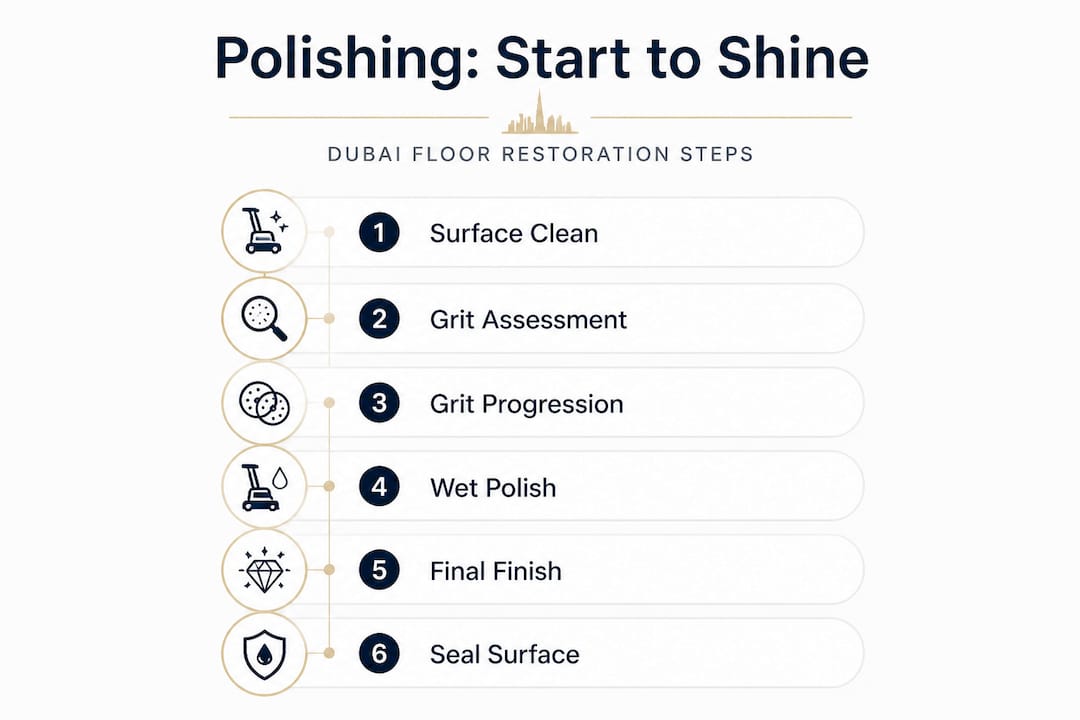
Step 6: Seal the surface. A penetrating sealer locks the result in. Without it, the polished surface is vulnerable within weeks.
Pro Tip: If you are restoring a floor after construction work, start by checking for lippage (uneven tile or stone edges) before polishing. Unaddressed lippage means the machine rides up and down across the floor, creating inconsistent contact and an uneven finish. See the full floor polishing after renovation process for how professionals handle post-construction floors.
Here is a quick reference table showing grit ranges matched to common floor problems:
| Problem type | Starting grit | Ending grit | Notes |
|---|---|---|---|
| Light surface haze | 400 | 3000 | Skip coarse stages |
| Moderate scratches | 200 | 3000 | Include mid-range pass |
| Deep scratches | 50 | 3000 | Full sequence required |
| Acid etching on marble | 100 | 3000 | Wet process strongly advised |
| Renovation residue | 50 | 1500 | May need grinding first |
| Wooden floor sanding | 40 | 120 | Different process, belt or drum sander |
For marble specifically, the marble floor polishing guide lays out the full sequence with material-specific recommendations.
Choosing the right finish: Polished, honed, or ground surfaces
Once you understand how polishing works, the next decision is what kind of finish you actually want. This is not just an aesthetic choice. It directly affects how safe, how easy to maintain, and how long-lasting your floor will be.
Contrasting finishes serve different purposes: polished surfaces deliver luxury mirror shine, honed finishes suit high-traffic areas with lower slip risk, and ground finishes prioritize surface flatness over visual appeal.
Here is a full comparison to help you decide:
| Finish type | Appearance | Slip resistance | Maintenance level | Best suited for |
|---|---|---|---|---|
| Polished | High-gloss mirror shine | Lower, especially when wet | Higher, shows dust and marks | Living rooms, formal entrances |
| Honed | Matte to satin, smooth | Better traction | Moderate, hides minor wear | Kitchens, bathrooms, family areas |
| Ground | Flat, rough texture | Highest | Lower visual maintenance | Outdoor areas, industrial use |
Key considerations for Dubai homeowners when choosing a finish:
-
Sand exposure: Polished surfaces show fine sand particles clearly. Honed finishes mask light dust better between cleanings.
-
Humidity: High humidity can make polished stone slippery in bathrooms and poolside areas. Honed finishes are much safer in wet zones.
-
Kids and pets: Honed marble or limestone is forgiving underfoot. Polished floors can become dangerous when wet.
-
Resale value: High-gloss polished marble in main living areas is a strong visual selling point for Dubai villa buyers.
-
Long-term cost: Polished finishes require more frequent maintenance to stay looking sharp. Honed finishes are more forgiving between professional visits.
For tile floors, finish choice is equally important. Properly restored tile floor cleaning includes grout restoration and surface refinishing that changes how the whole room reads visually and practically.
Expert tips for lasting, beautiful floors in Dubai
Getting a floor polished once is only part of the story. What you do between professional visits determines how long that result lasts and how much restoration is needed when you call again.
“Optimal for high-end villas: Diamond progression combined with crystallization and a penetrating sealer produces a durable mirror shine that lasts one to three years in Dubai’s climate.”
The diamond progression plus crystallization approach is considered the gold standard for marble floors in the region. Crystallization is a chemical and mechanical process that fuses the polishing compounds into the surface of the stone, creating a hardened layer that resists daily abrasion far better than standard polishing alone.
Here is what an expert maintenance plan looks like between professional visits:
-
Daily or every-other-day: Dry mop or vacuum to remove sand and grit before it embeds into soft stone surfaces
-
Weekly: Damp mop with a pH-neutral cleaner formulated for stone or hardwood, depending on your floor type
-
Monthly: Inspect grout lines and edges for early signs of darkening or cracking
-
Avoid always: Vinegar, lemon juice, bleach, ammonia, and any acid-based cleaners on natural stone. These dissolve the polished layer immediately.
-
Avoid always: Steam mops on marble or unsealed wood floors. The heat opens pores in stone and can warp wood planks.
Pro Tip: Buy a quality pH-neutral stone cleaner rather than using a “floor cleaner” from a supermarket shelf. Most general-purpose cleaners are either slightly acidic (to cut grease) or slightly alkaline (for sanitizing), and both will dull a polished marble finish over time. The investment in the right product protects the thousands of dirhams you spent on professional polishing.
For ongoing marble care between restoration visits, a consistent routine prevents the surface from degrading to the point where a full regrind is needed. That saves money and keeps your home looking its best every day.
The uncomfortable truth: Why DIY rarely matches professional results in Dubai
Here is something most polishing guides will not tell you directly. The gap between a professional result and a DIY result is not just about equipment quality. It is about the compounded knowledge behind every decision made during the process.
When a professional team works on a Dubai villa floor, they are making dozens of micro-decisions. Which pad hardness for this specific marble hardness rating? How much water flow during wet polishing to manage this level of friction? Does this acid-etched zone need chemical treatment before mechanical polishing? Should we switch from a rotary to a planetary machine for this uneven section?
Rental machines risk an uneven finish and can cause permanent surface damage that requires full regrinding to fix. We have seen Dubai apartments where a homeowner used a rented machine to “touch up” a dull patch, and ended up with a swirl-damaged floor that needed complete restoration from 50 grit upward. The repair cost significantly more than the original professional polish would have.
Dubai’s sand is particularly aggressive. It contains angular silica particles that act like sandpaper on soft stones. A rental machine running at the wrong speed with the wrong pad on a sandy surface can create more damage in 20 minutes than years of foot traffic.
There is also the question of surface flatness. Professional machines use weight and plate design to self-level across the floor surface. Handheld or lightweight rental machines follow the operator’s hand pressure, which is never perfectly even. On large open plan floors common in Dubai villas, this creates visible high and low areas that show up as waves of light and shadow in the finished surface.
The hard truth is this: floors in Dubai’s high-end properties are not forgiving of amateur technique. The cost of fixing a DIY mistake usually doubles the total project cost. Consulting a trusted polishing guide before making any decisions is a simple step that protects your investment and your peace of mind.
Professional floor polishing services tailored for Dubai homes
If this guide has shown you anything, it is that exceptional floor results come from expertise, not just effort. Our team at floorpolishing.ae covers every floor type found in Dubai homes, including marble, granite, wooden floors, vinyl, tiles, and natural stone. We handle grout restoration, broken tile repair, wooden floor sanding, epoxy floor coatings, and interior wall painting for villas and apartments across the city. Whether you need a full restoration or a periodic maintenance polish, our process is designed for Dubai’s specific climate and luxury property standards. Start with our floor polishing guide or compare polishing methods to understand what your floors need before booking your service.
Frequently asked questions
Can I use a rental polishing machine on my marble floor in Dubai?
Rental machines risk damaging marble surfaces and typically produce an uneven finish; professional machines calibrated for stone type and grit sequence are the safer and more effective choice.
How often do high-end Dubai floors need professional polishing?
With the right diamond progression and crystallization process, a mirror shine lasts 1 to 3 years in Dubai’s climate, though heavy foot traffic areas may need attention sooner.
What’s the safest cleaning routine between professional polishes?
Use pH-neutral stone-specific cleaners, dry mop daily to remove sand, and avoid acid or alkali-based products entirely to protect your polished surface.
Which finish is best for heavy foot traffic: polished or honed?
Honed finishes are slip-resistant and hide wear patterns better, making them the practical choice for busy households, hallways, and wet areas in Dubai homes.
Why is wet polishing preferred for Dubai floors?
Wet polishing cools surfaces and pads throughout the process, preventing friction-generated heat that can cause micro-fractures or discoloration in marble and other natural stone floors.