
A cupped wood floor can often be repaired, but only in the right order: find and stop the moisture, let the floor dry slowly, and only then decide whether it needs sanding or board replacement. Skip the first two steps and the sanding you pay for can leave the floor worse than before. This guide is for Dubai villa, apartment and commercial owners who are looking at boards with raised edges and want to know what to do, what to avoid, and when to call a restoration specialist.
TL;DR
- Cupping means board edges sit higher than the center. It is a moisture imbalance, most often with more moisture under the boards than on top.
- Do not sand first. Find the source (leak, wet slab, humidity, wet mopping, a non-breathable rug) and fix it before any repair.
- If the wood is not permanently damaged, it should return toward its original shape once its moisture content normalizes. That can take weeks, months or longer.
- Sand and refinish only after moisture readings are stable, and remove as little wood as possible. Badly warped, split or stained boards are replaced.
- In Dubai, the usual suspects are plumbing and AC condensate leaks, damp slabs, and humidity swings between air-conditioned rooms and the outdoors.
Table of Contents
- What cupping is, and what it is not
- Why wood floors cup in Dubai
- Can cupped wood floors be fixed?
- How to repair a cupped wood floor, step by step
- Why you should never sand a cupped floor too early
- Solid, engineered and parquet: what changes
- When replacement beats repair
- Our perspective: patience protects the floor
- Sun-faded wood floors: a different problem with a similar fix
- How to prevent cupping
- Need a cupped floor assessed in Dubai?
- FAQ
What cupping is, and what it is not
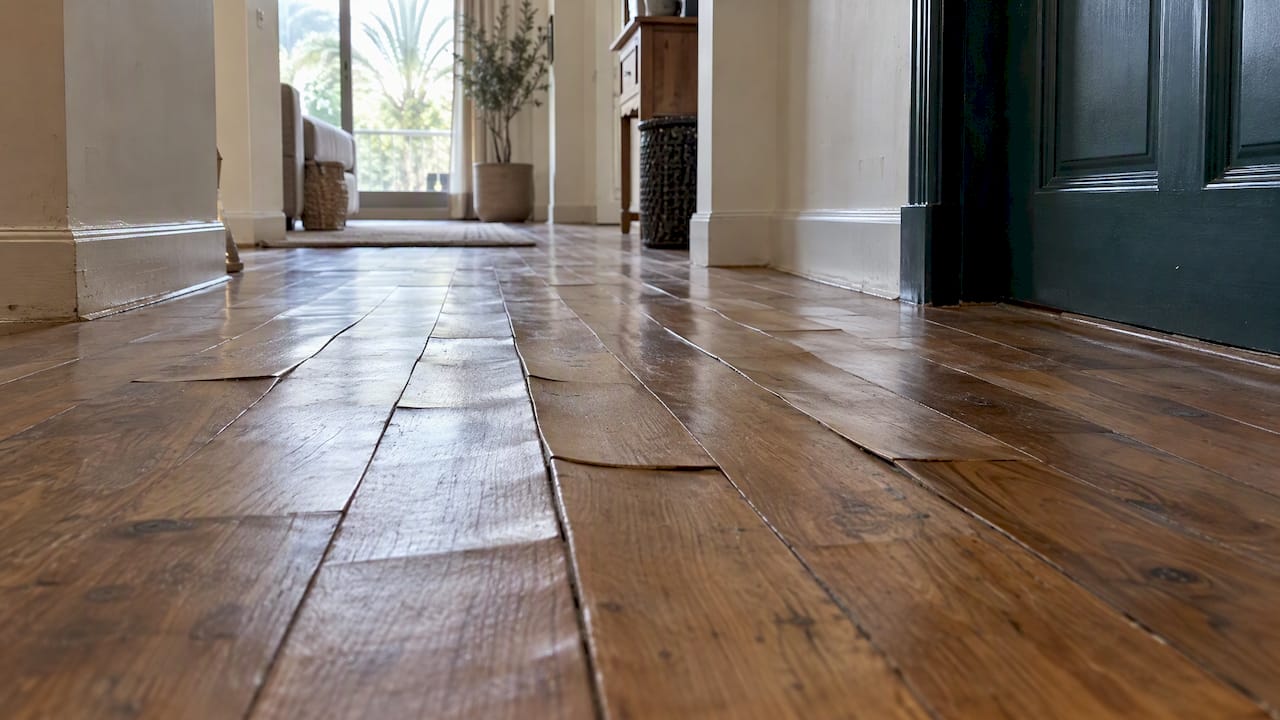
The National Wood Flooring Association (NWFA) describes cupping as a concave, dished look across each board, with the edges higher than the middle. You see it as ridges running along the length of every plank, and you feel it underfoot as a rolling surface. Light from a window along the floor makes it obvious.
Cupping is not the same as a few scratches, a dull finish or a loose board. Those are surface or fastening issues. Cupping is the wood itself changing shape because one face is holding more moisture than the other. If you are unsure what you are looking at, our guide to flooring defects, their causes and fixes helps you tell cupping from crowning, buckling, gapping and finish failure.
The common pattern is that the underside of the board is wetter than the top. The wet face swells, the dry face does not, and the board curls upward at the edges. The reverse can happen too. A floor that dries out too fast from above, or an engineered floor that loses moisture, can show a similar dished look. That is why you measure before you decide anything.
Why wood floors cup in Dubai
Wood is organic and reacts to its surroundings. Some seasonal movement is normal. Cupping is the sign that conditions around or under the floor have moved beyond what the boards can absorb. The NWFA lists these potential causes:
- wet subfloors or concrete slabs
- plumbing or appliance leaks
- inadequate moisture control
- elevated humidity
- wet-mopping or steam cleaning
- non-breathable rugs
In Dubai homes and buildings, those translate into very specific situations:
Leaks you cannot see. A slow leak from a bathroom supply line, a dishwasher or washing machine hose, a kitchen sink, or a split pipe in a wall can feed moisture into the floor for weeks before a stain shows. Wood next to bathrooms, kitchens and balcony doors cups first.
Damp concrete slabs. Wood laid over a slab that has not fully dried, or that takes moisture from below, will cup from the underside. This is common in new builds and ground-floor villas where a floor went in before the slab was ready.
AC condensate and humidity swings. A blocked AC drain line or a leaking fan coil unit can soak the floor beneath it. Beyond that, a property that is cooled hard indoors and then opened to humid outdoor air, or left shut with the AC off during a long absence, can see wood take on and lose moisture quickly.
Cleaning habits. Wet mops and steam mops are a quiet culprit. The NWFA homeowner guidance is to wipe spills promptly and avoid wet and steam mopping, because water and steam can damage the finish and the wood over time. Cleaning crews who treat a wood floor like tile can cause a problem that looks like a mystery leak.
Rugs and mats that trap moisture. A non-breathable rug or planter base can hold moisture against the surface and make that area cup differently from the rest.
Holiday homes and vacant units. Properties left closed for weeks with the AC off or set high are exposed to humidity swings and unnoticed leaks. If you manage several units, a monthly walk-through that checks floors near wet areas pays for itself.
Can cupped wood floors be fixed?
Often, yes. The NWFA’s guidance is that once the moisture source is eliminated and the wood returns to its normal moisture content, a cupped floor should return toward its original shape, provided it has not been permanently deformed or damaged. Drying can take weeks, months or longer. One UK flooring guide notes it can take as long as a whole season.
That timeline is the part owners dislike. A hotel manager wants the lobby back for a booking, and a villa owner wants the floor flat before a family event. But the wood sets the pace, not the contractor. Rushing it is how floors get ruined.
Three outcomes are realistic:
- The floor flattens on its own. Mild cupping from a short exposure often relaxes once the source is gone and the floor dries gradually. You may only need a light screen and recoat afterward.
- Some cupping remains. The boards have taken a partial set. After they are fully dry and stable, a careful professional sanding levels the surface and the floor is refinished.
- The boards are damaged. Boards that are badly warped, split, buckled, permanently stained or weakened are repaired or replaced individually, then blended into the floor.
How to repair a cupped wood floor, step by step
Step 1: Find and stop the moisture
The NWFA is clear that repairs should not begin while a leak, wet subfloor or other moisture problem is still present. Check these in order:
- Inspect plumbing, appliance hoses, AC drain lines and fan coil units near the affected area.
- Look at adjoining walls, skirting boards and the ceiling below for staining or swelling.
- Ask what changed: a new rug, a new cleaner, a recent renovation upstairs, a long vacancy with the AC off.
- Check whether the slab or subfloor is damp.
Finding the source can take longer than you expect and sometimes needs a plumber, an AC technician or a waterproofing specialist. That is normal. Do not treat the floor as the problem until you have ruled out what is feeding it. If the damage just happened, our first 24 to 48 hours guide for wood floors after water damage covers what to do straight away.
Step 2: Remove surface water and rugs
Mop up standing water with towels or a wet vacuum, not a wet mop. Lift rugs, mats and anything sitting on the floor. Open the area to air movement. Do not seal the floor under plastic sheeting, which traps moisture.
Step 3: Dry gradually
Use air circulation and normal climate control rather than aggressive heat. Fast drying can split boards and leave the floor in worse shape than cupping did. The target is for the floor to settle into balance with the air in the room, which for most indoor spaces means stable, moderate humidity.
Step 4: Measure, and keep measuring
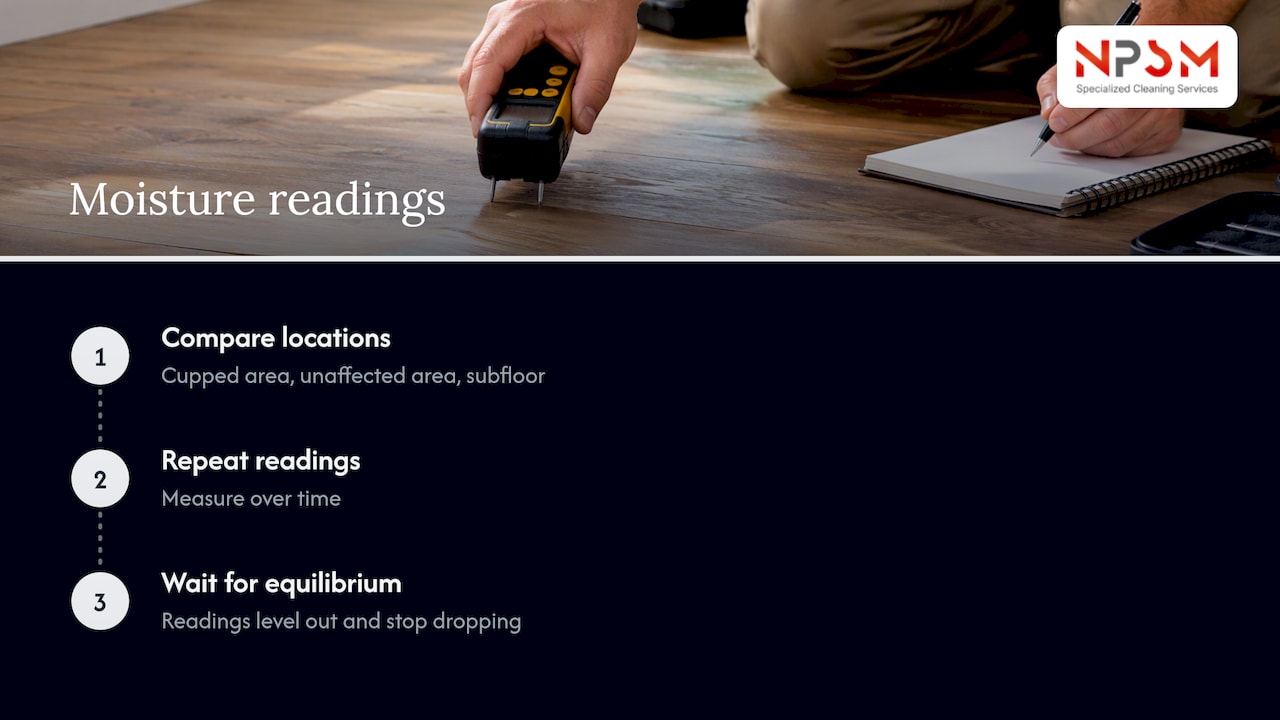
Moisture readings are what separate a guess from a diagnosis. Compare readings in the cupped area, in an unaffected area, and in the subfloor. Repeat them over time. When readings level out and stop dropping, the floor has reached equilibrium. Without readings, you are only looking at the surface, and the surface lies: a floor can look flat while the underside is still wet.
Step 5: Wait for the floor to settle
This is the hardest step. Cupping that is still improving should be left alone. If it stops improving and stays cupped after readings have stabilized, you can move to sanding.
Step 6: Sand and refinish only if cupping remains
Once readings are stable, a professional can sand the residual cupping flat and refinish the floor, removing as little wood as possible. This applies to structurally sound hardwood.
Step 7: Replace what cannot be saved
Boards that are split, buckled, permanently stained or weakened will not recover. Individual boards are cut out and replaced, then sanded and finished with the rest so the repair disappears.
Why you should never sand a cupped floor too early
This is the most expensive mistake in cupping repair, and the top search results for this topic agree on it. When a floor is cupped, the underside is still wetter than the top. If you sand the raised edges flat now, you take wood off the edges while the board is still distorted. As the board continues to dry and flattens, the center, which was ground least, ends up higher than the edges. The floor is then crowned, and you have removed wood you cannot put back.
The same logic applies to the DIY tricks you may see online, such as ironing seams with a towel to push moisture out. They address the surface and ignore the source. They can also scorch the finish. For a floor you care about, in a villa, penthouse or hotel corridor, treat them as unproven.
The wear layer matters too. Solid wood can be sanded and refinished many times. Engineered floors usually can be refinished, but not always as many times, because the top layer is thinner. Sand too early or too deep and you may use up a layer you needed. Our guide on the 3/32 inch test before sanding engineered versus solid wood explains how to check what you have. For parquet, see the 2.8mm test before sanding parquet.
Solid, engineered and parquet: what changes
| Floor type | How it usually behaves | Repair approach |
|---|---|---|
| Solid wood | Cups when moisture is higher below; can recover well when dried | Dry, confirm stable readings, then sand and refinish if cupping remains |
| Engineered wood | Can cup from moisture below, or from too much drying above (dry cupping) | Identify the direction of the moisture imbalance first; check wear layer before any sanding |
| Parquet | Many small pieces; movement shows as lifting or uneven blocks | Assess the whole panel; replace damaged pieces, then sand and finish |
If you own an engineered floor and want to know how to keep the finish healthy once it is flat again, see our guide to polishing engineered wood floors.
When replacement beats repair
Restoration is almost always cheaper than ripping a floor out, but there are limits. Consider replacing boards, or a section, when:
- boards are split or the edges are crushed from buckling
- the same area cups again after the source is fixed, which points to a source you have not found
- the wear layer on an engineered floor is too thin to sand safely
- staining from long water exposure will not lift
- the subfloor itself is damaged or still wet
A good contractor will tell you which of these applies after measuring, not before. Be wary of anyone who quotes a sanding price over a floor that has not been checked for moisture.
Our perspective: patience protects the floor
Most cupping jobs we are asked about start with a call that says the floor needs sanding. In the majority of cases the first useful thing we do is not sanding at all. It is working out why the floor moved, and whether it is still moving.
Dubai properties make this harder to read. A floor can sit in a cooled interior for months, then be hit by a leak behind a wall or a condensate overflow, and the damage shows weeks later. Owners often assume the finish has failed and ask for a new coat. A new coat over a floor that is still wet seals the problem in.
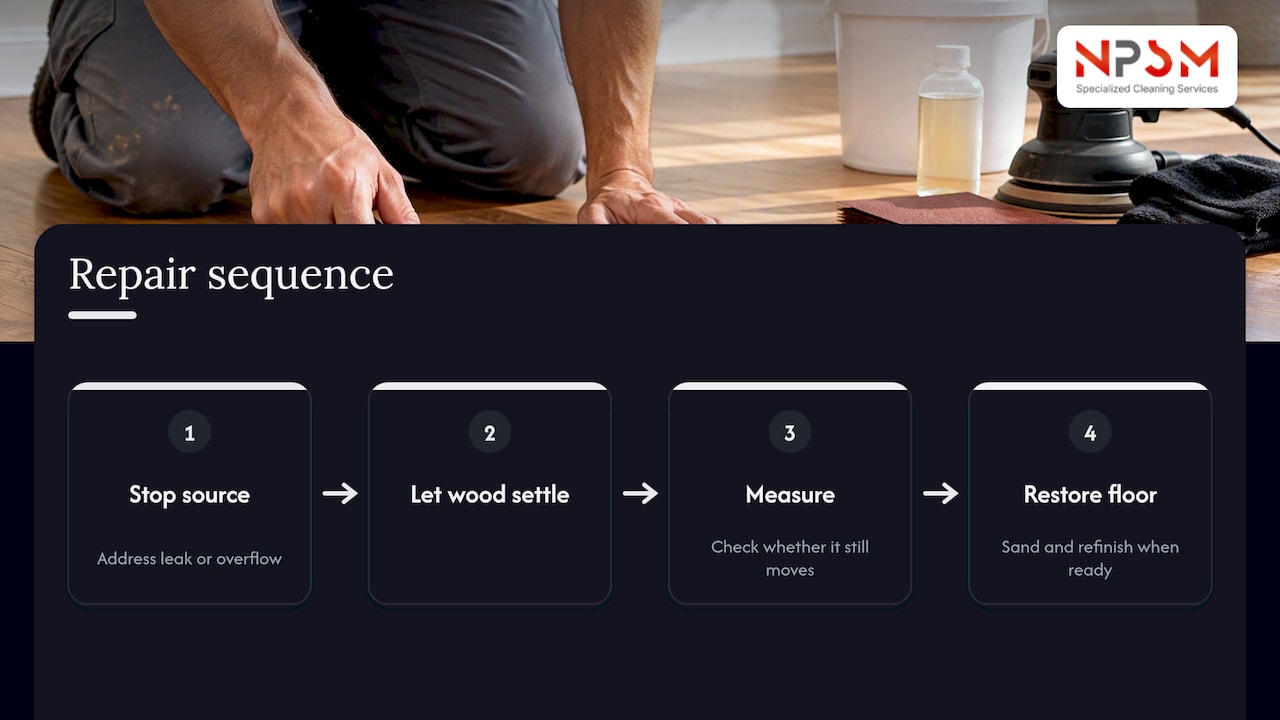
Our approach is simple: stop the source, let the wood settle, measure, and only then restore. We prefer restoring a floor you already own to replacing it, because solid hardwood and good parquet are expensive, and a careful sanding and refinish gives you most of the value back. But that only works when the timing is right. If we tell you to wait, it is because waiting is what saves the floor.
For property managers and facility teams, the lesson is to treat moisture as a maintenance item: regular checks near wet areas, clear cleaning instructions for contractors (no wet or steam mops on wood), and a fast response when a leak is reported.
— Qadir
Sun-faded wood floors: a different problem with a similar fix
Cupping is not the only reason a floor looks worn. Floors near large Dubai windows and balcony doors often fade or turn uneven in color where sunlight lands. National Park Service research on historic wood finishes found that visible light through windows can damage certain stains and finishes over time, even when UV is filtered, so glass alone does not fully protect a floor.
Fading is a finish and color issue, not a moisture issue, so the repair is different:
- Light fade or dull finish: a professional clean and recoat can restore even color and protect the wood. The NWFA suggests recoating every 3 to 5 years with a new coat of finish to protect and preserve wood floors.
- Deeper fade or uneven color: sanding to bare wood and refinishing evens the tone across the room.
- Prevention: rugs that breathe, curtains or window film, and rotating furniture so one area does not take all the light.
If a floor has both problems, such as a sun-bleached strip beside a cupped area, fix the moisture first and refinish the whole floor afterward. That also gives you a single consistent color. Our guide on fixing scratched wood floors without replacement covers the refinishing side in more depth.
How to prevent cupping
Prevention is mostly about keeping the room stable and the floor dry.
- Keep the climate steady. The NWFA recommends keeping the home at 60 to 80°F (about 15.6 to 26.7°C) and 30% to 50% relative humidity year-round to limit seasonal wood movement. In practice that means running the AC consistently and not letting vacant properties swing, and a simple hygrometer in each key room shows you what is really happening.
- Clean dry. Wipe spills quickly. Use a lightly dampened microfiber pad at most, with a cleaner made for wood, and skip wet mops and steam mops.
- Check the plumbing and AC. Look at hoses, drain lines, fan coil units and the areas around balcony doors on a schedule.
- Use breathable rugs. Avoid rubber or plastic-backed mats that trap moisture.
- Confirm the slab is ready. If you are installing or renovating, make sure the subfloor has been tested and is dry before any wood goes down. If you are a developer or contractor, that test is cheap compared with a warranty claim.
Our article on wood floor protection in Dubai goes through finishes and routines that suit local conditions, and our Dubai floor care guide covers mixed-floor properties.
Need a cupped floor assessed in Dubai?
If your floor is cupped and you are unsure whether it should be left alone, sanded or partly replaced, we can inspect it and tell you plainly. Our team restores solid wood, engineered wood and parquet in villas, apartments, hotels, offices and retail spaces across Dubai and the UAE, including sanding, refinishing and board replacement once the floor is stable. See our wooden floor polishing and restoration services or read about resurfacing wooden floors in Dubai. For luxury interiors, our floor refinishing guide shows what a full refinish involves. Pricing depends on floor type, area and condition, so we quote after assessment.
FAQ
Can wood floor cupping be fixed?
Yes, often. Once the moisture source is eliminated and the wood returns to its normal moisture content, a cupped floor should return toward its original shape, as long as the boards are not permanently damaged. If some cupping remains after readings stabilize, professional sanding and refinishing can level it. Badly warped or split boards are replaced.
How long does it take for a cupped floor to flatten?
It depends on how wet the floor got and how stable the room is. The NWFA says it can take weeks, months or longer. Expect the slow end of that range if the subfloor or slab was wet, and keep taking moisture readings rather than going by appearance.
Should I sand a cupped floor right away?
No. If you sand while the underside is still wetter than the top, the floor can end up crowned once it fully dries. Wait until the moisture problem is fixed and readings are stable, then have a professional sand with minimal wood removal.
Why is my hardwood floor cupping when there is no visible leak?
Hidden causes are common: a slow leak inside a wall or under a fixture, a damp slab, a blocked AC drain, high humidity, or wet and steam mopping. Non-breathable rugs can also trap moisture. On engineered floors, excessive drying from above can cause a similar dished look, so measuring moisture from both sides matters.
Can sun-faded wood floors be restored?
Usually, yes. A light fade can often be handled with cleaning and a new coat of finish, while deeper or uneven fading is evened out by sanding to bare wood and refinishing. Solid wood tolerates this many times. Engineered floors depend on the thickness of the wear layer, so check it before any sanding.