
Rust stains on marble can often be lifted, but only if you treat them as a stain and not as dirt. Scrubbing, vinegar and bleach make them worse. The safe route is a poultice made with a rust remover designed for stone. Deep stains that have sat for months may need professional work, and some never fade completely. This guide shows how to confirm it is rust, what to try first, and the point where it makes sense to hand the job to a restoration team.
TL;DR
- Rust shows up as orange to brown marks, often in the shape of the metal object that caused it. Etch marks from acids look different: dull, pale patches.
- Never use vinegar, lemon juice or abrasive scrubbing on marble. Acids etch the surface and leave a bigger problem than the one you started with.
- The standard method is a poultice: a stone-safe rust remover mixed with a white absorbent powder, spread over the stain, covered with plastic and left for 24 to 48 hours.
- Old, deep rust can be permanent, and polished marble in villas, penthouses and hotel lobbies is not worth experimenting on. Call a stone specialist early.
- Fix the source (metal, moisture, unsealed stone) or the stain returns.
Table of Contents
- First, confirm it is rust
- Why rust shows up on marble in Dubai homes
- What not to use on a rust stain
- How to remove a rust stain with a poultice
- When to stop and call a stone specialist
- Our perspective: treat the stone, not just the stain
- What professional marble stain and rust treatment looks like
- Keeping rust stains from coming back
- Rust stain removal: DIY or professional?
- FAQ
First, confirm it is rust
Most failed stain removal starts with a wrong diagnosis. Marble shows several kinds of marks, and each needs a different fix. Treat a rust stain like an etch mark and nothing happens. Treat an etch mark like a stain and you can ruin the finish.
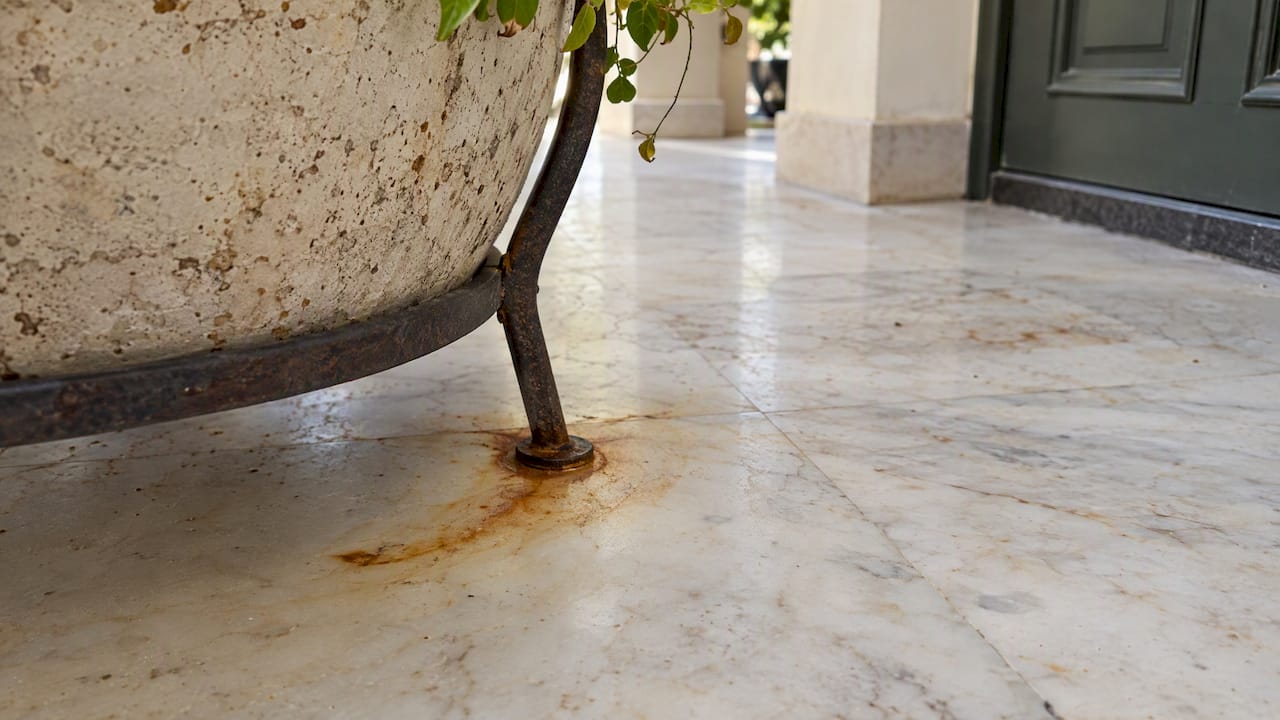
Rust stains are orange to brown. They usually follow the outline of whatever caused them: a ring where a metal can stood, a spot under a planter stand, a streak below a steel fixing or a trail from a corroding screw. The Natural Stone Institute describes rust stains this way and says they call for a poultice.
Etch marks are not stains at all. They are damage to the stone’s surface caused by an acid that was left on it. They look dull, whitish or slightly rough, and they feel different under your fingertip. They rarely show orange or brown color. If your mark is dull and pale, read our guide on telling etching from staining, because the fix is polishing, not poulticing.
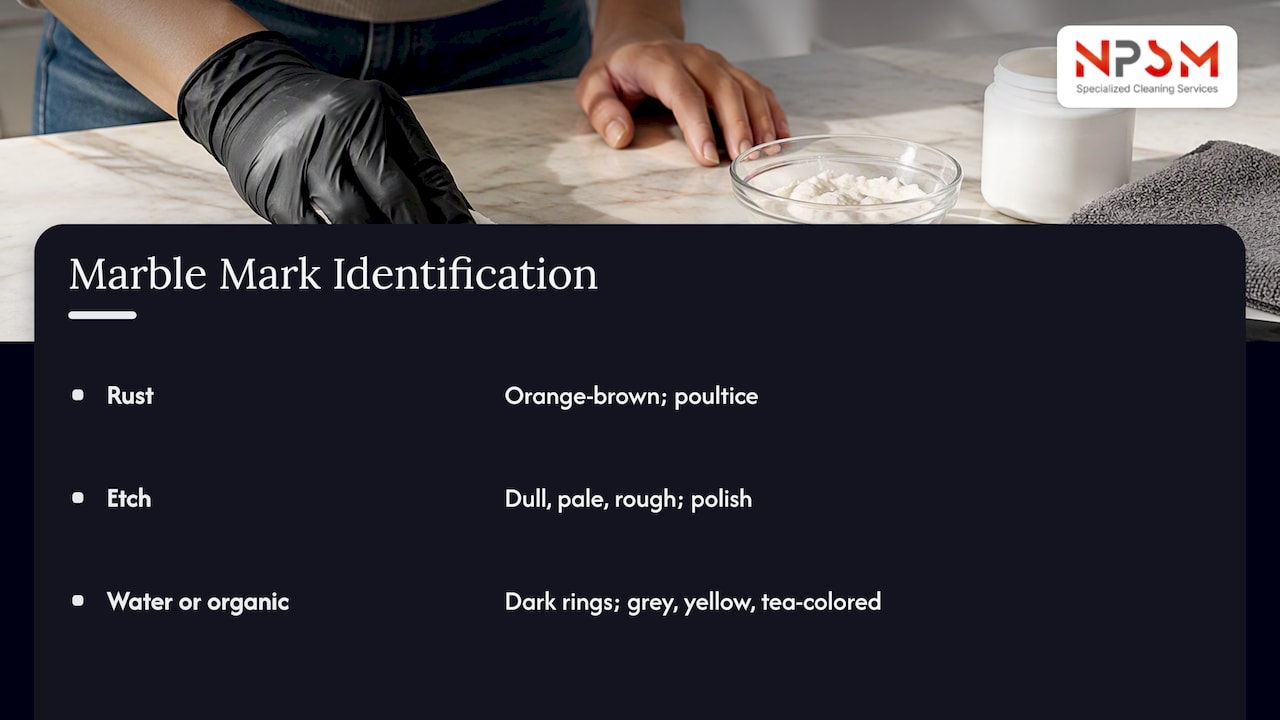
Water stains and organic stains tend to be darker rings, grey or yellowish patches, or tea- and coffee-colored marks. Our guide to marble water stains covers those. A broader overview of the types you are likely to meet is in seven marble floor stains UAE homeowners should know.
A quick test at home
- Look at the shape. Does the mark match a metal object that sat or dripped there? That points to rust.
- Check the color under good daylight. Rust is orange, rust-brown or reddish. Yellow-brown in a ring pattern is more often organic.
- Run a fingertip across it. A smooth surface with a colored mark is a stain. A rough, dull patch is likely an etch.
- Look for the source. Rust has to come from somewhere: metal, a leak, or iron inside the stone itself.
If the mark appears on a wet area, spreads over time or reappears after cleaning, the source is still active. Stopping the source comes before any cleaning.
Why rust shows up on marble in Dubai homes
Marble is porous. Moisture carries tiny particles of iron into the stone, and once they oxidize they leave color behind. Dubai homes offer plenty of ways for that to happen.
- Metal on the floor. Steel and iron planter stands, furniture feet, tins of cleaning product left on a bathroom counter, metal wastebaskets and curtain track hardware are common culprits. Anything that rusts and sits on damp stone can mark it.
- Balconies, terraces and entrance halls. Outdoor furniture dragged indoors, wet pot bases and moisture tracked in from a terrace all bring rust risk close to the marble.
- Bathrooms and kitchens. Steel drain covers, shower fixtures, trapped moisture under mats and countertop appliances with corroding feet.
- Humidity and condensation. Coastal humidity and air conditioning produce condensation on cold surfaces. Metal that never looked wet can still corrode underneath a mat or pot.
- Water quality. Dubai’s desalinated water is low in minerals, and building tanks and plumbing can influence what comes out of the tap. Where older pipes or tanks corrode, rust-colored water can reach your fixtures and the stone around them.
- Iron in the stone. Some marbles naturally contain iron minerals. When moisture reaches them, orange or brown discoloration can develop from within, even with no metal object nearby. This kind is the hardest to treat and the most likely to return.
- Poor installation or cheap cement beds. Moisture from the substrate can rise through grout lines and marble joints and bring discoloration with it.
This list is also useful in reverse. If you find the orange stain under a metal object, the cause is clear. If it appears in a pattern across the floor, the water or substrate is the suspect and a surface treatment alone will not hold.
What not to use on a rust stain
Search results are full of kitchen remedies. Most are wrong for marble.
Vinegar and lemon juice. Both are acids. Marble is calcium carbonate, and acids dissolve it. Even a short contact leaves a dull etched patch. You may lift a little color and gain a permanent dull mark. Never use vinegar on marble floors, counters or tables.
Bleach. Bleach does not dissolve rust. It can discolor some stones and leaves residues. It is simply the wrong chemistry.
Generic rust removers. The ones sold for sinks, tiles, clothing or metal often contain strong acids. Unless the label says it is safe for marble and acid-sensitive stone, assume it will etch the surface.
Abrasive pads, powders and scouring creams. Rust sits in the pores, not only on top. Scrubbing spreads the stain, scratches the polish and leaves a visibly worn area.
Baking soda alone. A baking soda paste is a mild option for some everyday marks and is harmless to marble, but it does not dissolve iron. It is not a rust remover and you should not expect it to fix a true rust stain.
Steam and heat. Heat can drive the stain deeper into the pores and make a marginal stain permanent.
When you are unsure what a product contains, do not put it on the stone. A stone-specific product with a clear safety statement for marble is the only sensible option.
How to remove a rust stain with a poultice
A poultice works by pulling the stain out of the stone and into an absorbent powder. It is slow, but it is the method stone professionals rely on, and the Natural Stone Institute recommends it for rust stains. Success depends on patience and on using a product made for marble.
What you need
- A rust-stain remover labeled safe for marble and acid-sensitive natural stone
- A white absorbent powder such as kaolin or a similar clay (white, so it does not add color)
- A plastic spatula or spoon (not metal)
- Plastic wrap and masking tape
- Clean water, a soft cloth and a soft sponge
- Gloves and ventilation. Follow the product’s safety instructions.
The steps
- Clean and dry the area. Wipe away dust and any film. Let the stone dry completely.
- Test first. Try the remover on a hidden spot or an offcut if possible. Confirm it does not dull or darken the stone.
- Wet the stain lightly with clean water if the product instructions suggest it.
- Mix the paste. Combine the rust remover and the powder until it reaches the consistency of peanut butter. Too wet and it runs. Too dry and it will not draw the stain.
- Apply about 6 mm (a quarter inch) thick, extending a little beyond the stain edge so the stain can be drawn outward.
- Cover with plastic wrap and tape the edges. This keeps the paste working slowly.
- Leave it for 24 to 48 hours. Do not peek and re-wet. Let the paste dry inside the cover as directed.
- Remove the paste with a plastic spatula. Rinse with clean water and wipe dry.
- Judge the result in daylight. If the stain has faded but is still visible, repeat. Several rounds may be needed on stubborn marks.
How to read the result
- Stain gone or nearly gone: the stain was surface-level. Leave it a few days to see if it returns, then consider sealing.
- Stain lighter but present: repeat the poultice. Fading with each round is a good sign.
- No change after two or three rounds: the stain is deep, or the product is wrong for the problem. Stop. Further attempts at home rarely help and can damage the polish.
- Dull patch where the poultice sat: the product etched the surface or the polish wore down. This now needs polishing, not more chemicals.
A poultice will not restore a worn finish. If the stain lifts but the surface looks flat, the stone needs re-honing and polishing to bring the shine back to match the rest of the floor.
When to stop and call a stone specialist
Do-it-yourself makes sense for a small, recent stain on a countertop, a side table or a bathroom ledge. It makes less sense in these situations:
- Large or multiple stains across a hall, lobby or living room floor
- Rust that keeps returning, which suggests moisture coming from below or iron inside the stone
- Stains on light or white marble, where any color shift stands out, and on high-end or imported stone that is expensive to replace
- Old stains that have been there for months or years
- Stains combined with etching, scratches or worn polish, which need mechanical restoration as well as stain removal
- Commercial spaces such as hotel lobbies, retail floors and office reception areas, where appearance and downtime matter
- Any situation where a failed attempt would cost more than hiring a specialist
Professionals can test the stone, identify the stain type, choose a suitable poultice chemistry, control the dwell time and then restore the finish if needed. Deep-seated rust is difficult to remove and can permanently mark the stone, so early action matters. The longer iron sits in the pores, the harder it is to draw out.
Our perspective: treat the stone, not just the stain
We restore marble in Dubai villas, apartments, hotels and commercial buildings, and we see the same story often. A homeowner finds an orange mark, tries vinegar or a scouring product, and by the time we arrive there are three problems: the original rust, an etched patch and a scratched surface. The stain is usually fixable. The damage from the first attempt is what costs money.
Our approach follows the stone. We identify what the mark really is, rust, etch, water or organic. We find the source, because a stain with a live source will come back. Then we choose treatment according to the stone type and the condition of the finish. Where a stain lifts but the shine is uneven, we hone and polish the area so it blends with the floor around it. Where the stone is sound, restoration is almost always more economical than replacement, and it keeps the original material you chose for the property.
Dubai’s conditions matter too. High humidity, air conditioning condensation, terraces that open straight onto marble floors and heavy foot traffic in commercial spaces all put stress on marble. A rust stain is often the first visible sign of a moisture or sealing problem, and we would rather deal with the cause than keep treating the symptom.
Our advice to any owner is simple. Act quickly, use nothing acidic and be honest about what a poultice can and cannot do. When a stain is deep or the floor is valuable, ask for an inspection before you experiment.
— Qadir
What professional marble stain and rust treatment looks like
If you decide to bring in a specialist, it helps to know what a proper job involves. It also helps you compare quotes honestly.
- Inspection and diagnosis. The technician checks the stain type, how deep it goes, the stone type, the finish and the likely source.
- Source control. Metal items are removed, leaks are traced, and grout joints or substrate moisture are flagged.
- Targeted stain treatment. A poultice or a stone-specific treatment is applied and monitored, with repeat rounds if the stain needs them.
- Surface restoration. Where the stain or the treatment has left the finish uneven, the area is honed and polished so the shine blends across the floor.
- Sealing. A suitable stone sealer is applied to reduce how easily moisture and staining agents enter the marble.
- Care guidance. You receive practical advice on what to use and avoid in daily cleaning.
Our marble polishing and restoration service in Dubai covers stain removal, polishing and buffing, full floor restoration, staircases and countertops, with pricing from AED 30 per sqm for marble polishing and restoration. For anything involving other stone, our natural stone restoration team handles granite, terrazzo and other surfaces. If you have a rust stain and are not sure what it is, contact us through the FloorPolishing.ae homepage for an assessment before you try anything on the stone.
Keeping rust stains from coming back
Removing a stain is half the job. The rest is keeping the conditions that caused it from returning.
Remove the source
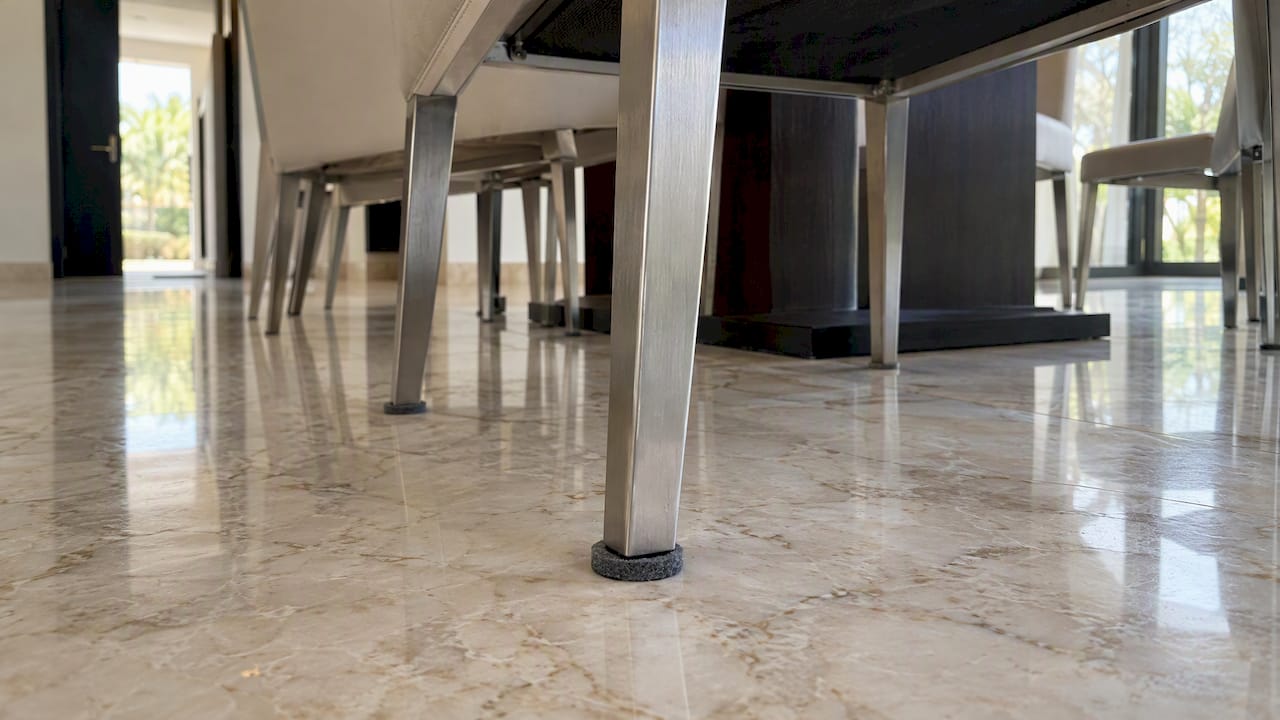
Move metal planters, cans and furniture feet off the marble. Use plastic, ceramic or rubber-footed bases and felt or rubber pads under metal furniture legs. Replace corroding screws and fixtures, and fix any leak that keeps the stone wet.
Keep the stone dry
Dry wet marble promptly, especially near balcony doors, bathrooms and kitchens. Do not leave damp mats or pots on the floor. Where condensation forms under metal items, give them a dry barrier.
Seal the marble
A good impregnating sealer slows the absorption of water, oil and staining agents, which makes marble easier to clean and gives you more time to wipe up spills. Sealing does not make marble stainproof, and it does not stop etching. It needs reapplication over time, and the interval depends on the stone, the sealer and how heavily the surface is used. Ask your stone specialist what suits your floor.
Clean with the right products
Use a pH-neutral cleaner made for natural stone and a soft mop or microfiber cloth. Avoid acidic bathroom cleaners, vinegar-based sprays and abrasive powders. Put mats at entrances to catch grit and moisture.
Check the water side
If rust-colored staining appears near taps, showers or drains, or the water itself looks discolored, ask your building management or a plumber to check tanks and pipework. Treating the stone while the water still carries iron is a short-lived fix.
Schedule periodic inspections
For villas, hotels and commercial buildings, build a stone check into the maintenance calendar. Spotting a small orange mark early is cheaper than treating a deep one. Property managers and facility teams can include marble inspection and re-sealing in routine maintenance contracts.
Rust stain removal: DIY or professional?
| Situation | Likely best approach |
|---|---|
| Small, recent stain on a table or counter | Poultice with a stone-safe rust remover |
| Stain with a clear metal source, now removed | Poultice, then seal |
| Stain under an etch mark or dull patch | Professional polishing and stain treatment |
| Large area or several stains across a floor | Professional assessment |
| Stain keeps returning | Find moisture or water source, then professional treatment |
| Light or valuable stone, hotel or retail floor | Professional treatment |
| Stain left for months or years | Professional treatment, with realistic expectations |
No method guarantees complete removal, and an honest specialist will tell you so after inspecting the stone.
FAQ
Can you get rust stains out of marble?
Often, yes. A poultice made with a stone-safe rust remover and a white absorbent powder can draw rust out of the pores, though it may take several rounds. Deep or old rust can be very difficult to remove and may leave a permanent mark, so the sooner you act the better.
Will vinegar remove rust from marble or stone?
It may lift a little color, but it will also etch the marble. Vinegar is an acid, and acid dissolves the calcium carbonate that marble is made of. You end up with a dull patch on top of the stain. Use a product made for marble instead.
How do you get orange stains out of marble?
First check that the orange mark is really rust and not an etch or a water stain. Orange to brown marks that follow the shape of a metal object are usually rust and respond to a poultice. Pale, dull patches are etch marks and need polishing, not a stain remover.
Is vinegar safe to clean marble?
No. Vinegar etches and dulls polished marble, even when diluted and even when left only briefly. Use a pH-neutral stone cleaner and a soft cloth for everyday cleaning.
How long does a poultice take to work?
Leave it covered for 24 to 48 hours, then remove it, rinse and judge the result once the stone is dry. Stubborn rust can need repeat applications. If you see no improvement after two or three rounds, stop and ask a stone specialist to look at the surface.