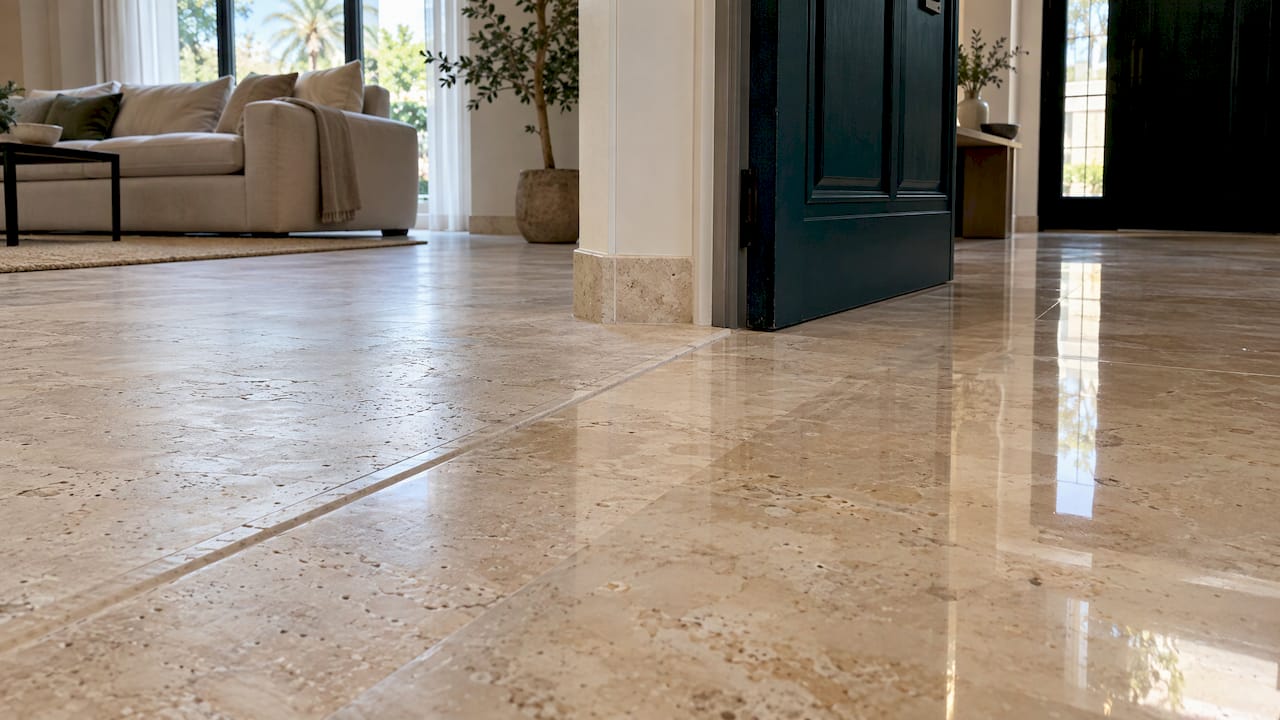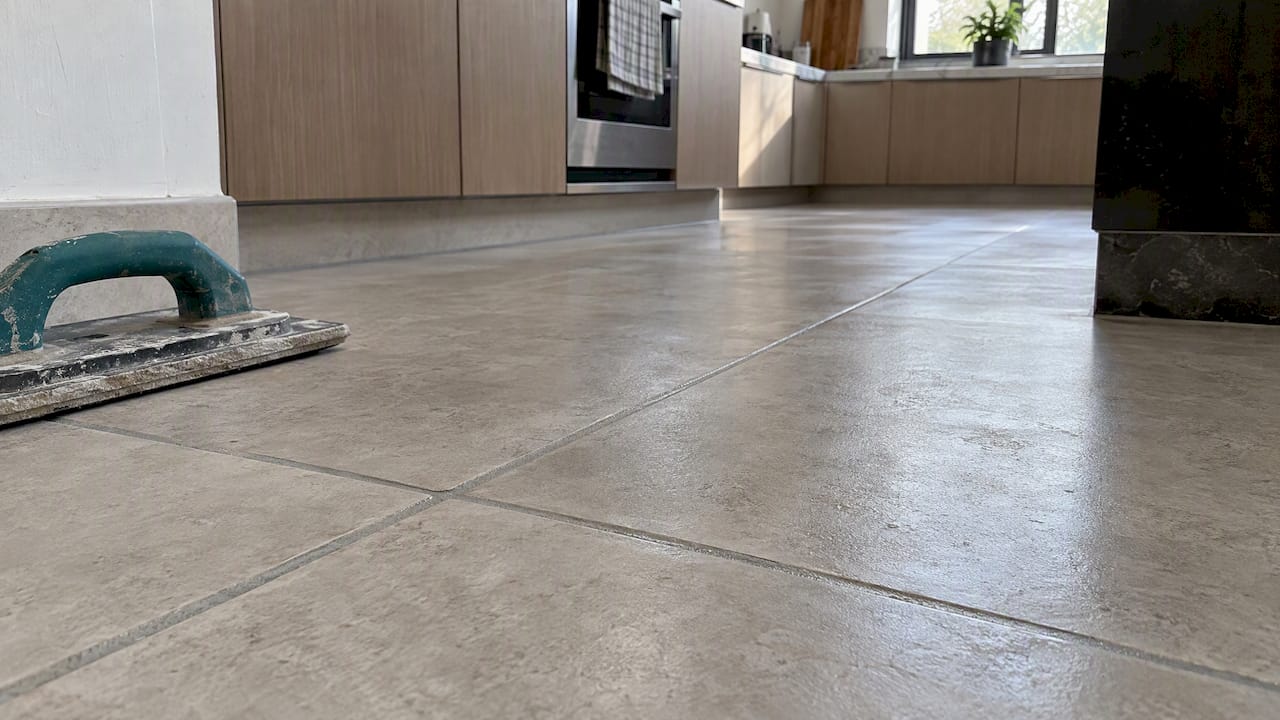

Polished marble is glossy, reflective and dramatic. Honed marble is matte, soft and forgiving. Both come from the same stone and the same grinding process, and the only real difference is where the abrasive work stops. For most villa and apartment floors in Dubai that have heavy foot traffic, bright sun and the occasional wet footprint, honed is the easier finish to live with. Polished is the stronger choice for feature areas where you want depth of colour and veining, and where traffic is light.
This guide explains how each finish is made, how they behave over years of use, and how to decide for a new floor or for one you already own. It also covers a question we hear constantly on site: can a floor be switched from one finish to the other?
TL;DR
- Honing and polishing are stages of one process. Honing stops at a coarser abrasive and gives a matte surface. Polishing continues to finer abrasives and gives gloss.
- Polished marble shows colour and veining at their richest, but it also shows scratches, etch marks and wear sooner.
- Honed marble hides wear and usually gives better grip when wet. It is more open to oils and coloured liquids if spills sit, so sealing and quick wipe-ups matter.
- Neither finish is stain-proof or acid-proof. Both need pH-neutral cleaning, grit control and periodic sealer checks.
- An existing floor can usually be changed from one finish to the other, because the finish is the worked surface of the stone and not a coating.
Table of Contents
- What actually separates honed from polished
- Side-by-side comparison
- Appearance: how each finish looks in a Dubai interior
- Scratches, etching and stains
- Slip resistance and safety
- Cleaning and daily care
- Which finish for which space
- Honing versus polishing as restoration work
- Our perspective
- Getting your marble floor reworked
- FAQ
What actually separates honed from polished
Marble is cut into slabs or tiles and then ground flat with diamond abrasives, starting coarse and moving to finer grits. Each pass removes the scratches left by the one before it, so the surface gets smoother and more reflective with every step.
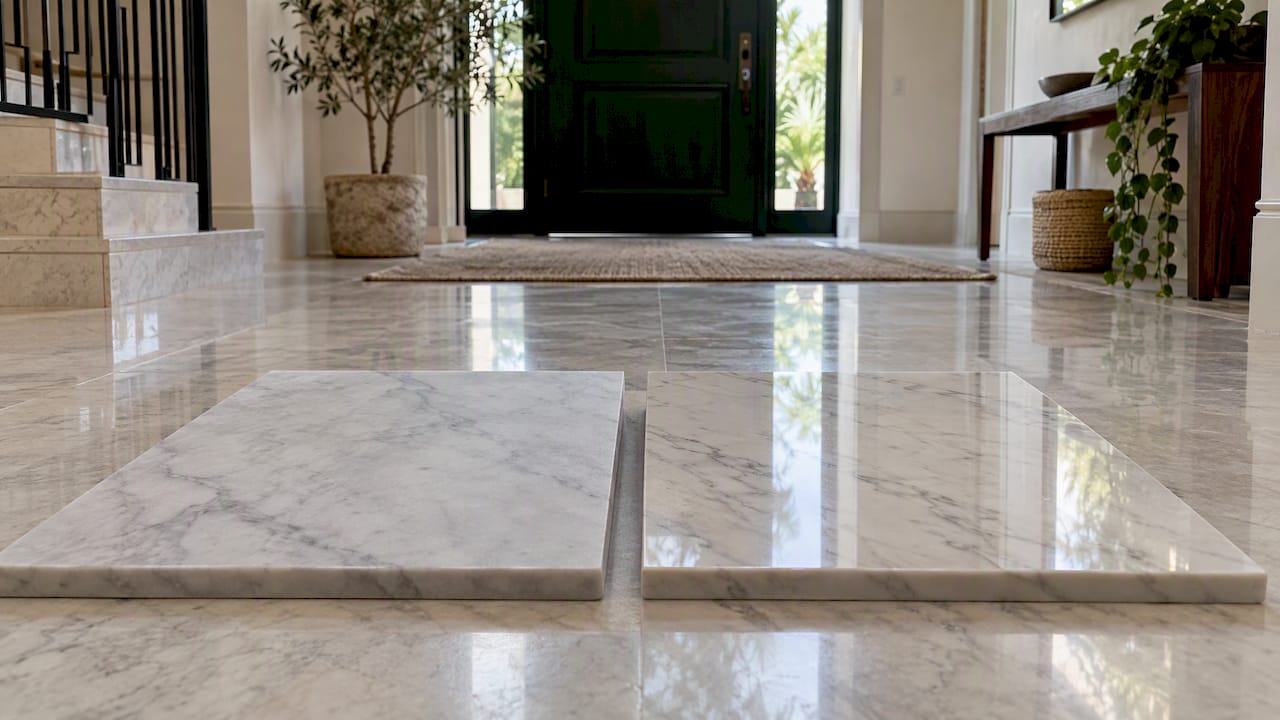
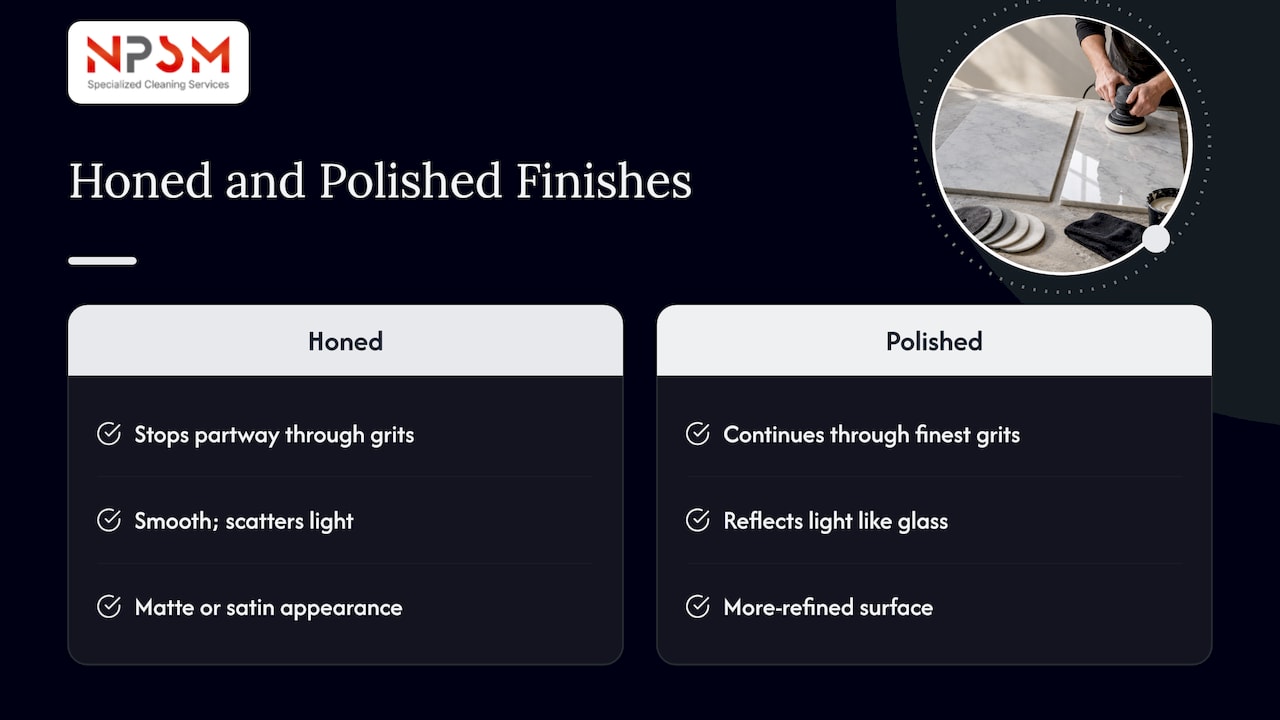
A honed finish stops partway. The stone is smooth to the hand, but its surface still scatters light, so it looks matte or satin. A polished finish keeps going through the finest abrasives until the surface reflects light like glass.
That is why the finish is not a coating or a varnish. Nothing sits on top of the stone. What you see is the stone’s own surface at a different level of refinement, and that is also why a finish can be changed later by working the surface again.
One point confuses many buyers. Marble polishing at a specialist is sometimes done with powders and crystallizing treatments, which is a different method from the diamond stages used to produce the finish at the factory. Whatever the method, the result is judged the same way: how much light the surface reflects and how evenly it does so.
Side-by-side comparison
| Factor | Polished marble | Honed marble |
|---|---|---|
| Look | Glossy, mirror-like, deeper colour | Matte or satin, softer and lighter colour |
| Veining | Sharp and prominent | Gentle and diffused |
| Scratches | Visible as dull lines against the gloss | Blend into the matte surface |
| Etching | Shows as a dull patch, very noticeable | Less conspicuous, blends in |
| Porosity | Lower, so liquids are slower to soak in | Higher, so liquids can soak in faster |
| Wet grip | Can be slippery | Usually better |
| Glare | Reflects sunlight and spotlights | Calm under strong light |
| Best for | Feature walls, entrance halls, low-traffic floors | Busy floors, stairs, bathrooms, family areas |
The table simplifies, and individual stones differ. A dense white stone and a softer, more porous beige one will not behave identically even in the same finish. But as a starting point, the pattern holds across most marbles.
Appearance: how each finish looks in a Dubai interior
Polished marble deepens colour and makes veining stand out. In a large lobby or a double-height villa entrance, that effect is what people mean when they say a floor looks luxurious. The surface also bounces light around the room, which can make a space feel larger and brighter.
Honed marble does the opposite. It diffuses light, so colours look softer and a little paler, and veining recedes. The look suits contemporary interiors, warm timber, plaster walls and the muted palettes many designers favour today. Honed is widely treated as the modern default for residential stone because it feels calm and natural rather than showy.
There is a practical Dubai angle. Many homes here have floor-to-ceiling glazing and strong direct sun for much of the year. A high-gloss floor in front of a large west-facing window can throw glare and show every footprint and smudge in the afternoon light. A honed floor in the same room looks the same at noon and at sunset.
If you cannot decide, look at both finishes in the room where they will go, at the time of day you use it most. A small sample under your own lighting tells you more than any showroom.
Scratches, etching and stains
This is where the two finishes behave most differently, and where most owners’ regrets begin.
Scratches
On polished marble, a scratch is a dull line interrupting a reflective surface, so the eye finds it immediately. The same scratch on honed marble is surrounded by a surface that is already matte, so it barely registers. Furniture dragged across a floor, grit under shoes and pet claws all leave marks, and a honed floor forgives much more of it.
Etching
Marble is made mostly of calcite, which reacts with acids. Lemon juice, wine, vinegar and many bathroom or kitchen cleaners can dissolve a thin layer of the surface and leave a dull mark. This is called etching, and it is a chemical change to the stone, not a stain sitting in it.
On polished marble, an etch looks like a cloudy patch in a mirror. On honed marble, the same etch blends in and is far harder to spot. So honed is not safer from acid; it is simply better at disguising the damage. Our guide to telling an etch from a stain shows how to check which one you are dealing with, because the fix is different.
Staining
Honed marble has more open pores than polished marble, so oils, coffee, tea and coloured liquids can soak in more readily if they are left to sit. Polished marble is denser at the surface and gives you more time to wipe up a spill. That is a genuine advantage for polished in kitchens and dining areas.
Sealing narrows the gap. A good penetrating sealer makes either finish more resistant to staining, but it does not make marble stain-proof, and it does not stop acids etching it. Treat a sealer as extra reaction time, not as armour. If a stain has already set, our page on removing marble water stains walks through safe first steps.
Slip resistance and safety
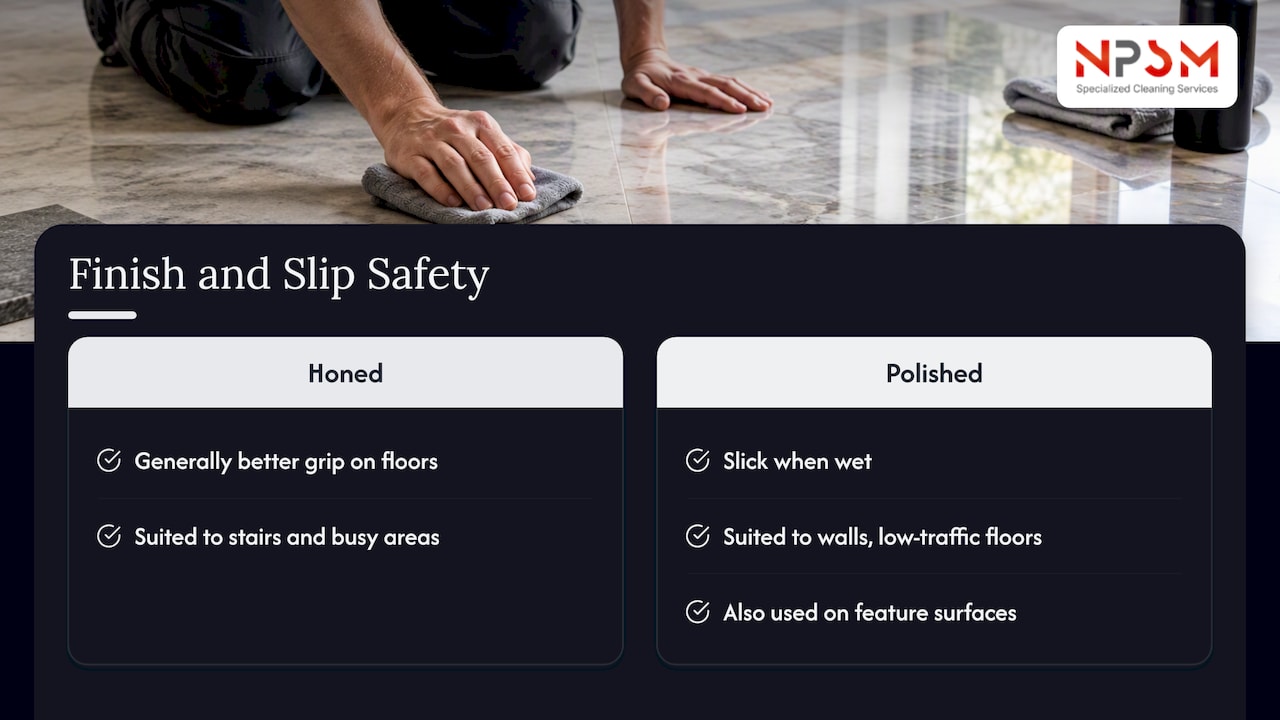
A wet polished floor is slick. Bathrooms, pool-side entrances, terraces that connect to indoor floors, and stairs are the places where that matters most. In the UAE, where people regularly walk in from outdoor areas with damp feet or splashed water, honed finishes generally give better grip on floors, stairs and busy circulation areas. Polished finishes suit walls, low-traffic floors and feature surfaces.
If a polished floor is already installed and you have children, elderly relatives or a hotel-style entrance with heavy traffic, the answer is not always to re-do the whole surface. Entrance mats, quick drying of wet areas and, in some cases, a controlled honing of the highest-risk zones can help. We cover the wider picture in our marble floor safety measures guide.
For commercial spaces, the stakes are higher. A hotel lobby, a mall corridor or a clinic entrance has a duty of care toward the public, and gloss that looks excellent on the day of handover can become a liability once cleaning crews mop it daily. Facility managers should weigh finish choice against the cleaning routine, not only against the design brief.
Cleaning and daily care
The good news is that the care routine is nearly identical for both finishes. The same few habits protect either one.
- Sweep or vacuum first. Sand and grit are the main cause of scratches, and Dubai has plenty of fine dust. Dry-remove it before any wet cleaning.
- Damp-clean with a pH-neutral stone cleaner. Use a product made for natural stone, and follow the label. Test any new product in an inconspicuous spot first.
- Wipe spills and standing water promptly. Do not leave liquids to dry on the surface, and remove leftover water so it does not leave deposits.
- Avoid acids and harsh products. Vinegar, even diluted, and acidic bathroom cleaners can damage both honed and polished marble. Routine use of all-purpose cleaners, degreasers and oil-treated dust mops is best avoided too.
- Check the sealer. There is no universal timetable, because traffic, cleaning frequency and the chemicals used all change how fast it wears. A simple test: put a few drops of water on the floor. If the stone darkens and absorbs them quickly, it is probably time to reseal.
How to clean a honed marble floor specifically
Follow the steps above, but be a little quicker with spills, since honed stone absorbs more readily. Avoid wax-based or gloss-enhancing products, which can leave a patchy sheen on a matte surface. Use a soft mop and clean water for rinsing, and dry the floor if it has been very wet. If the floor develops uneven shine in walkways, that is usually wear and residue, not a failure of the finish, and it can be corrected professionally.
Which finish for which space
There is no single right answer, but there are sensible defaults.
| Space | Better default | Why |
|---|---|---|
| Villa living areas and family rooms | Honed | Hides daily wear and glare |
| Grand entrance hall or foyer | Polished, with mats | Maximum visual impact, controlled traffic |
| Kitchens | Honed, well sealed | Hides etching from food acids; seal against oils |
| Bathrooms and wet rooms | Honed | Better grip when wet |
| Staircases | Honed | Safer underfoot |
| Feature walls, vanity fronts | Polished | Colour and veining shown at their best, little wear |
| Hotel lobbies and corridors | Depends on traffic and cleaning regime | Weigh slip risk and maintenance cost |
| Offices and retail | Honed or a low-sheen polish | Practical for constant footfall |
Two cautions. First, kitchens and bars tempt owners toward polished because it wipes clean easily, but the sheen makes acid etching obvious. Second, a floor that runs continuously through several rooms is best kept to one finish, since changes in sheen at doorways can look like a mistake.
Honing versus polishing as restoration work
This is the part many articles skip, and it matters most if you already own a marble floor.
Because the finish is the worked surface of the stone, it can be reworked. A floor that has dulled, etched or scratched can be ground back through the abrasive stages and finished at whichever level you want. That gives you three realistic routes:
- Repolish. The floor was polished originally and has lost its shine. The stone is ground through the stages again until the gloss returns, which also removes light etching and scratches.
- Rehone. The floor is taken to a matte finish. This is a common choice when a polished floor shows too much wear or feels too slippery, and when owners simply prefer the softer look.
- Switch finishes. Moving from honed to polished is possible too, by continuing through the finer stages. Owners sometimes do this in a formal reception area while keeping honed elsewhere.
The condition of the floor decides how much work is needed. Light dullness and fine scratches need only the finer stages. Deep etching, lippage between tiles or heavy stains mean coarser grinding first, and that removes a thin layer of stone. Marble is not unlimited, so repeated aggressive grinding over decades is something to avoid. A good contractor will start with the least invasive step that achieves the result.
Polishing frequency is the other common question. There is no fixed number of times a floor can be polished or a fixed interval. It depends on stone thickness, traffic and care. A well-maintained residential floor may need a refresh only when it visibly dulls, while a hotel entrance will need it far more often. For the practical steps and what to expect from a visit, see our complete guide to polishing marble floors in Dubai.
One more benefit of restoring rather than replacing: you keep the original stone, its veining and the continuity of the floor, and you avoid demolition, dust and the waiting time that comes with new material.
Our perspective
After working on marble in villas, apartments, hotels and offices across Dubai, we see the same pattern. Owners choose polished because the showroom sample looked stunning, then call us a year or two later because the traffic lane through the hall has gone dull and every chair leg has left a mark. The stone was never the problem. The finish was wrong for the way the room is used.
Our advice is to choose the finish for the room’s daily life first and its photograph second. Honed suits most family spaces, wet areas and stairs. Polished earns its place where light traffic and a strong visual statement go together. Whichever you pick, spend as much attention on cleaning habits as on the finish itself: a pH-neutral cleaner, a doormat and a quick wipe-up will do more than any treatment.
And if your floor is already installed and you are unhappy, it is rarely a replacement case. Marble can usually be taken back to a different finish. We would rather show you that on a test area than have you spend on new stone.
— Qadir
Getting your marble floor reworked
If your floor needs to be repolished, rehoned or switched to the other finish, our team handles marble polishing, buffing, stain removal, full restoration, staircases and countertops for homes and commercial properties across Dubai. Marble polishing and restoration starts from AED 30 per sqm, and the final figure depends on the condition of the stone, the finish you want and the area. You can see the full scope on our marble polishing and restoration services page, and our guide to marble polishing cost in Dubai explains what moves a quote up or down.
FAQ
Is honed marble cheaper than polished marble?
As new material, honed is often priced similarly or slightly lower, because it skips the final polishing stages, though prices vary by stone and supplier. For an existing floor, the cost depends more on its condition and the area than on the target finish. Ask for a site assessment before comparing quotes.
Can I change polished marble to honed, or honed to polished?
Yes, in most cases. The finish is the worked surface of the stone, not a coating, so it can be ground back to a matte level or taken further to a gloss. The existing condition, tile levelness and stone thickness decide how much work is needed.
Which finish is better for a marble floor in a busy home?
Honed is usually the better choice. It hides scratches, etching and foot traffic marks, and it generally gives better grip on wet feet. Polished can work in low-traffic rooms where you want the most striking look.
Does honed marble stain more easily?
It can, because honed stone has more open pores, so oils and coloured liquids soak in faster if left to sit. Sealing the floor and wiping spills quickly reduces the risk a great deal. Sealing improves stain resistance but does not make marble stain-proof or immune to acid etching.
How do I clean a honed marble floor?
Sweep or vacuum to remove grit, then damp-clean with a pH-neutral cleaner made for natural stone. Avoid vinegar, acidic bathroom cleaners, abrasive products and oil-treated dust mops, and remove standing water promptly. If water drops soak in quickly, the floor may need resealing.