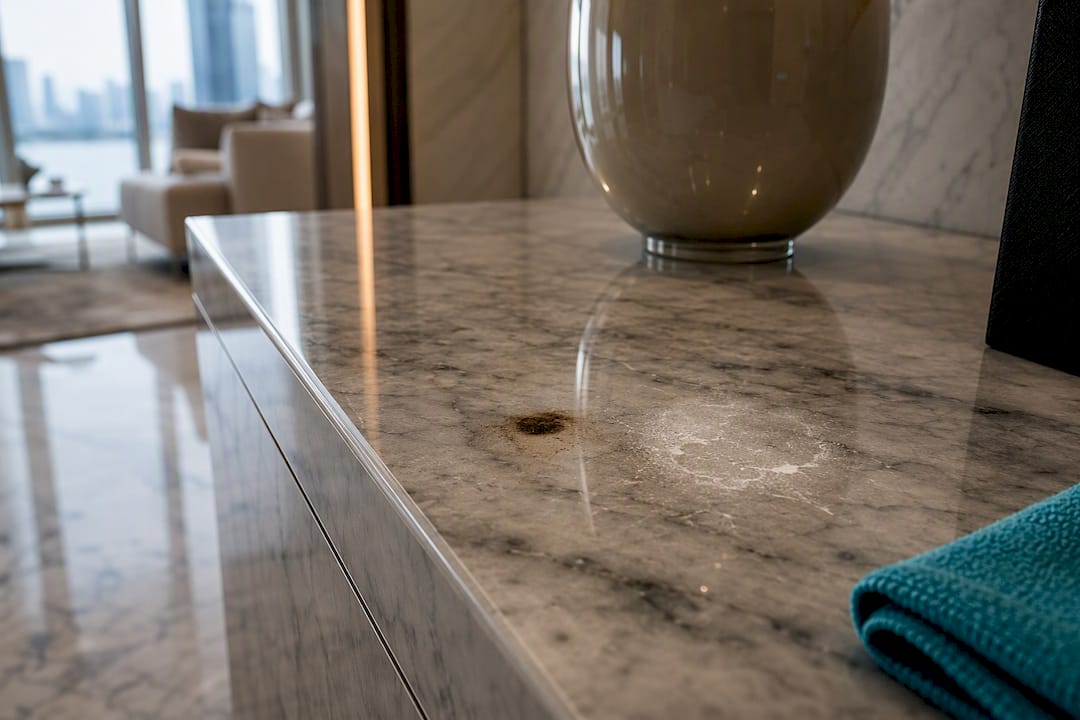

If a mark is darker than the surrounding stone, it’s almost always a stain. If it’s dull, lighter, or slightly rough under your fingertip, that’s an etch. Blot any fresh spill immediately, rinse with plain water, skip the vinegar or lemon juice, and run the quick diagnostic checklist below before you touch a cleaner or a polishing pad.
TL;DR:
- Most etching results from acidic spills like citrus or wine, and it creates dull, cloudy patches that cannot be polished out easily.
- Stains penetrate the marble’s pores and need a poultice with the correct chemistries, such as hydrogen peroxide for organic stains or acetone for oily stains, to be effectively removed.
- DIY repairs are suitable for small, shallow etches and minor stains, but larger or textured damage requires professional honing, grinding, or polishing.
- Sealers only prevent staining and do not stop etching, so immediate blotting of spills and avoiding acids helps extend the marble’s surface life.
- When stains or etching cover a large area or do not respond to DIY treatment after several attempts, professional diagnosis and restoration are recommended.
Table of Contents
- What Is Marble Etching and What Causes It?
- What Is Marble Staining and What Types Exist?
- How Do You Tell the Difference in Under a Minute?
- How Do You Fix Marble Stains Safely?
- How Do You Fix Marble Etching?
- How Do You Prevent Marble Etching and Staining?
- When Should You Call a Professional Stone Restorer?
- What I’ve Learned About DIY Versus Calling a Pro
- Get a professional marble inspection
- Sources for Diagnosis and Treatment Guidance
- FAQ
What Is Marble Etching and What Causes It?
Etching happens when an acid reacts with the calcium carbonate that makes up marble, dissolving a microscopic layer of the polished surface. The reaction doesn’t add color. It changes the finish itself, which is why an etch reads as a dull or cloudy patch even under bright light, and why it can feel matte or faintly gritty compared to the surrounding stone. The Natural Stone Institute points out that some substances etch and stain at the same time, which is exactly why a quick visual check isn’t always enough on its own.
Common household culprits move fast, usually within seconds of contact:
- Citrus juice, wine, and vinegar
- Tomato sauce and salad dressing
- Many bathroom and glass cleaners
- Rust removers containing hydrofluoric acid traces
Cleaning an etch does nothing, because there’s no material to lift out. The stone’s surface chemistry has already changed, and fixing it means resurfacing, not scrubbing.
What Is Marble Staining and What Types Exist?
Staining works the opposite way. Instead of altering the surface, the liquid or material soaks into the stone’s natural pores and sits there, usually darkening the marble or leaving a visible tint. Marble is porous enough that a spill left overnight can travel further into the stone than most homeowners expect.
Stains generally fall into a handful of categories:
- Oil and grease from cooking, lotions, or cosmetics
- Organic stains from coffee, tea, wine, or fruit juice
- Metal and rust stains from planters, cans, or old pipe fittings
- Ink stains from pens or markers
- Biological stains from mold, algae, or organic debris outdoors
Because the discoloring material is physically inside the stone, a surface wipe rarely fixes it. Removing a stain means pulling the substance back out, which is where a poultice earns its reputation as the go-to fix for anything absorbed rather than reacted.
How Do You Tell the Difference in Under a Minute?
Grab a flashlight or angle a lamp across the mark. Here’s the fastest way to sort it out:
- Check reflection first. Shine light across the spot at a low angle. A dull, cloudy, or hazy patch that breaks up the reflection is an etch. If the shine looks normal but the area is darker or discolored, you’re looking at a stain.
- Run a fingertip test. Etches often feel slightly rough or matte compared to the surrounding polish. Stains usually feel identical to the rest of the surface, since the finish itself hasn’t changed.
- Think about what happened. Recall recent events. A citrus spill, a splash of wine that sat too long, or an abrasive cleaner points to etching. Cooking oil, a dropped coffee mug, or a metal object left on the counter points to staining.
- Consider both possibilities. Wine and coffee are notorious for doing both: staining the pores and etching the surface in the same spill.
Pro Tip: When a spill could have done both, always treat the stain first. Pulling out the discoloration before you touch a polishing pad keeps you from buffing color deeper into the stone.
How Do You Fix Marble Stains Safely?
Start by matching your treatment to the type of stain. Oil, organic material, rust, and ink each respond to different chemistry, and using the wrong one wastes a cycle or, worse, sets the stain deeper.
- Identify the stain type by color and context. Yellowish and greasy points to oil. Brownish with a coffee or wine history points to organic. Orange or reddish-brown near metal points to rust.
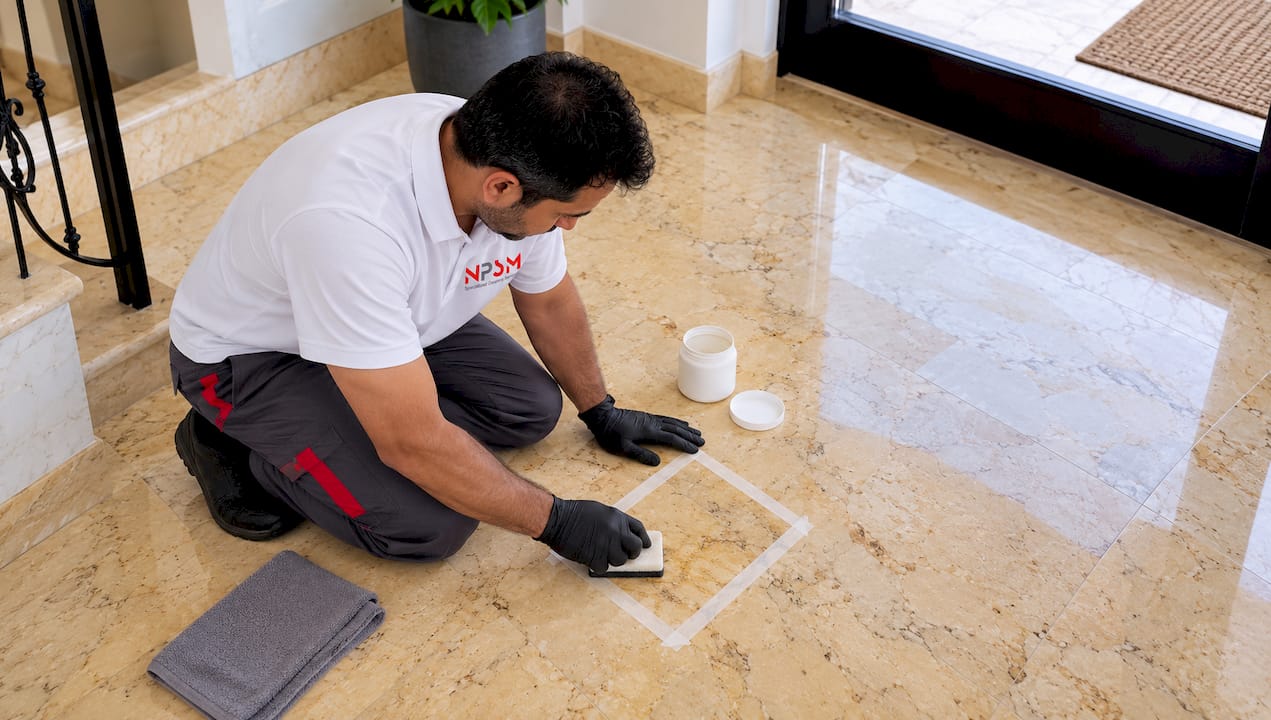
- Build a poultice. Mix an absorbent powder (whiting, diatomaceous earth, or talc) with the appropriate liquid until it forms a paste roughly the texture of peanut butter. For organic stains, hydrogen peroxide is the standard choice. For oil-based marks, acetone or mineral spirits works better.
- Apply and cover. Spread the paste about a quarter to a half inch thick over the stain, extending slightly past the edges. Cover with plastic wrap and tape down the perimeter to slow evaporation.
- Let it dry completely. This is the part most people rush. The poultice pulls the stain out as it dries, not simply by sitting in contact with it, so 24 to 48 hours is standard, and cutting that short is the single most common reason a poultice “doesn’t work.”
- Remove, inspect, repeat. Scrape off the dried paste, rinse the area, and check the result. Deep or old stains often need two or three cycles before the color fully lifts.
Never reach for vinegar, lemon juice, or off-the-shelf rust removers not formulated for stone. Rust removers built for other surfaces frequently contain acids strong enough to etch the marble while they’re trying to pull the stain, trading one problem for two. If a rust or metal stain shows no improvement after two or three careful poultice cycles, that’s a sign it may involve metal salts that have bonded deeper into the stone, a job better suited to controlled gel and chelating treatments than another round of DIY paste.
How Do You Fix Marble Etching?
Small, shallow etches are often fixable at home with marble polishing powder, a damp cloth, and a lot of patience. Work the powder into the etched area in small circular motions, using a felt or burlap pad on a low-speed buffer if you have one, and always test in a hidden corner first to make sure the powder matches your marble’s finish.
- Apply light, even pressure. Marble polishing corrects a shallow finish change, not a gouge.
- Wipe away residue and check the reflection under angled light after every few passes.
- Stop as soon as the sheen matches the surrounding stone.
Overzealous buffing is the mistake that turns a small etch into a bigger problem. Grinding too aggressively can thin the polished layer unevenly, leaving a slightly different sheen that’s more noticeable than the original mark. Wider etching, textured damage, or dulling across a large area is a job for professional honing and diamond polishing, which restores a uniform finish across the whole surface rather than one patch at a time. If a single spill left both a stain and an etch, always extract the stain with a poultice first. Polishing over an active stain only buffs the discoloration further into the stone.
Pro Tip: If you can’t tell whether polishing powder actually fixed the etch or just made it less obvious under one specific light angle, check it again at a different time of day. Etches that still show under raking afternoon light usually need a professional hone.
How Do You Prevent Marble Etching and Staining?
Daily habits do more to protect marble than any product. Blot spills the moment they happen rather than wiping, since wiping can spread acid or oil across a wider area. Use a neutral stone cleaner or a mild dishwashing detergent for regular cleaning, and dust-mop often to clear away the grit that scratches polish underfoot.
- Keep vinegar, lemon-based sprays, and abrasive powders away from marble entirely
- Avoid rust removers unless they’re specifically labeled safe for natural stone
- Reseal with a penetrating impregnator on the schedule your installer recommends
- Place mats at entrances and under planters or metal decor
Sealers deserve a fair expectation check here. An impregnating sealer makes marble more resistant to staining by slowing how fast liquids soak into the pores, buying you time to blot a spill before it sets. It does nothing to stop etching, because etching is a chemical reaction with the stone surface itself, not an absorption problem. Property managers running multiple units get the most value from a simple response protocol: mats at every entry, a written spill checklist near kitchens and bars, and staff trained to blot first and ask questions later.
When Should You Call a Professional Stone Restorer?
Call a professional when etching covers a large area, when the texture has visibly changed, when a stain involves metal or rust that hasn’t budged after repeated poultice cycles, or when there’s real risk of damaging the stone further with DIY chemicals.
- On-site diagnosis to confirm etch versus stain versus both
- Targeted poulticing for stubborn or deep-set stains
- Controlled honing and grinding to level texture damage
- Diamond polishing to restore uniform reflection across the whole surface
- Impregnating sealer application to protect the finish going forward
What I’ve Learned About DIY Versus Calling a Pro
My rule of thumb: try the poultice, always. It’s cheap, low risk, and reversible. Where I’d stop and call someone is texture change you can feel with your hand, or a stain that hasn’t moved after two honest attempts. Weigh the cost of a professional visit against the cost of an antique table or a lobby floor you can’t easily replace.
— Qadir
Get a professional marble inspection
If the poultice hasn’t pulled a stain after a couple of honest attempts, or an etch covers more than a small patch, that’s the point where DIY stops being worth the risk. NPSM Specialized Cleaning Services LLC runs marble stain removal, polishing, and full restoration services across Dubai and the UAE, using diamond polishing systems and industry-approved methods matched to the property’s climate and traffic level instead of a one-size-fits-all approach.
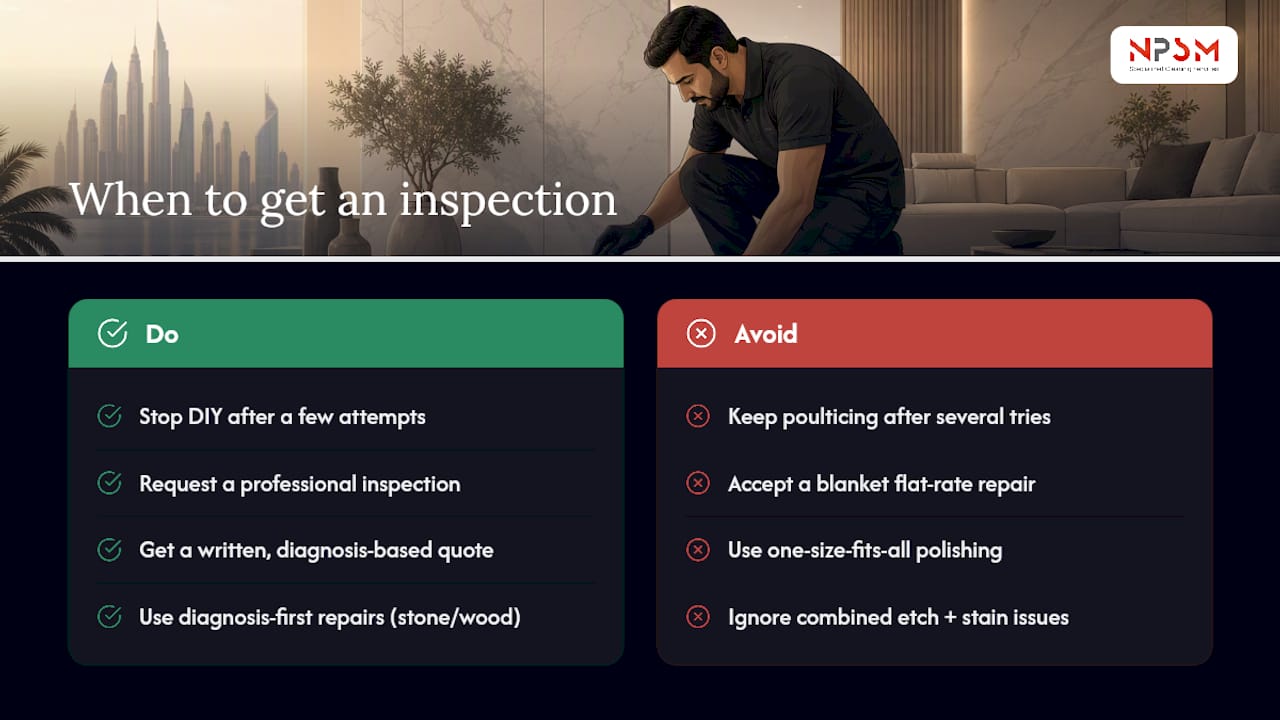
An inspection identifies exactly what you’re dealing with, whether it’s a straightforward stain, a surface etch, or both, and the quote reflects the actual repair needed rather than a blanket rate. If your floor is stone, wood, or natural stone in general, the same diagnosis-first approach applies. Request an inspection or a written quote through Floorpolishing and get a straight answer on what it will take to bring your marble back to a uniform finish.
Sources for Diagnosis and Treatment Guidance
- Natural Stone Institute stain identification and removal procedures
- Practical consumer cleaning guidance for marble surfaces
FAQ
Can Marble Etching Be Fixed?
Minor etches often respond to marble polishing powder and gentle buffing with a felt pad, restoring most of the shine. Larger or textured etching usually needs professional honing and diamond polishing to bring back a uniform finish across the whole surface.
What Does Etching on Marble Look Like?
An etch typically shows up as a dull, cloudy, or lighter patch that breaks up the reflection compared to the surrounding polish. It can also feel matte or slightly rough to the touch, unlike a stain, which usually feels the same as the rest of the stone.
Can Stained Marble Be Fixed?
Most stains can be pulled out with a poultice matched to the stain type, whether that’s hydrogen peroxide for organic marks or acetone for oily ones, left to dry fully for 24 to 48 hours. Deep or older stains often need two or three repeat cycles before the color fully lifts.
How Do You Stop Marble From Etching?
You can’t fully stop etching since it’s a chemical reaction between acid and the stone, but you can drastically reduce the risk. Blot spills immediately, use only neutral stone cleaners, and keep citrus, vinegar, and acidic products off the surface entirely; a penetrating sealer helps with stains but does not prevent etching itself.