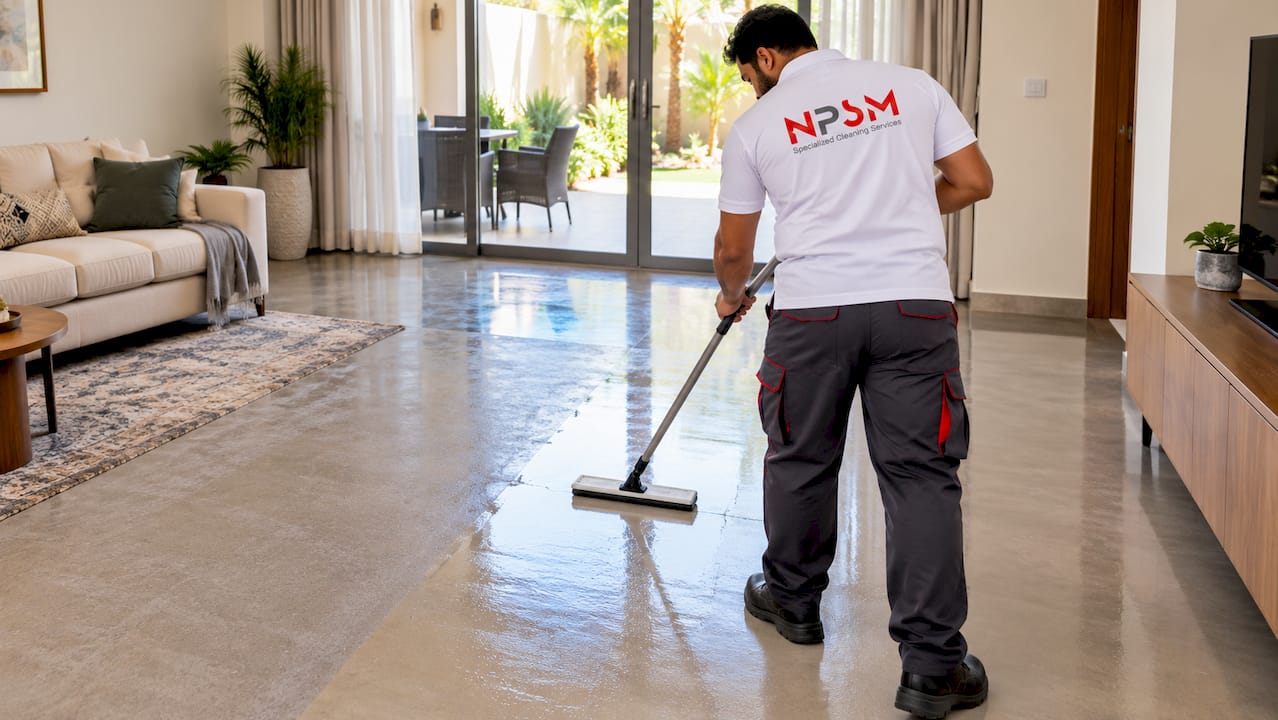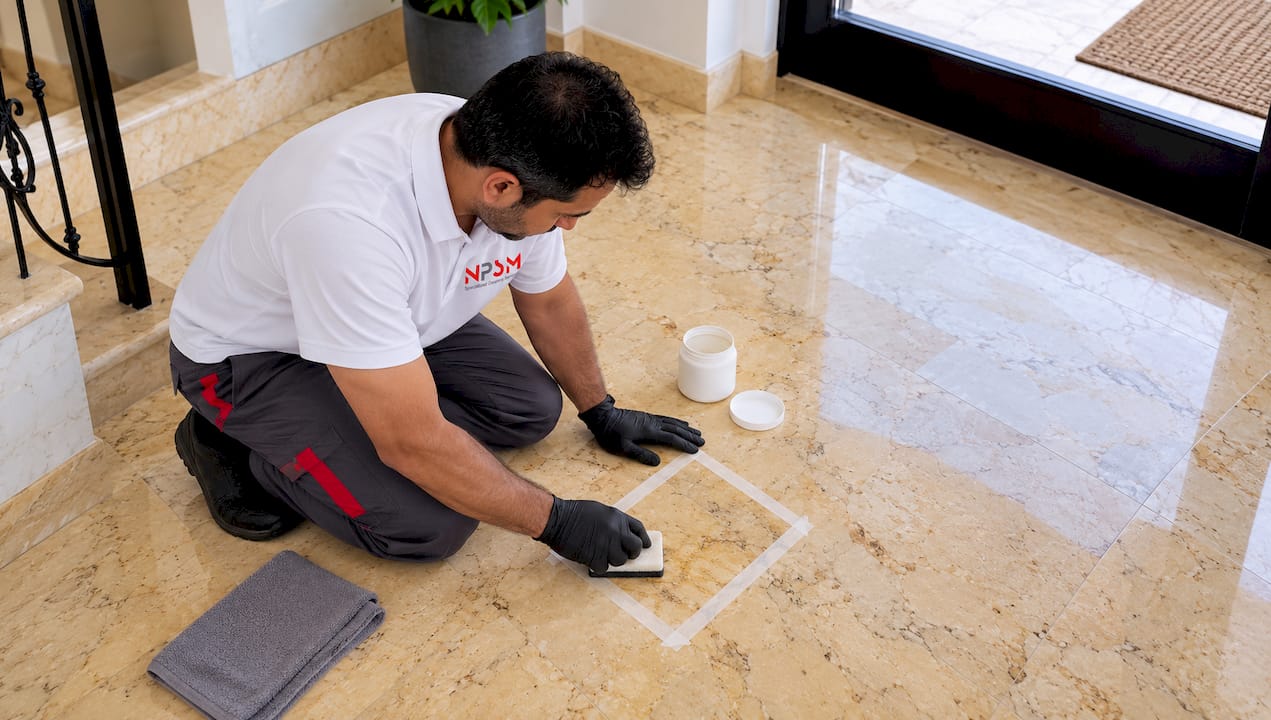

Keep terrazzo stain-free with five habits done consistently: entrance matting to stop grit at the door, daily dust-mopping, neutral-pH damp mopping, spills wiped up within minutes, and a sealing plan matched to your floor type. Guidance from the National Terrazzo & Mosaic Association and manufacturer operations manuals (including Strongcoat) backs all five, and the same priorities guide expert terrazzo restoration work.
TL;DR:
Proper sealing choices depend on whether the terrazzo is cement-based or epoxy, with cement floors benefiting from densifiers and epoxy from topcoats.
High-traffic zones require more frequent inspection and resealing, typically every 12 to 18 months for heavily used areas.
Immediate spill response with blotting and neutral cleaning prevents stains from becoming permanent, especially in moisture-prone environments.
Daily dust-mopping and the use of walk-off mats significantly reduce grit buildup and micro-scratching, extending sealer life.
Avoid acidic, high-alkali, or abrasive cleaners, as they damage terrazzo and its sealer films, requiring careful product testing before use.
Table of Contents
-
Sealing and protective finishes: film-forming versus penetrating
-
Cement-based versus epoxy terrazzo: why the matrix changes your stain risk
Quick prevention checklist for today
Post this near the cleaning closet or hand it to your janitorial contractor:
-
Install walk-off mats at every entrance, long enough for at least two full strides, and vacuum or shake them out daily.
-
Dust-mop the entire floor once a day, more often in lobbies and corridors, using a treated microfiber mop that traps grit instead of pushing it around.
-
Damp-mop on a set schedule with a neutral-pH cleaner diluted exactly as labeled, never left to sit and dry into a haze.
-
Treat every spill the same way: blot first, dilute with water, clean with a neutral product, and escalate only if a stain remains after drying.
-
Add felt pads under furniture legs and wipe cart or chair wheels before they roll across the floor, since grit on wheels scratches as fast as grit on shoes.
Each step is cheap. Skipping any one of them shortens the life of whatever sealer sits on top.
Daily cleaning technique and products to avoid
Dry cleaning comes first, every time. Dust-mopping and vacuuming pull up the sand and grit that would otherwise grind into the surface under foot traffic, and that grit is the single biggest cause of dulling and micro-scratching in terrazzo. Do this at least once daily in normal traffic, twice in lobbies or building entrances.
Damp cleaning follows a simple pattern: a neutral-pH cleaner, diluted to the manufacturer’s ratio, applied with enough dwell time to lift soil, then rinsed and picked up before it dries on the surface. Auto-scrubbers work well for large open areas but need a soft pad, never a scrub brush rated for stripping.
Several common household products do real damage to terrazzo and its sealer:
-
Vinegar and other acidic cleaners etch the calcium-based aggregate in cement terrazzo.
-
Bleach and ammonia can discolor grout lines and break down some sealer films.
-
High-alkali strippers and abrasive powders dull the polish and open up pores.
-
Scrub pads rated above a light duty mark leave fine scratches that trap future stains.
Test any new cleaning product in a closet or storage area first, and give it a full day before judging the result.
Sealing and protective finishes: film-forming versus penetrating
Two main strategies protect terrazzo, and they work differently enough that picking the wrong one for your traffic pattern creates ongoing headaches. Film-forming sealers sit on top of the surface as a sacrificial layer. They are easy to strip and reapply when scratched or stained, which makes them a practical choice for retail lobbies and other spaces where fast cosmetic recovery matters more than permanence.
Penetrating densifiers work the opposite way: they soak into the terrazzo and chemically reduce porosity from within, rather than coating it. The effect is permanent and doesn’t wear off underfoot, but repair after damage means re-honing the surface, not just recoating it. Densifiers suit cement-based terrazzo well; epoxy terrazzo is already far less porous, so densifiers often add little benefit there and some epoxy matrices respond poorly to them.
A few practical notes for heavy-traffic commercial floors:
-
Film-forming finishes need more frequent maintenance coats in corridors and entrances.
-
Densified floors hold their polish longer between professional visits but cost more upfront to prepare correctly.
-
Either approach can affect slip resistance, so check the coefficient of friction rating before applying in wet-prone areas like lobbies near exterior doors.
Pro Tip: Match the sealer to the terrazzo matrix before you match it to the budget. Applying the wrong system is more expensive to fix than choosing correctly the first time.
Spill response and stain removal workflow
Most stains become permanent because of delay, not because the spill itself was unusually aggressive. A fast, consistent response limits damage regardless of what was spilled.
-
Blot the spill immediately. Never wipe, since wiping spreads the liquid across more surface area.
-
Dilute with clean water, then clean with a neutral-pH product and dry the area completely.
-
For coffee, tea, or soft drinks, repeat the neutral cleaning and check again after full drying before escalating.
-
For oil and grease, use an absorbent poultice rather than a liquid cleaner, since liquids can push oil deeper into porous terrazzo.
-
For ink, marker, or rust, a small amount of denatured alcohol on a cloth works for ink and marker; rust typically needs a dedicated rust-removal poultice.
-
For paint, scrape gently once dry, then poultice; never use a metal blade directly on the polished surface.
Trapping dirt and moisture at entrances significantly reduces how often a floor needs this kind of intervention in the first place, since less grit and fewer tracked-in contaminants reach the open floor at all.
If a stain persists after a poultice treatment, it has likely penetrated past the point a surface clean can reach, and the fix becomes a mechanical repolish or a chemical strip and reseal.
Inspection checklist and maintenance schedule
Inspection frequency should track traffic volume. Lightly used areas can go up to several years between detailed condition checks, medium-traffic corridors and offices need more frequent inspection, and heavy-traffic lobbies, retail floors, or hospital corridors require the most regular inspections.
What to check and log at each inspection:
-
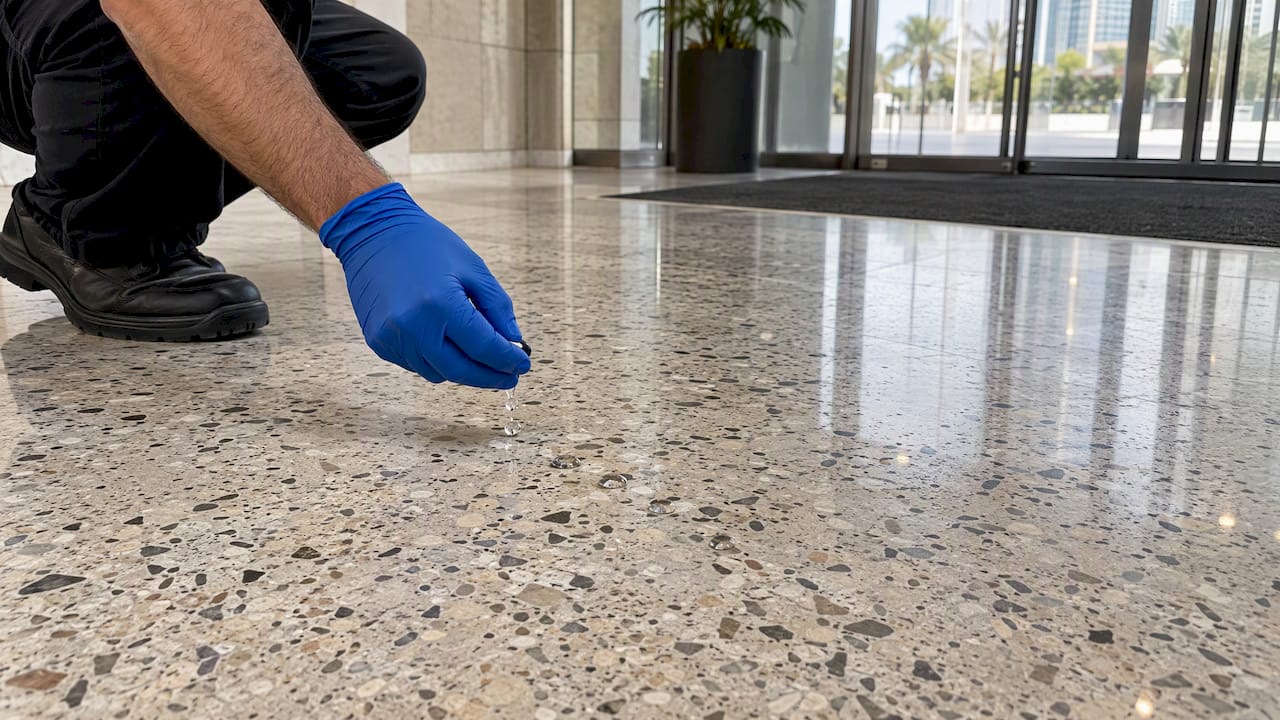
Water-spot or darkening test: a few drops of water on the surface for five minutes reveal whether the sealer is still repelling moisture or has worn through.
-
Visible dulling or a matte haze across traffic lanes, a sign the topical finish is thinning.
-
Grout line condition and any hairline cracking at aggregate edges.
-
Date of last reseal or repolish, product used, and any problem areas noted for the next visit.
Before resealing or recoating a full floor, test the product on a small, inconspicuous section and let it cure fully to confirm compatibility and appearance.
When to call a professional restoration team
Daily maintenance and sealing handle most prevention, but some conditions are past what in-house cleaning can fix. Deep or widespread staining, a haze that won’t buff out, cracked or pitted aggregate, or sealer failure across large areas all call for a professional visit rather than another round of spot cleaning.
A professional job typically includes:
-
Diamond honing to remove scratches and open the surface evenly before resealing.
-
Densification for cement terrazzo where permanent pore reduction is the goal.
-
Full repolish and a sealer system matched to the terrazzo type and traffic load.
-
A curing period before the floor returns to normal foot traffic, which varies by product.
Diamond polishing systems and sealer application equipment are used to restore terrazzo floors, and a site visit is the fastest way to find out whether your floor needs a light refresh or a full repolish.
Cement-based versus epoxy terrazzo: why the matrix changes your stain risk
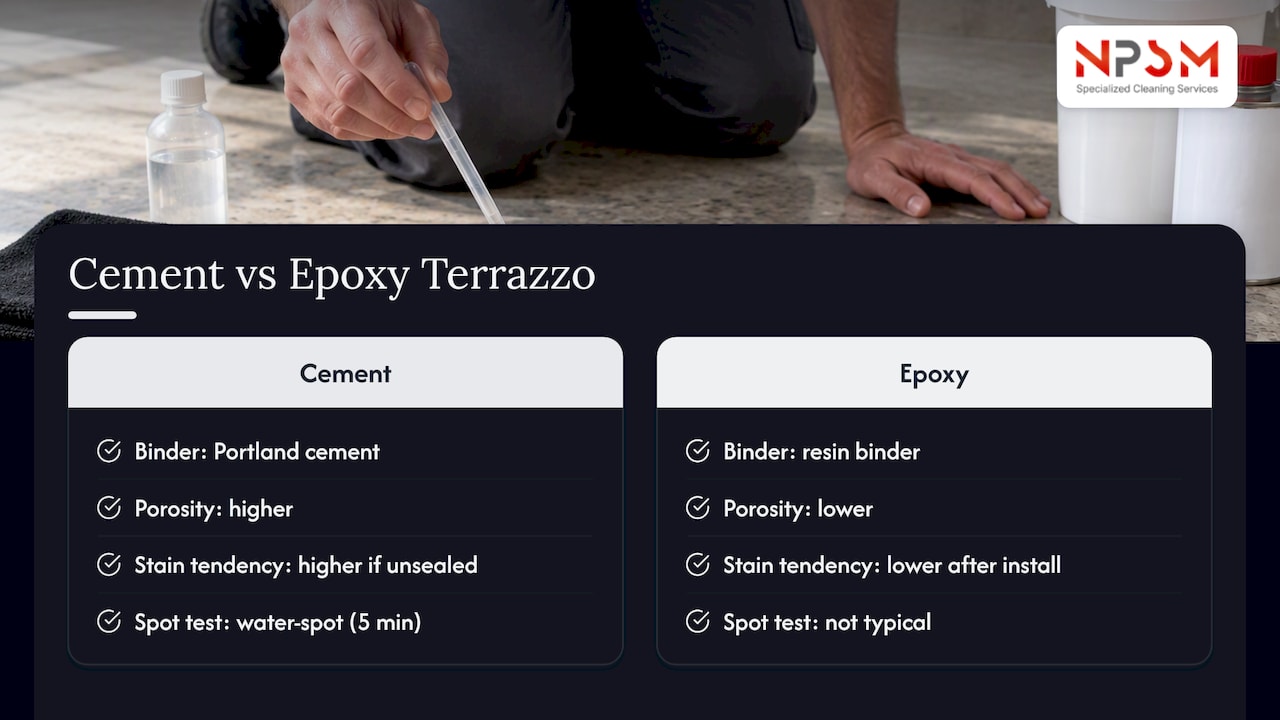
The binder holding the aggregate together determines how a terrazzo floor handles spills, and the two common types behave quite differently. Cement-based terrazzo uses a Portland cement matrix that is naturally more porous, which means liquids can soak in faster if the surface isn’t properly sealed. A water-spot test, a few drops left for five minutes, shows whether a cement terrazzo floor darkens, a clear sign it needs sealing or resealing.
Epoxy terrazzo uses a resin binder that is inherently tighter and less porous, so it resists staining better right out of the install. That lower porosity also means epoxy terrazzo usually needs less penetrating protection. A densifier that works well on cement terrazzo can be a poor match for an epoxy floor, and some epoxy resin binders are also sensitive to prolonged steam cleaning or high heat, since excess moisture and temperature can affect the resin over time.
Practically, this means your maintenance plan should start with identifying which type of terrazzo you have. Cement terrazzo benefits most from a densifying strategy or a well-maintained topical sealer. Epoxy terrazzo leans more on cleaning discipline and a compatible sealer or finish rather than deep penetration treatments. Mixing up the two approaches wastes money and, in the case of densifiers on certain epoxy matrices, can even cause a poor reaction. Always check the manufacturer’s technical data sheet for your specific terrazzo system before choosing a product.
Environmental and usage factors that raise stain risk
Not every terrazzo floor faces the same exposure, and the conditions around a floor matter as much as the floor itself. High-traffic zones such as building entrances, retail aisles, and hospital corridors accumulate grit faster, and that grit works like sandpaper under shoes, opening tiny scratches that become entry points for liquids and soil.
Moisture-prone areas carry a different kind of risk. Terrazzo shower floors, kitchens, and spaces near exterior doors see more standing water and humidity, which accelerates wear on a sealer film and gives cement-based terrazzo more opportunity to absorb moisture before it evaporates. Areas exposed to oil, grease, or food spills, such as restaurant kitchens or cafeterias, need a maintenance routine tuned to those specific contaminants rather than a generic office cleaning schedule.
Climate plays a role too, particularly in environments with high ambient humidity or frequent temperature swings near entrances, where condensation can sit on the floor longer than it would in a drier interior space. Buildings with heavy seasonal foot traffic, like retail stores during holiday periods, may need to shift from a medium-traffic inspection schedule to a heavy-traffic one temporarily.
Matching your prevention routine to these conditions, rather than applying one standard schedule across an entire building, keeps high-risk zones from becoming the areas that force an early, expensive restoration.
Preventive coatings and treatments built to repel stains
Beyond the basic film-forming sealer, several treatments exist specifically to improve stain resistance on terrazzo, and knowing the difference helps you choose the right one. STONETECH BulletProof Sealer, for example, is designed for honed terrazzo to resist both water- and oil-borne stains, and its application calls for a clean, dry substrate, controlled temperature during application, and a second coat after proper drying time for full coverage.
Penetrating densifiers, covered earlier as a porosity strategy, double as a preventive treatment since reduced porosity means fewer places for staining agents to penetrate in the first place. For floors needing an extra layer of protection in food service or lab environments, some penetrating stain-repellent treatments are applied as an additional step after densification rather than as a replacement for it.
Application methods matter as much as the product. Most penetrating and film-forming treatments require the substrate to be clean, fully dry, and free of old sealer residue before application, and manufacturers typically specify a minimum cure or dwell time before the floor can be walked on or exposed to moisture. Skipping surface prep is one of the most common reasons a new sealer fails early, showing patchy absorption or peeling within months rather than years. Following the manufacturer’s technical data sheet for prep, dwell time, and reseal intervals protects the investment far more reliably than choosing a premium product and rushing the application.
How terrazzo porosity drives stain prevention strategy
Porosity is the underlying reason terrazzo needs any sealing strategy at all. Both cement and epoxy terrazzo contain tiny surface voids between the aggregate and the binder, and the size and number of those voids determine how fast a spill can work its way below the surface where routine cleaning can’t reach it.
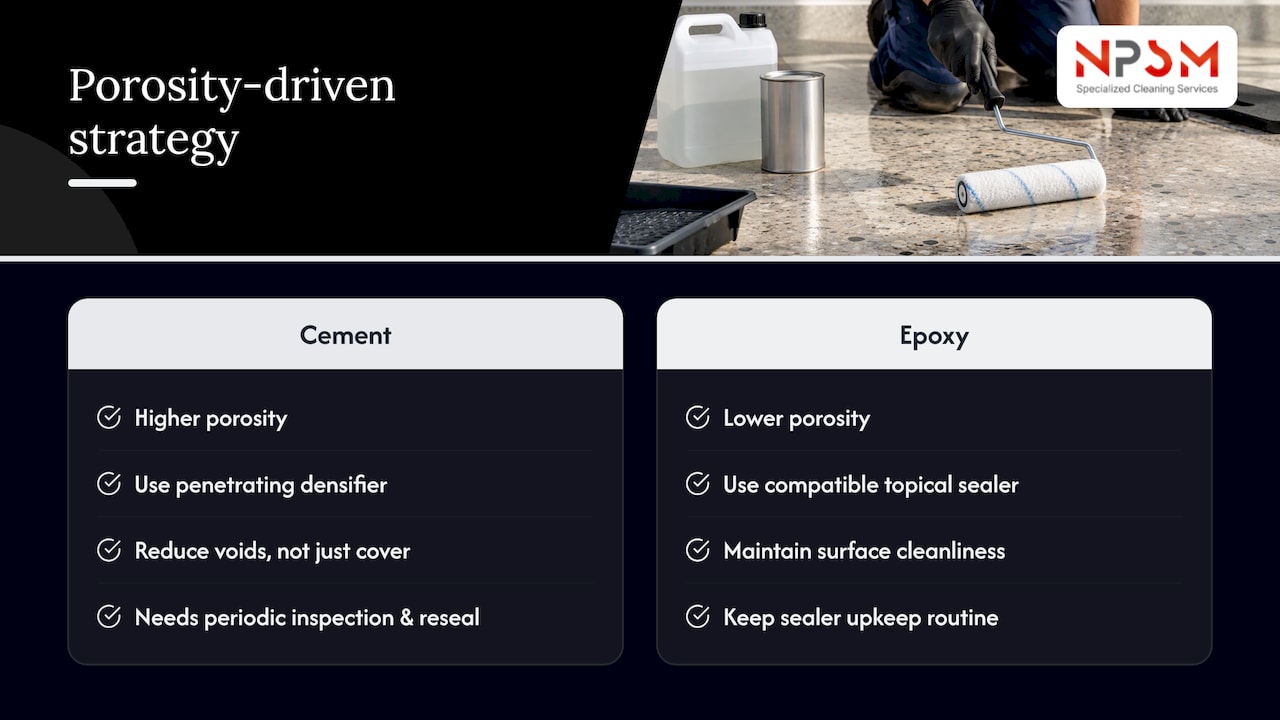
Cement-based terrazzo tends to have higher porosity than epoxy terrazzo, which is why it generally benefits most from a penetrating densifier that physically reduces those voids rather than just covering them. Epoxy terrazzo’s naturally tighter matrix means its porosity is already low, so the priority shifts toward keeping the surface clean and using a compatible topical treatment rather than trying to densify further.
Managing porosity in practice starts with the water-spot test described earlier: water that beads and stays on the surface for several minutes indicates a well-sealed, low-porosity surface, while water that darkens the stone signals absorption and elevated stain risk. From there, the strategy is straightforward: reduce porosity where it’s high (densification on cement terrazzo), maintain the barrier where porosity is already low (sealer upkeep on epoxy terrazzo), and reinforce both with the daily grit control and prompt spill response covered earlier. Porosity management is not a one-time fix. Traffic wear, cleaning chemical exposure, and age all gradually change how porous a sealed surface remains, which is exactly why periodic inspection and resealing stay part of the routine rather than a step you complete once and forget.
Three priorities for facility teams
If I had to rank it, grit control and entrance matting matter more than any coating you can buy, since even the best sealer fails faster under untreated foot traffic. Second, pick a sealing strategy that fits your terrazzo type and traffic, not whatever a vendor pushes hardest. Third, budget for periodic professional maintenance before damage is visible. Waiting costs more than scheduling.
— Qadir
How we can help with terrazzo restoration and sealing
When daily maintenance isn’t enough to reverse dulling, staining, or sealer failure, our team restores terrazzo through diamond honing, densification, and sealer systems matched to cement or epoxy matrices. Before booking a survey, have your approximate square footage, a few photos of problem areas, and a description of daily foot traffic ready so we can scope the job accurately.
We cover terrazzo alongside marble, stone, and other hard flooring restoration work, and the same visit can address adjoining surfaces if needed. Request an on-site assessment through our terrazzo and natural stone restoration services page, and we’ll confirm whether your floor needs a light refresh or a full re polish and reseal.
FAQ
How do you seal terrazzo tiles?
Sealing starts with a clean, fully dry surface, then applying either a film-forming topical sealer or a penetrating densifier depending on whether the terrazzo is cement-based or epoxy-based. Follow the product’s dwell time and recoat instructions closely, since skipping prep or rushing cure time is the most common cause of early sealer failure.
What are the common colors of terrazzo flooring?
Terrazzo color comes from the binder (cement or epoxy) and the aggregate chips mixed into it, which can include marble, granite, glass, or quartz in nearly any color combination. Light neutral tones with marble or quartz chips remain among the most widely used because they hide grit and wear better than very dark or very light solid colors.
Should you wax terrazzo floors?
Traditional wax has largely been replaced by film-forming acrylic sealers and finishes, which offer similar sacrificial protection with better durability and easier maintenance through spray-buffing. If your terrazzo already has a topical finish system in place, adding wax on top can interfere with recoating and should generally be avoided.
How do you clean a terrazzo shower floor?
Clean a terrazzo shower floor with a neutral-pH cleaner, never vinegar or acidic bathroom cleaners, since acids etch cement-based terrazzo and can damage sealer films. Rinse thoroughly and allow the floor to dry, and check periodically that the sealer is still repelling water, since shower floors see more standing moisture than any other terrazzo application.
How often should terrazzo be resealed?
Reseal timing depends on traffic and sealer type, but inspection intervals of 12 to 18 months for heavy traffic, 18 to 24 months for medium traffic, and 24 to 36 months for light traffic are a reasonable starting point for deciding when a reseal is due. A simple water-spot test during inspection shows whether the current sealer is still performing or needs renewal sooner.
Key manufacturer and industry references
-
NTMA sealer reference guide: film-forming versus penetrating sealer approaches and repair options
-
Tile and grout maintenance tactics for high-traffic entrances and matting strategy.