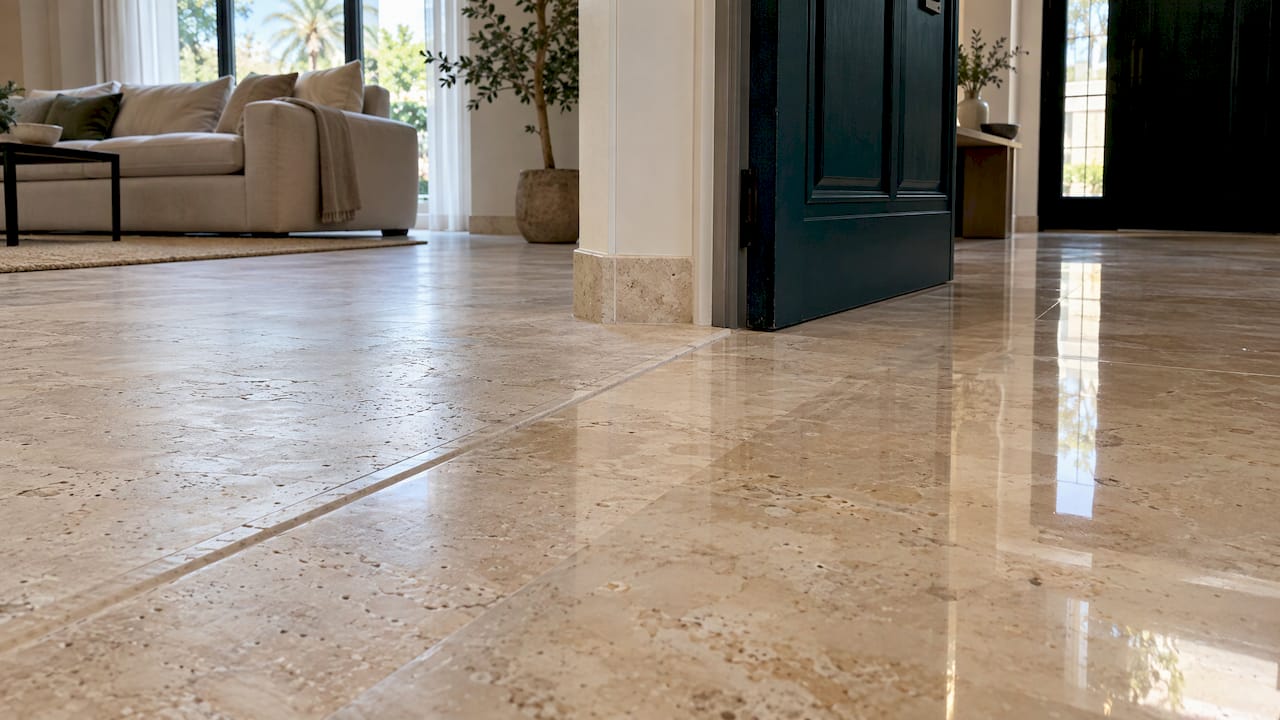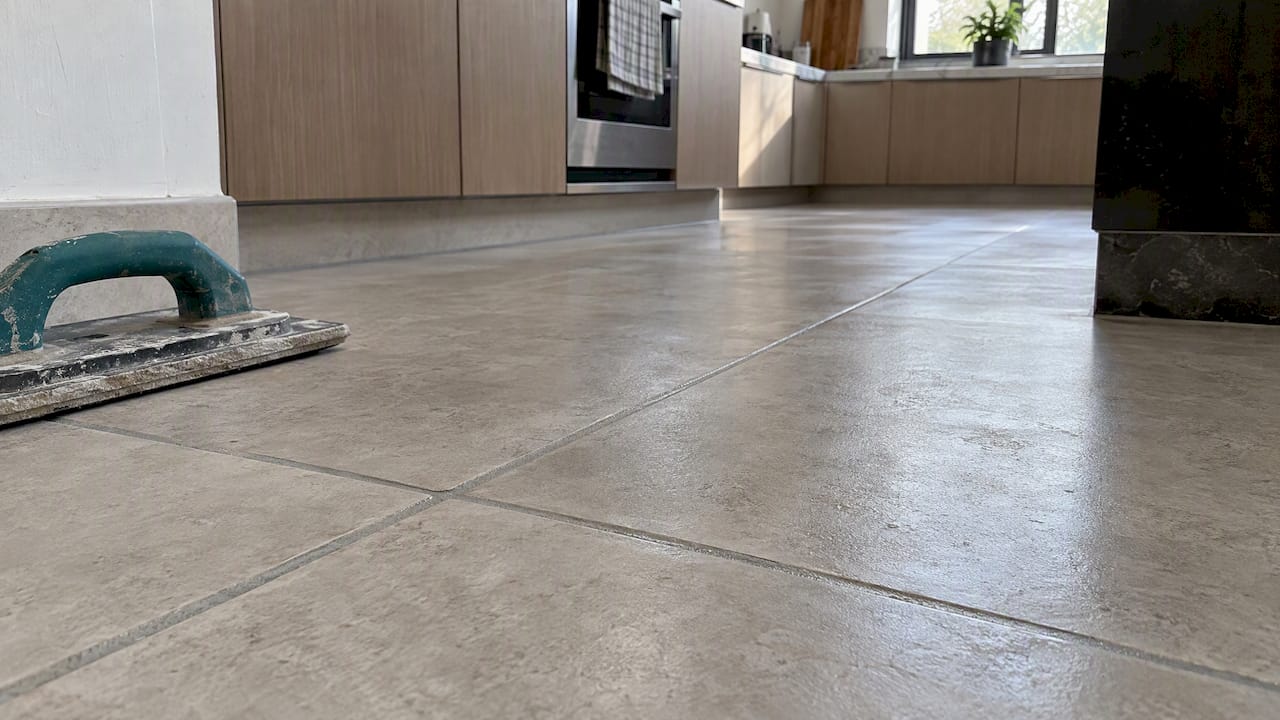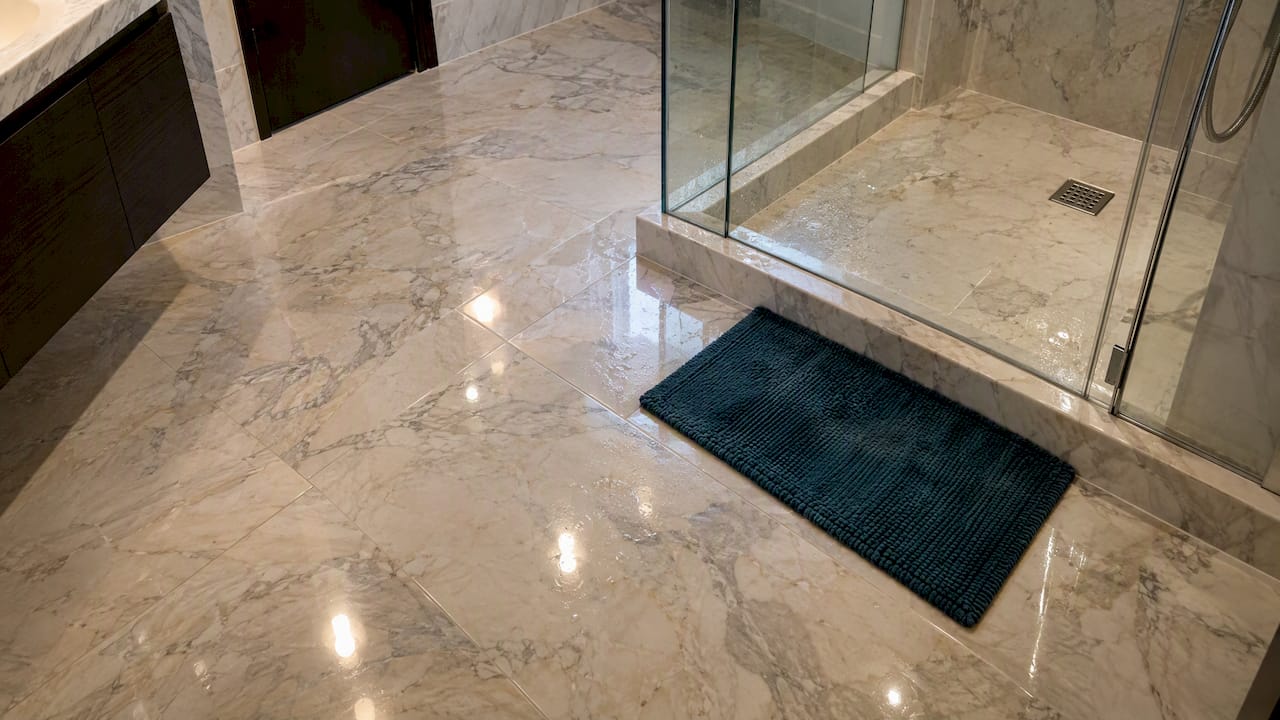

The safest way to fix a slippery marble floor is to find out why it is slippery, then match the fix to the cause. Sometimes the cause is just cleaning residue, and a proper neutral clean solves it. Sometimes it is the polish itself, and the answer is a controlled professional treatment that adds grip without turning your marble dull. What you should not do is reach for vinegar, a bottle of “anti-slip” liquid from a hardware shop, or a sander.
This guide is written for Dubai villa, apartment, hotel and building owners who have noticed that a marble floor feels unsafe when wet, and want to fix it without wrecking an expensive surface.
TL;DR
-
Polished marble is smooth by design, so grip drops sharply when water, soap film, or dust sits on it. Start by finding out whether the problem is the surface or the contamination on it.
-
Never use vinegar, lemon, acidic descaling products, or topical wax. They dull the stone, trap dirt, or both.
-
Real fixes fall into three levels: a deep neutral clean, a controlled anti-slip treatment or honing, and, for worn or damaged floors, full restoration.
-
Test any treatment on a hidden patch first. A bad test costs a few centimeters of stone, a bad full-floor job costs the whole finish.
-
For lobbies, bathrooms, pool decks and stairs, ask for a measured slip result before and after, not just a promise.
Table of Contents
Why polished marble gets slippery
Marble is a calcium-based stone. When it is polished, the surface is ground and buffed until it is nearly mirror-flat. That flatness gives you the depth and shine people pay for. It also means a thin film of water has almost nothing to grip through. Your shoe or bare foot slides on the film instead of touching stone.
That is why the same floor feels fine when dry and treacherous after a mop, a shower, or a spilled drink. It is most common in:
-
Bathrooms and wet rooms
-
Entrance lobbies, where people walk in with damp soles
-
Kitchens, where oil and water spill
-
Pool surrounds, terraces and balconies
-
Staircases, where a slip becomes a fall
Dubai adds its own factors. Air conditioning moves between cool interiors and humid outdoor air, so condensation can appear near entrances and glass doors. Fine desert dust settles on floors every day and acts like grit under a mop. Frequent mopping with strong detergents leaves a film. High foot traffic in hotels and malls wears some areas smoother than others, so one floor can have slick patches and rough patches side by side.
Work out the real cause first
Most slippery marble floors fall into one of three situations. The right fix is different for each, so it is worth ten minutes to decide which one you have.
| What you notice | Likely cause | Right level of fix |
|---|---|---|
| Floor is slippery only after mopping, feels slightly tacky or streaky when dry | Detergent residue, soap film, or wax buildup | Deep neutral clean, change cleaning routine |
| Floor is slippery whenever wet, looks glossy and uniform | The polish itself is very smooth | Controlled anti-slip treatment or honing |
| Slippery in some zones, dull or scratched in others, uneven shine | Uneven wear, old coatings, or surface damage | Inspection, then restoration with honing and re-finishing |
A simple home check helps. Clean a small area with plain water and a clean microfiber mop, let it dry fully, then wet it lightly and walk across it in the shoes you normally wear. If grip returns after the clean, you had residue. If the floor is still slick on clean, bare stone, it is the finish.
This is also where the causes of dull marble floors overlap with slipperiness: a floor that has lost its shine to coatings and residue can feel slick and look tired at the same time.
Quick fixes you can do today
These do not change the stone. They remove what is making it worse, and they are worth doing before you pay for anything.
Clean with a pH-neutral stone cleaner
Use a cleaner made for natural stone, or a very mild neutral soap diluted properly. Use less than you think you need, then rinse with clean water, because leftover soap is itself a slip hazard. Dry the floor afterward with a clean microfiber cloth or mop head.
Use microfiber, not sponge mops
Sponge mops push dirty water around and leave grit sitting on the surface. Microfiber lifts dust and grit away. This matters in Dubai, where dust is constant and grit scratches polished marble over time, creating a patchy, uneven surface.
Sweep or dust-mop daily
Removing dust before it meets water keeps both the finish and the grip in better shape. Put a quality mat inside every entrance, and a second one outside if you can, so people dry their soles before stepping onto stone.
Control spills and wet zones
Safety specialists describe a simple order of priorities for slips: first stop the contamination, then limit its effect, and only then change the floor. In practice that means wiping spills immediately, using absorbent non-slip mats beside showers, sinks and kitchen workstations, and fixing leaks from planters, AC drip lines, and door seals. Our own marble floor safety measures guide covers the practical routine for homes and buildings.
What not to do to a slippery marble floor
This is where most damage happens. People get frustrated, try something cheap, and create a second problem that costs more than the first.
-
Vinegar, lemon juice, and acidic cleaners. Marble is calcium carbonate and acid dissolves it. The result is etching: dull, cloudy marks. Etched marble is not safer, only uglier, and the damage spreads when acid is used across a whole floor.
-
Wax or acrylic polish on top. Topical coatings make the floor shinier but often more slippery when wet. They also trap dirt and wear unevenly.
-
“Non-etching” acid products of unknown composition. Some products sold as safe alternatives to acid are not safe at all. Certain formulations contain compounds that behave like hydrofluoric acid when mixed with water, which is a real health risk for whoever applies them and for people in the building. If you cannot get a clear safety data sheet, do not use the product.
-
Sanding or grinding by someone without stone experience. Roughening the surface does add grip, but done aggressively it destroys the polished finish permanently and leaves a uniformly scratched, matte look. It is also very hard to reverse evenly.
-
Skipping the test patch. Any treatment, even a good one, should go on an inconspicuous area first, such as inside a wardrobe, under a door, or in a corner covered by furniture. Let it dry and check both grip and appearance.
The goal is never to roughen marble. The goal is to create very fine, controlled texture that channels water away and increases friction while the stone still looks like marble.
Professional options that add grip safely
When cleaning is not enough, there are three realistic routes. They differ in how much they change the stone.
| Option | What it does | Effect on appearance | Best for |
|---|---|---|---|
| Anti-slip treatment (controlled micro-texturing) | Creates microscopic surface texture so water breaks up and shoes grip | Minimal if done correctly, finish stays close to original | Bathrooms, entrances, pool areas, stairs where you want to keep the look |
| Honing | Removes the high gloss and leaves a smooth satin surface with more traction | Matte or soft-sheen, noticeably less mirror-like | Wet rooms, terraces, commercial lobbies where safety outranks shine |
| Full restoration (grinding, honing, polishing, sealing) | Levels damage, removes old coatings, re-establishes an even finish | Uniform, fresh surface, with the sheen level you choose | Worn, scratched, stained or unevenly damaged floors |
The difference between polishing, grinding and crystallization is worth understanding before you commission any work. We explain it in marble polishing vs grinding vs crystallization and in what to know about polishing versus grinding. One practical point: a high-gloss crystallized or polished finish looks wonderful in a dry living room, but it is the wrong finish for a wet bathroom floor.
The finish choice matters as much as the fix
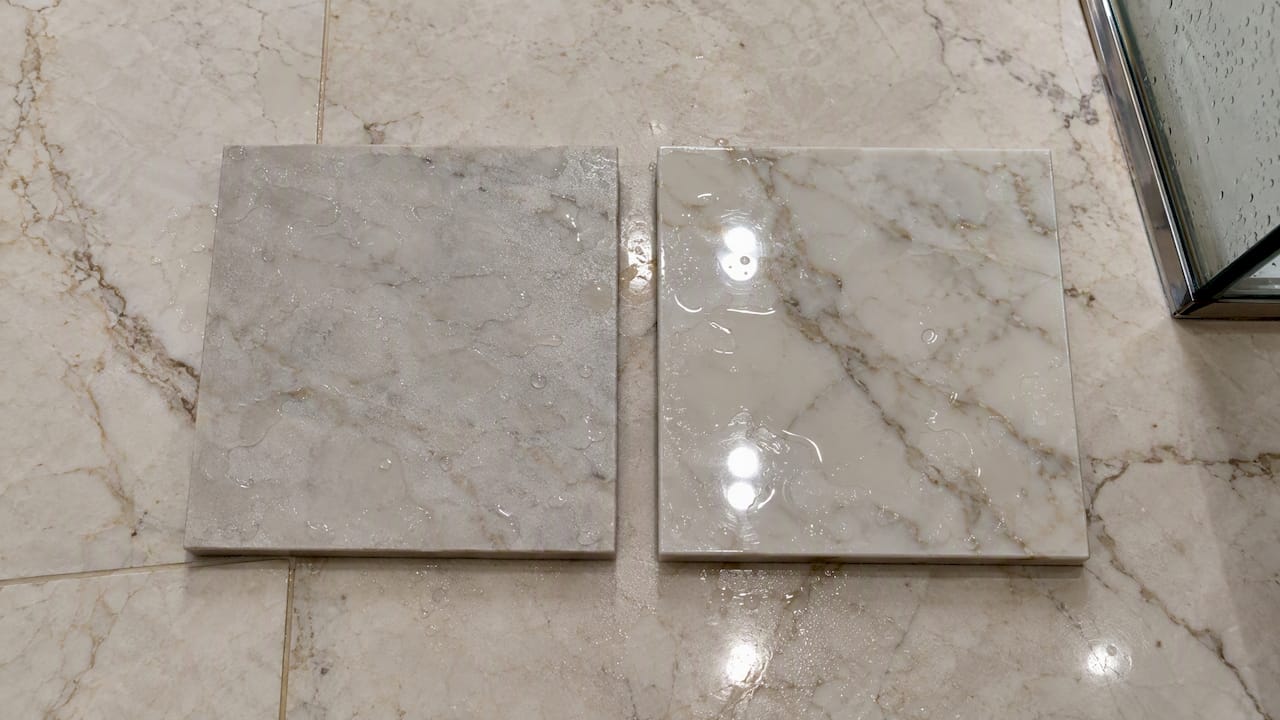
Honed and brushed marble finishes generally give better traction than high-polish ones, which is why many specifiers choose them for bathroom floors and other wet areas. If you are renovating rather than repairing, choosing a honed or textured finish at the start is easier than correcting a mirror polish later. Whatever finish you pick, confirm it on a physical sample, wet, in the room’s lighting.
Treatments are not permanent
A common assumption is that you treat the floor once and forget it. In reality slip resistance changes over time. Wear smooths textured areas, and detergent residue builds up. A floor that was safe after treatment can drift back toward slippery if the cleaning routine is wrong. Plan for re-checking, particularly in hotels, lobbies and any space with public foot traffic.
Slip resistance standards in Dubai
If you manage a building, “it feels slippery” is not enough to act on, and “it feels fine” is not enough to defend you after an accident. Dubai’s Universal Design Code sets slip resistance targets using the Pendulum Test Value (PTV). Indoor level floors in dry areas should fall between 15 and 35 PTV. For wet areas and for outdoor or inclined surfaces (above a 5% slope), the required value is 45 or higher.
Two things follow from that:
-
The same marble can be acceptable in a dry living room and unacceptable at a wet entrance ramp. The location decides the target.
-
A measured test gives you a number to improve on and a record to keep. Natural stone industry guidance also points property owners toward standardized friction testing, noting that no single test is perfect but a measurable value is a reasonable basis for managing risk and liability.
If you manage a hotel, retail space, office building or residential tower, ask for test results before and after any anti-slip work, from a qualified testing provider, and keep the report with your maintenance file. We can coordinate the treatment around that testing, but the measurement itself should come from an independent party.
Our perspective: grip and beauty are not opposites
We restore marble in Dubai villas, apartments, hotels and commercial buildings, and the pattern repeats. Owners call us about slippery floors after trying something that made the problem worse: an acidic descaler, a layer of wax, or a quick “anti-slip” liquid. By then the stone has often lost its shine, and the grip has not even improved.
Our approach is to diagnose first. A floor with residue needs a proper deep clean. A floor with an over-smooth finish needs controlled work that matches the stone type and the room. A damaged floor needs honing, restoration and sealing done in the right order. We tailor the method to the floor and the property, rather than applying one product to every job, because marble varies a great deal in hardness, porosity and finish.
We would rather tell you a cleaning routine change is enough than sell you a treatment you do not need. And where safety is the priority, such as a wet room, a stair, or a lobby, we will tell you honestly if a honed, softer-sheen finish is the better answer than trying to keep a mirror polish and add grip to it.
— Qadir
What a proper assessment and treatment looks like
Whatever contractor you choose, the sequence should look like this. If it does not, ask why.
-
Inspection. The stone type, existing finish, coatings, damage and the wet or dry use of each area are checked. Stairs, bathrooms and entrances are treated as higher risk.
-
Deep clean. Old residues, wax and soap film are removed so the true surface is visible. Sometimes this step alone changes the result.
-
Test patch. A small hidden area is treated, left to dry, and checked for grip and appearance. You approve it before the work spreads.
-
Controlled treatment. The chosen method is applied evenly, such as anti-slip treatment or honing, with contact times and equipment suited to the stone.
-
Neutralize, rinse and dry. Any treatment must be properly rinsed or neutralized and the floor dried, so no residue remains.
-
Seal and protect where appropriate. Sealing helps against stains but must not leave a slick coating on a wet-area floor.
-
Care instructions and re-check. You get a cleaning routine suited to the new surface, and a plan for re-checking grip.
What it costs
Price depends on floor area, condition, stone type and the method needed. Our marble polishing and restoration work starts from AED 30 per sqm, and the final figure for anti-slip work or deeper restoration is set after we see the floor. A site visit is the only way to quote honestly, because a lightly worn hallway and a heavily etched bathroom are very different jobs.
Fix it with a team that knows Dubai marble
If your marble is slippery, dull, stained or worn, we can inspect it and recommend the least aggressive method that solves the problem. Our marble polishing and restoration services in Dubai cover polishing and buffing, stain removal, full restoration, staircases, and countertops. If you have other stone in the property, see our natural stone polishing and restoration work for granite and terrazzo too. You can also browse everything we do on our services page.
Keeping marble grippy after the fix
The best result is one that lasts. A few habits make a large difference:
-
Use a pH-neutral stone cleaner and measure it properly. More detergent does not mean cleaner.
-
Rinse and dry after mopping in wet or high-traffic areas.
-
Keep mats at every entrance and at wet zones, and wash them regularly so they do not become dirt carriers.
-
Dust-mop daily, because dust and sand are what scratch the surface.
-
Deal with water marks early. Our guide to removing marble water stains explains safe steps.
-
Do not let a treated floor drift. Re-test or re-inspect high-risk areas on a schedule, especially in commercial properties.
-
Consider the overall surface care plan too: marble surface enhancement can help preserve durability and shine between restorations.
FAQ
How do I make a marble floor less slippery?
Start by deep cleaning with a pH-neutral stone cleaner, rinsing well and drying, because soap film and wax are common culprits. If the clean bare stone is still slick when wet, you need a controlled anti-slip treatment or honing by a stone professional. Avoid vinegar, acidic cleaners and wax, which damage the finish or worsen the problem.
Are marble floors slippery by nature?
Polished marble is smooth, so it becomes slippery when water, soap or dust is on the surface. Honed, brushed or textured finishes of the same stone give noticeably better traction. How slippery a floor feels depends on the finish, the contamination and how the floor is used.
Will an anti-slip treatment ruin the look of my marble?
A well-matched, controlled treatment should leave the look close to the original, though some reduction in gloss is possible, especially on very high-polish floors. Aggressive sanding or acid etching is what causes the dull, scratched look. Always approve a test patch first.
Is the fix permanent?
No. Wear, dirt and detergent residue can reduce grip over time, so the treatment needs a correct cleaning routine and periodic re-checking. High-traffic areas such as lobbies and hotel bathrooms should be assessed on a regular schedule.
Do I need a slip test in Dubai?
If you manage a commercial or multi-user building, yes, it is wise. Dubai’s Universal Design Code sets Pendulum Test Value ranges: 15 to 35 for indoor dry level floors and 45 or higher for wet areas and inclined or outdoor surfaces. A test report before and after treatment gives you proof of improvement.