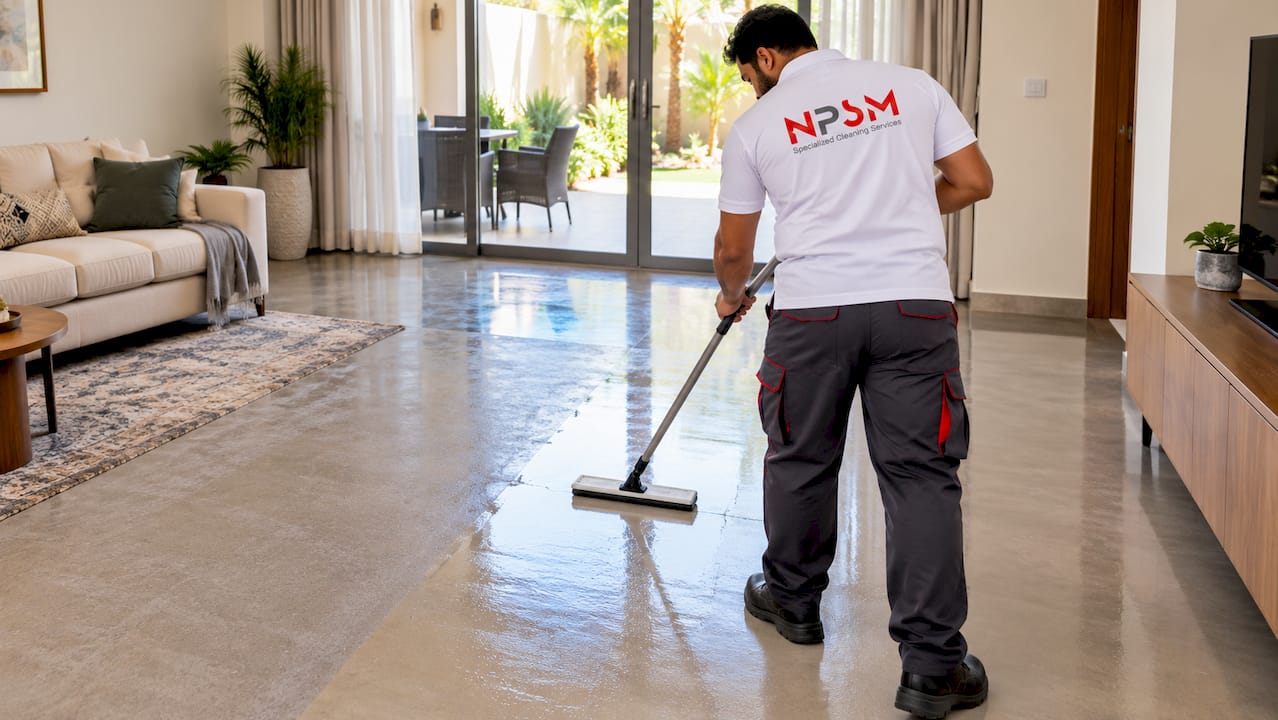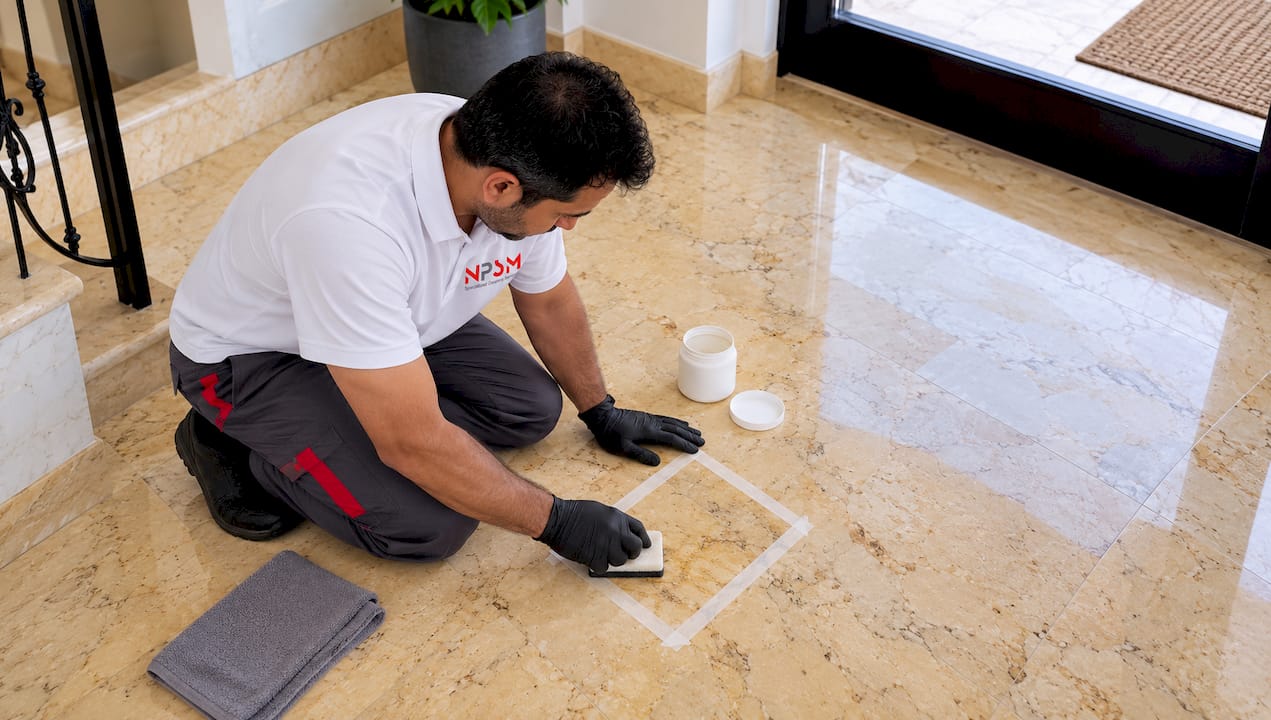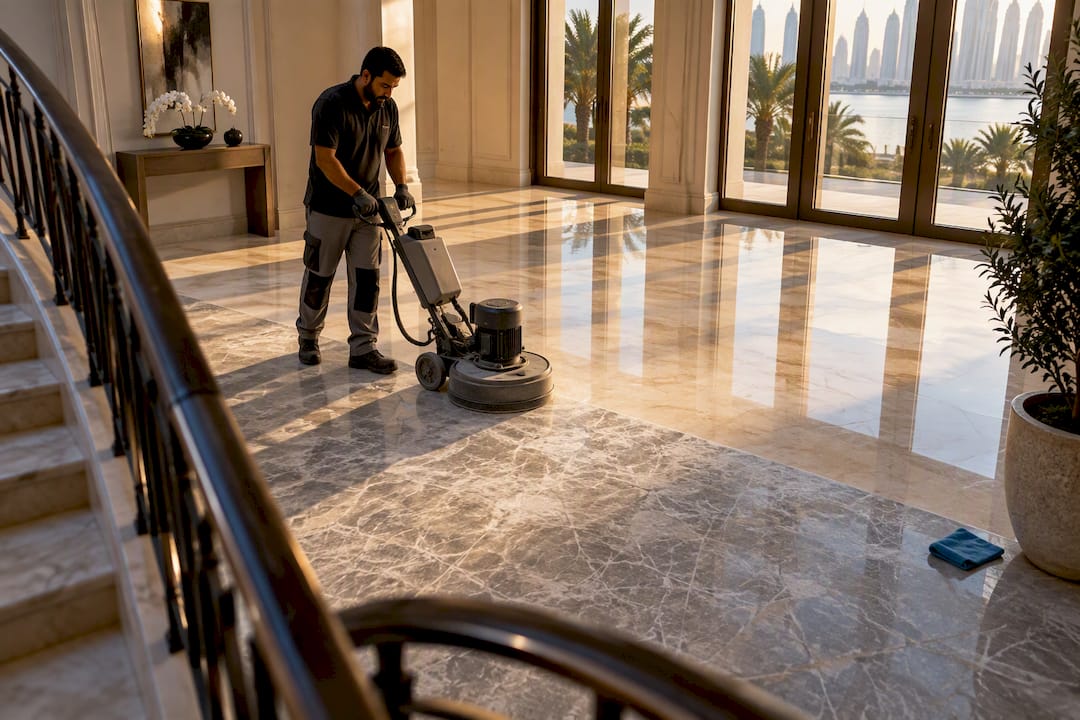

Yes. Most badly damaged marble floors can be restored without replacement, even when the surface looks scratched, dull, etched, or stained beyond hope. The exception is structural: through-cracks, unsupported slabs, or stone already ground too thin. Restoration is a mechanical process, grinding, honing, polishing, and sealing, plus color-matched repairs, so the right first move is a professional on-site assessment or test patch, not a demolition quote.
TL;DR:
- Most severely damaged marble floors can be restored through professional grinding, honing, polishing, and sealing, avoiding the need for costly replacement unless there’s structural failure.
- Restoration techniques vary by damage type, with diamond grinding correcting uneven surfaces, polishing restoring gloss, and resin repairs blending chips and cracks.
- A proper restoration process begins with an on-site assessment and test patch, followed by deep cleaning, grinding, honing, polishing, repairing, and sealing, which can take from one day to several weeks depending on size and severity.
- Restoration costs are generally lower than replacement when the stone’s structural integrity remains intact, but replacement is necessary if the slab has full-depth cracks or structural failure.
- Maintaining a restored marble floor with neutral-pH cleaners, prompt spill cleanup, and regular resealing extends its lifespan, while acidic products like vinegar permanently etch the surface and require professional correction.
Table of Contents
- Why Does Marble Floor Get Dull or Damaged?
- What Restoration Methods Fix Badly Damaged Marble?
- What Does a Professional Marble Restoration Process Look Like?
- How Much Does Marble Restoration Cost, and When Should You Replace Instead?
- How Do You Maintain a Restored Marble Floor?
- Why Restoration Beats Replacement More Often Than People Assume
- Get a Professional Assessment Before You Consider Replacement
- Further Reading on Marble Care and Restoration Technique
- FAQ
Why Does Marble Floor Get Dull or Damaged?
Marble is soft calcium carbonate, which means everyday life leaves marks that look permanent but usually are not. Foot traffic drags grit across the surface and creates thousands of micro-scratches you cannot see individually but notice collectively as haze. Acidic substances etch the polished layer on contact; a splash of orange juice or a vinegar-based cleaner leaves a dull spot within minutes, and once etched, marble cannot be wiped back to gloss with soap and water.
Common causes worth naming:
- Dry grit ground in by shoes and casters, causing fine surface scratching
- Acidic cleaners (vinegar, lemon, some all-purpose sprays) etching the polish
- Standing water and mineral deposits leaving stains or a cloudy film
- Uneven grinding or settling at joints, producing lippage (edges sitting higher than neighboring tiles)
- Old wax or topical coatings yellowing and trapping dirt underneath
Each damage type demands a different fix, which is why restoration starts with correctly diagnosing what you’re actually looking at, not guessing.
What Restoration Methods Fix Badly Damaged Marble?
Professional restoration matches the technique to the damage instead of applying one blanket process to everything.
- Diamond grinding and honing removes deep scratches and corrects lippage by working through progressively finer diamond abrasives, similar to sanding wood from coarse to fine grit, flattening the surface before any shine work begins.
- Polishing or crystallization restores optical clarity and gloss. Polishing uses finer diamond pads and polishing powders for a true reflective finish; crystallization uses a chemical reaction to harden the surface, producing a satin sheen that some property managers prefer for high-traffic lobbies over a mirror finish.
- Epoxy and resin repairs fill chips, pits, and hairline cracks. Technicians color-match the resin to the surrounding stone, and this in-place repair usually blends better than a replacement slab, since aged marble veining rarely matches new material.
- Sealing follows every restoration. Impregnating sealers soak in and resist staining without changing the look; topical coatings sit on the surface and add shine but wear faster under foot traffic and need more frequent reapplication.
Pro Tip: Ask your restoration contractor whether they’re proposing an impregnating sealer or a topical coating. The two behave very differently under UAE humidity and air-conditioning cycles, and mixing them up leads to premature peeling.
The one hard limit: none of these methods can rebuild stone that has physically failed. If the slab has cracked all the way through or lost structural support underneath, grinding and polishing only smooths the surface of a problem that starts below it.
What Does a Professional Marble Restoration Process Look Like?
A restoration project on badly damaged marble follows a fairly consistent sequence, and knowing the steps helps you evaluate whether a contractor’s quote actually covers the job.
- Assessment and test patch. A technician examines the stone’s condition, measures how deep the etching or scratching runs, and grinds a small test area so you can see the achievable result before committing to the whole floor.
- Deep cleaning and stripping. Old wax, sealer residue, and grease get stripped first. Skipping this step is the single most common reason restoration jobs fail: polishing over unremoved residue locks in contaminants and produces a patchy, short-lived shine instead of a clean, even finish.
- Diamond grinding and lippage correction. Coarse grits (roughly 50 to 200) flatten uneven tiles and remove deep scratches; the visual change here is dramatic, dull gray patches turn into consistent, level stone within the first pass.
- Honing and polishing sequence. Progressively finer grits (400 up through 3,000 or higher) bring the surface from matte to satin to high gloss. On a typical residential room, this stage runs a few hours; large commercial floors can take multiple days depending on square footage and desired finish level.
- Chip and crack repair. Color-matched epoxy fills voids and hairline cracks, then gets ground flush and blended so repairs disappear into the surrounding stone rather than standing out as patches.
- Sealing. An impregnating sealer typically goes on in one or two coats, with drying time before the floor returns to foot traffic, often overnight for full cure depending on the product and ambient humidity.
- Final inspection and documentation. Reputable contractors photograph before-and-after results and outline a follow-up maintenance schedule, since restoration protects your investment longer when it’s paired with routine care.
Restoration specialists frequently report that a properly restored floor ends up looking better than day one, because grinding removes original installation flaws like uneven lippage that nobody ever fixed. That is one advantage replacement genuinely cannot offer: a brand-new slab still has to be installed and leveled, introducing the same risk of imperfect seams all over again.
How Much Does Marble Restoration Cost, and When Should You Replace Instead?
Cost and timeline depend on square footage, how deep the damage runs, how many chips or cracks need epoxy repair, site access, and which finish level you want. A shallow etching problem across an open floor plan is a faster, cheaper job than a heavily lipped, stained floor full of furniture and fixed obstacles.
As a general pattern, restoration lands well below full replacement cost when the stone’s structural integrity is intact, since replacement includes demolition, disposal, new material, and installation labor on top of the finishing work restoration alone requires. Timelines scale with area and damage severity: a single room might take a day, while a hotel lobby or large villa floor can run several days to a couple of weeks.
Replacement becomes the honest recommendation only when:
- The slab has a through-crack that runs the full depth of the stone
- The subfloor or supporting structure beneath the marble has failed
- Previous restorations have ground the stone so thin there’s no material left to work with safely
Pro Tip: When comparing quotes, ask each contractor for a small test patch, a written scope of work, and whether a maintenance plan or warranty is included. A quote without a test patch is a guess, not a plan.
How Do You Maintain a Restored Marble Floor?
Restoration buys you years of good-looking floor, but only if daily habits don’t undo the mechanical work. Neutral-pH cleaners protect the polish, while vinegar, lemon-based products, and other acidic cleaners etch it right back to dull within days of a fresh restoration.
Keep this routine simple and consistent:
- Dust-mop or use a soft microfiber mop weekly to remove grit before it scratches the surface
- Clean spills immediately, especially wine, juice, or coffee, and dry the area rather than letting liquid sit
- Use only neutral-pH stone cleaners, never vinegar, bleach, or abrasive powders
- Avoid vacuum attachments with a beater bar, and lift furniture instead of dragging it across the floor
- Reseal on a schedule your restoration contractor recommends, generally checked annually, rather than waiting until water stops beading on the surface
Scheduling periodic professional buffing between full re-polishes extends the life of a restoration significantly and costs far less than starting the grinding process over from scratch. A maintenance contract with a restoration provider keeps this on a predictable calendar instead of leaving it to memory, which is usually where good intentions quietly fail.
Why Restoration Beats Replacement More Often Than People Assume
Most people call a stone contractor assuming their floor is beyond saving, and most of the time they’re wrong. Badly etched, scratched, or lipped marble almost always responds to mechanical restoration, because the damage sits in a thin surface layer, not in the stone’s structure. The bigger issue I see repeatedly isn’t damage severity, it’s maintenance habits that keep undoing the work. A property gets restored, someone mops it with a vinegar solution six months later, and the etching returns, prompting another costly redo that a neutral-pH routine would have prevented. Before signing off on replacement, get an assessment and a test patch. It costs little and settles the question with evidence instead of assumption.
— Qadir
Get a Professional Assessment Before You Consider Replacement
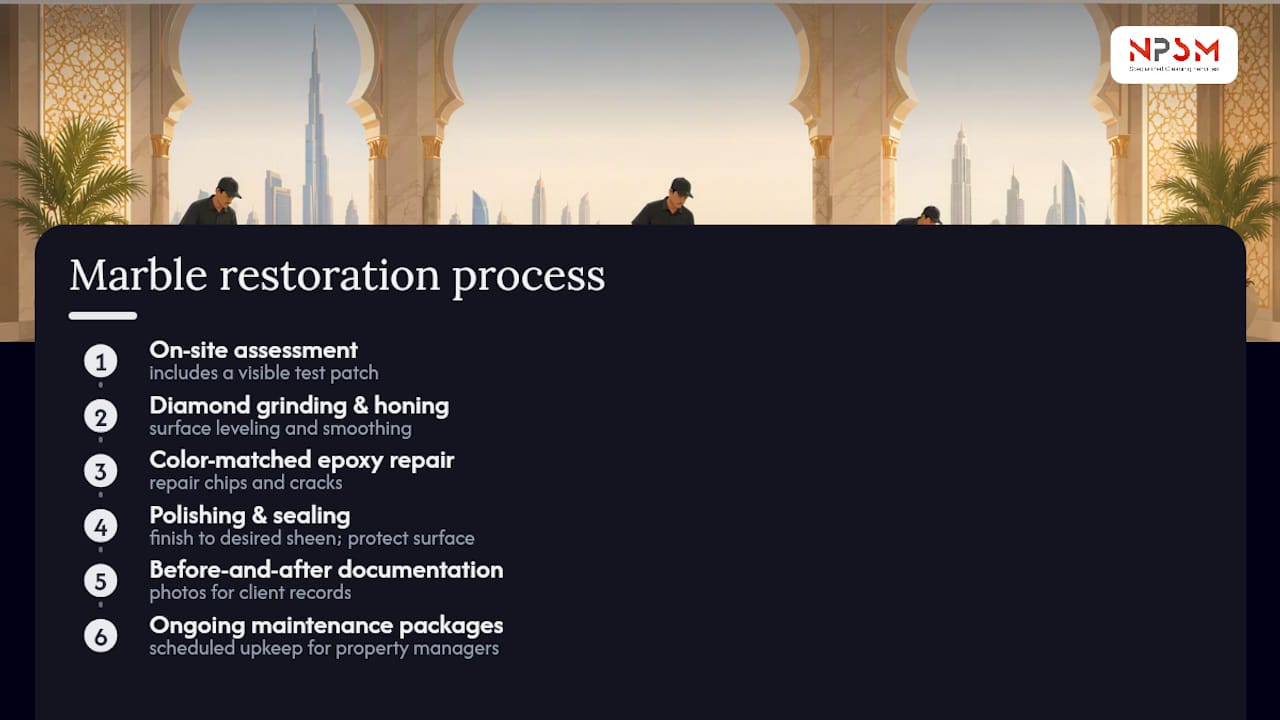
Ripping out marble and replacing it costs far more than reviving it, and NPSM Specialized Cleaning Services LLC exists precisely to make that second, cheaper path work. Through FloorPolishing.ae, the team handles the full sequence covered above: on-site assessment, a test patch so you see real results before committing, diamond grinding and honing, color-matched epoxy repair for chips and cracks, polishing to your preferred finish, sealing, and before-and-after documentation for your records. Ongoing maintenance packages are available for property managers who want predictable upkeep instead of repeat emergencies.
To request a quote, share your floor’s square footage, a few photos of the worst-affected areas, and your property type (villa, office, hotel, retail). Visit the marble polishing and restoration services page to see the full scope of marble-specific work, or browse the complete floor restoration services if other surfaces in your property need attention too. Compare a test patch result against a replacement estimate before you decide anything.
Further Reading on Marble Care and Restoration Technique
- Marble polishing vs grinding vs crystallization breaks down how each restoration technique differs in practice.
- Removing marble water stains safely covers DIY-safe spot treatment before a full restoration is needed.
FAQ
How Do You Restore a Badly Damaged Marble Floor?
Professionals restore damaged marble through diamond grinding to remove scratches and lippage, honing and polishing to rebuild the finish, color-matched epoxy repair for chips and cracks, and sealing to protect the result. Start with an on-site assessment and test patch rather than guessing at the scope.
How Much Does It Cost to Restore Marble Floors?
Cost depends on square footage, damage depth, and finish level, but restoration is generally far less expensive than full replacement when the stone’s structural integrity is intact. Get a written quote from Floorpolishing based on photos and measurements of your specific floor.
What Is the Average Lifespan of Marble Flooring?
Marble itself can last for generations when the slab remains structurally sound, since the material is durable stone rather than a wearable coating. What actually fails over time is the polish and sealer, which is why periodic restoration and resealing, not full replacement, keeps most marble floors performing indefinitely.
What Does Vinegar Do to Marble?
Vinegar is acidic and etches marble’s polished surface on contact, leaving dull, cloudy spots that plain water cannot remove. Neutral-pH cleaners are the safer daily choice, and any floor already etched by acidic products typically needs professional honing and polishing to correct.