
Picture a marble floor in a Palm Jumeirah villa, once gleaming like a mirror, now dulled by fine desert sand tracked in daily and left hazy by the wrong cleaning products. That transformation in reverse, from dull to showpiece, is exactly what this guide covers. Dubai’s unique combination of airborne sand and high humidity creates challenges that standard polishing guides simply don’t address. Dubai sand requires adjusted grit sequences, and test patches are mandatory before any work begins. We’ll walk you through tools, preparation, the polishing process, troubleshooting, and long-term maintenance.
Table of Contents
-
What tools and products do you need to polish marble floors?
-
Common mistakes and troubleshooting for marble floors in Dubai
-
What most Dubai marble owners get wrong—and what actually works
Key Takeaways
| Point | Details |
|---|---|
| Use only pH-neutral cleaners | Acidic products like vinegar or lemon can cause permanent etching on marble. |
| Test before you polish | Always perform test patches, especially on unknown or historic marble, to avoid irreversible damage. |
| Adjust for Dubai’s climate | Fine sand and humidity in Dubai require more frequent cleaning, specific grit sequences, and expert care. |
| Professional help pays off | For deep scratches or large areas, licensed professionals deliver better long-term results and protect your investment. |
What tools and products do you need to polish marble floors?
Now that we’ve previewed the process and challenges, let’s look at the exact supplies and equipment you’ll need for a marble floor that stands out.
Getting the right tools is not optional. Using the wrong product on marble, even once, can cause damage that takes days of professional work to reverse. Start with the essentials:
-
pH-neutral stone cleaner: Only pH-neutral cleaners should be used to avoid etching or stripping the surface.
-
Marble polishing powder or compound: Specifically formulated for calcium-based stone.
-
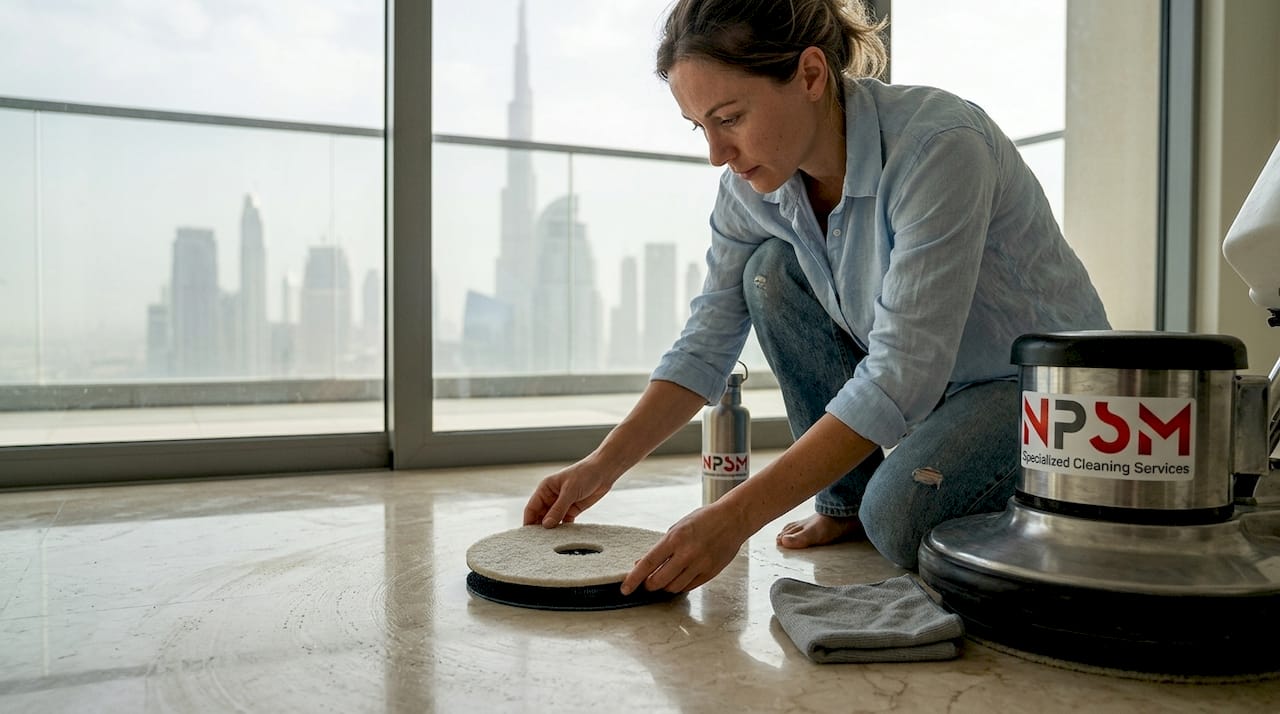
Floor buffer or rotary polishing machine: Essential for even pressure and consistent results.
-
Diamond polishing pads: Multiple grits, from coarse to ultra-fine, for staged polishing.
-
Microfiber cloths and a squeegee: For residue removal and final buffing.
-
Dust control equipment: Especially important in Dubai, where fine sand settles fast.
Acidic or abrasive household products are the biggest risk. Bleach, vinegar, and scouring pads all cause etching, which is a chemical burn on the marble surface that no amount of buffing will fix without grinding. Review marble floor care tips before purchasing anything.
For Dubai specifically, stock extra fine grit pads to address micro-scratches left by sand particles. A good marble countertop product guide can also help you identify stone-safe products. For a broader overview, marble maintenance basics is worth reviewing before you buy.
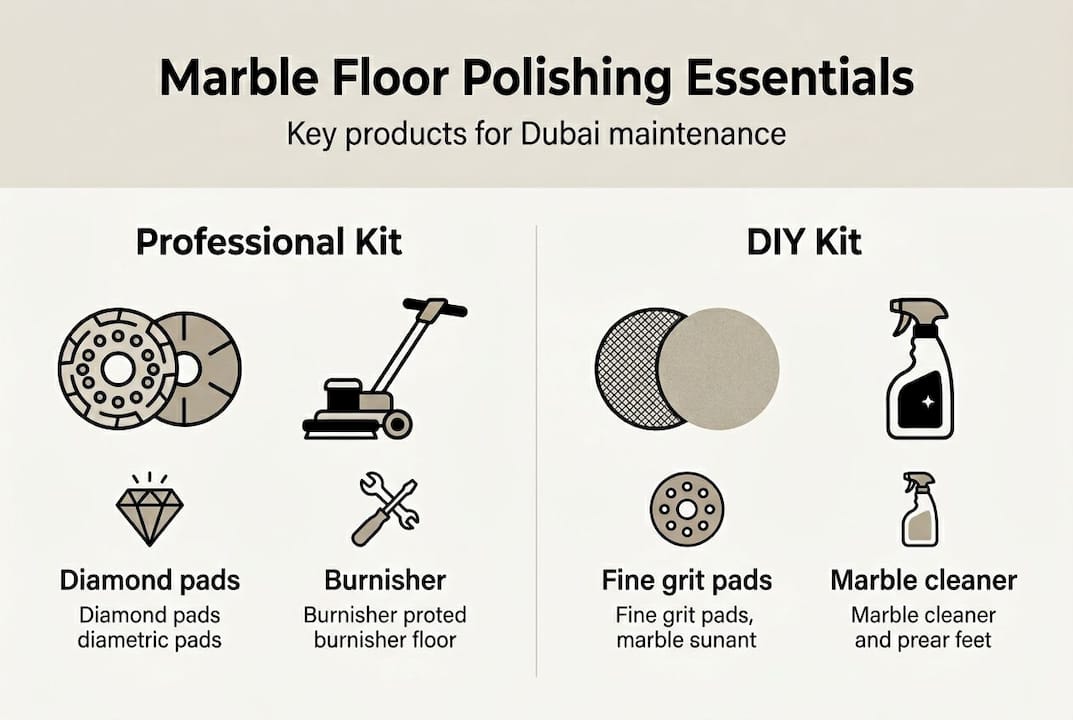
| Feature | Professional kit | DIY kit |
|---|---|---|
| Diamond pad grits | 50 to 3000 | 400 to 1500 |
| Machine type | Industrial rotary buffer | Handheld or rental buffer |
| Polishing compound | Commercial grade | Consumer grade |
| Dust control | Integrated vacuum system | Separate vacuum needed |
| Estimated cost | AED 3,000+ | AED 400 to 900 |
Pro Tip: Always test every product and pad on a discreet 6×6 inch area first. Marble varies by origin and finish, and what works on Carrara may behave differently on local UAE stone.
How should you prepare marble floors before polishing?
Once you’ve gathered your supplies, preparing the floor itself is the next critical step.
Preparation is where most DIY attempts go wrong. Skipping even one step here can trap sand under your polishing pad, turning a restoration into a scratching session. Start with a thorough dry dust removal using a microfiber mop or a vacuum with a soft brush attachment. In Dubai, this step needs to happen twice before you introduce any moisture.
Next, inspect the floor carefully:
-
Stains: Identify the type (oil, water, rust) before treating, since each requires a different approach.
-
Etching: Look for dull, matte patches where acid has reacted with the stone.
-
Lippage: Check for uneven tile edges that may need grinding before polishing.
-
Cracks or chips: These need repair before any polishing begins to avoid spreading damage.
Test patches are mandatory for any marble type, but especially for historic stone or imported marble with unknown origins. A 6×6 inch test patch in a hidden corner tells you exactly how the stone will respond before you commit to the full floor.
Protect walls, baseboards, and adjacent flooring with painter’s tape and plastic sheeting. Polishing compounds and water can stain grout lines and damage painted surfaces if they splash.
Learn how Dubai humidity impacts marble before starting, since moisture trapped under stone can cause issues that surface only after polishing.
Safety reminder: Never use vinegar, lemon juice, or any acidic agent on marble at any stage of preparation or cleaning. Even diluted acids cause permanent etching that requires professional grinding to remove.
Step-by-step process to polish marble floors safely
With floors fully prepped, it’s time for the polishing itself. Here’s how to do it right, step by step.
-
Remove all surface dust and debris using a dry microfiber mop.
-
Apply pH-neutral cleaner diluted in water, mop gently, and allow to dry fully.
-
Perform initial buffing with a coarse diamond pad (only for scratched or heavily worn floors).
-
Apply marble polishing powder evenly across a small section.
-
Work through the grit sequence, moving from coarser to finer pads in stages.
-
Buff to gloss using an ultra-fine pad and a small amount of polishing compound.
-
Remove all residue with a damp microfiber cloth, then dry immediately.
Pro Tip: Only start with a coarse grit (below 200) if the floor has deep etches or scratches. For maintenance polishing, begin at 400 or higher to avoid unnecessary material removal.
Dubai restoration jobs may take 2 to 3 days due to sand and humidity constraints, so plan accordingly. Understand the differences between polishing vs grinding vs crystallization before choosing your method. For chemical-based approaches, the chemical marble polishing process guide explains when and how to use them safely.
| Step | Tool | Estimated time | Expert notes |
|---|---|---|---|
| Dust removal | Microfiber mop | 10 to 15 min | Do twice in Dubai |
| Wet cleaning | pH-neutral cleaner | 20 to 30 min | Let dry fully |
| Initial buffing | Coarse diamond pad | 30 to 60 min | Skip if floor is in good shape |
| Polishing powder | Buffer + compound | 45 to 90 min | Work in small sections |
| Grit sequence | Diamond pads 400 to 3000 | 60 to 120 min | Don’t skip grits |
| Final gloss | Ultra-fine pad | 20 to 40 min | Overlap passes by 50% |
| Residue removal | Damp microfiber | 10 to 20 min | Dry immediately |
For professional marble maintenance tips, including how to assess your results, check the linked resource.
Common mistakes and troubleshooting for marble floors in Dubai
Even with the best methods, obstacles may arise. Here’s how to troubleshoot the most common issues and keep your marble flawless.
The most common mistakes are also the most avoidable. Knowing what to watch for saves you from costly repairs.
Mistakes to avoid:
-
Over-wetting the floor: Excess water seeps into grout lines and can cause staining or loosening of tiles.
-
Using the wrong cleaner: Acids or vinegar can permanently etch marble and are never appropriate, even for tough stains.
-
Skipping test patches: Rushing this step is the single most common cause of irreversible damage.
-
Sanding too aggressively: Starting with too coarse a grit removes more material than needed and shortens the floor’s lifespan.
Troubleshooting common issues:
-
Dull patches after polishing: Usually caused by residue left on the surface. Re-clean with a pH-neutral solution and re-buff with a fine pad.
-
Uneven shine: Often the result of inconsistent pad pressure. Use a machine buffer for large areas to maintain even contact.
-
Water marks: Buff with a dry microfiber cloth immediately. Persistent marks may need a light re-polish.
-
Micro-scratches from sand: This is Dubai’s most specific problem. Fine sand particles act like sandpaper underfoot. Increase your dust-removal frequency and use extra-fine pads during polishing.
Pro Tip: For severe issues like lippage, deep etching, or large cracked sections, stop and call a professional. Attempting to fix these without the right equipment usually makes them worse. Check these marble care tips for guidance on when DIY ends and professional help begins.
How to maintain polished marble for lasting shine
After polishing, routine maintenance will protect your hard work and extend the stunning look of your floors.
The work doesn’t end when the polishing does. In Dubai’s environment, consistent care is what separates a floor that looks great for six months from one that holds its shine for years.
Daily and weekly habits:
-
Dust with a dry microfiber mop every day, especially near entryways where sand accumulates.
-
Mop weekly with a damp (never soaking wet) microfiber mop and a diluted pH-neutral cleaner.
-
Blot spills immediately with a clean cloth. Never wipe, as wiping spreads the liquid and pushes it into pores.
-
Place entry mats at all exterior doors to trap sand before it reaches the marble.
Periodic care:
-
Seal the floor every 12 to 24 months if your marble is porous or in a high-traffic area.
-
Schedule a professional assessment once a year to catch early signs of etching, staining, or grout deterioration.
-
For older or historic marble, use the gentlest cleaning methods possible to avoid accelerating wear.
For a full breakdown of ongoing care strategies, the marble maintenance advice page covers everything from spill response to seasonal care in Dubai’s climate.
What most Dubai marble owners get wrong—and what actually works
Here’s something we see constantly: a property owner buys a strong chemical cleaner, convinced that a more aggressive product will produce a faster, better shine. It doesn’t. It etches the surface and creates a dull, chalky patch that takes professional grinding to fix.
The real secret to luxury marble in Dubai is not the strength of your products. It’s the consistency of your process. Dubai’s climate is genuinely harsh on stone. Humidity causes mineral migration inside the marble, and sand creates micro-abrasion every single day. That means cleaning frequency matters more than polishing frequency.
Test patches are the most undervalued step in the entire process. We’ve seen imported Italian marble react completely differently to the same compound used successfully on local stone. Gentlest methods are best for high-value marble, and that principle holds whether the floor is 2 years old or 20.
For major restoration work, especially in large villas or properties with mixed stone types, professional help is not a luxury. It’s the smarter investment. Explore chemical polishing in villas to understand when professional-grade methods are the right call.
Professional marble floor polishing in Dubai: The next step
If this guide has shown you the complexity involved in restoring or maintaining marble to a true luxury standard, you’re not alone in deciding that professional help makes sense. Large villas, mixed stone types, deep etching, and high-traffic areas all benefit from expert equipment and trained technicians who understand Dubai’s specific conditions.
At floorpolishing.ae, we handle everything from light maintenance polishing to full marble restoration across Dubai villas and apartments. You can compare marble polishing methods to understand which service fits your floor, or explore chemical floor polishing options for a deeper look at our process. Reach out for a custom quote tailored to your property.
Frequently asked questions
Can I use vinegar or lemon to clean marble floors?
No. Acids like vinegar or lemon will etch and permanently damage marble surfaces, leaving dull, matte patches that require professional grinding to restore.
How often should marble floors be polished in Dubai?
Marble floors in Dubai typically need professional polishing every 12 to 18 months, but light cleaning and maintenance should happen weekly. Dubai villa restoration is often required every 1 to 2 years due to sand and humidity exposure.
What should I do if my marble has deep scratches or lippage?
Deep scratches or lippage require grinding with a coarse grit and should be handled by professionals. Deep etching and lippage require coarse-grit grinding that can cause further damage if done incorrectly.
Are test patches really necessary before polishing?
Yes, absolutely. Test patches of 6×6 inches are required before starting to prevent unexpected results, especially with unknown or imported marble types.