
A travertine floor in Dubai is restored in a fixed order: deep clean, fill the holes, grind, hone, polish if you want gloss, then seal. The order matters more than any single product. Fill the voids badly or skip the sealer, and the floor looks worse within months. Done properly, a pitted, dull or stained travertine floor can look close to new without lifting a single tile.
This guide is for villa, apartment and penthouse owners, and for property and facility managers who look after travertine in lobbies, hotel corridors and showrooms. It explains what each stage does, how to choose between a honed and a polished finish, what affects the price, and what to ask a contractor before you sign.
TL;DR
-
Travertine is naturally full of holes (voids). Restoration means filling them with color-matched resin or cement-based filler, then grinding, honing and, if you want shine, polishing.
-
Honed gives a soft matte look and hides wear. Polished gives a glossy look but shows scratches sooner and is more slippery when wet.
-
Sealing after honing or polishing is not optional. Grinding opens the pores of the stone.
-
Our published rate for floor polishing and restoration is 25 to 200 AED per sqft depending on the floor and the work. Travertine jobs are quoted after an on-site inspection.
-
Always insist on a test patch in a hidden corner before the whole floor is filled.
Table of Contents
Why travertine needs more than a standard polish
Travertine is a limestone formed around mineral springs. As it formed, gas bubbles and water channels left cavities and fissures in the stone. Manufacturers fill many of these at the factory, but the fill is often a cement-based material. Over years of foot traffic, mopping, hot weather and cleaning chemicals, that filler shrinks, cracks and falls out. The result is the pitted, dirt-catching surface you see in many Dubai villas, especially in entrance halls, majlis rooms and around pools.
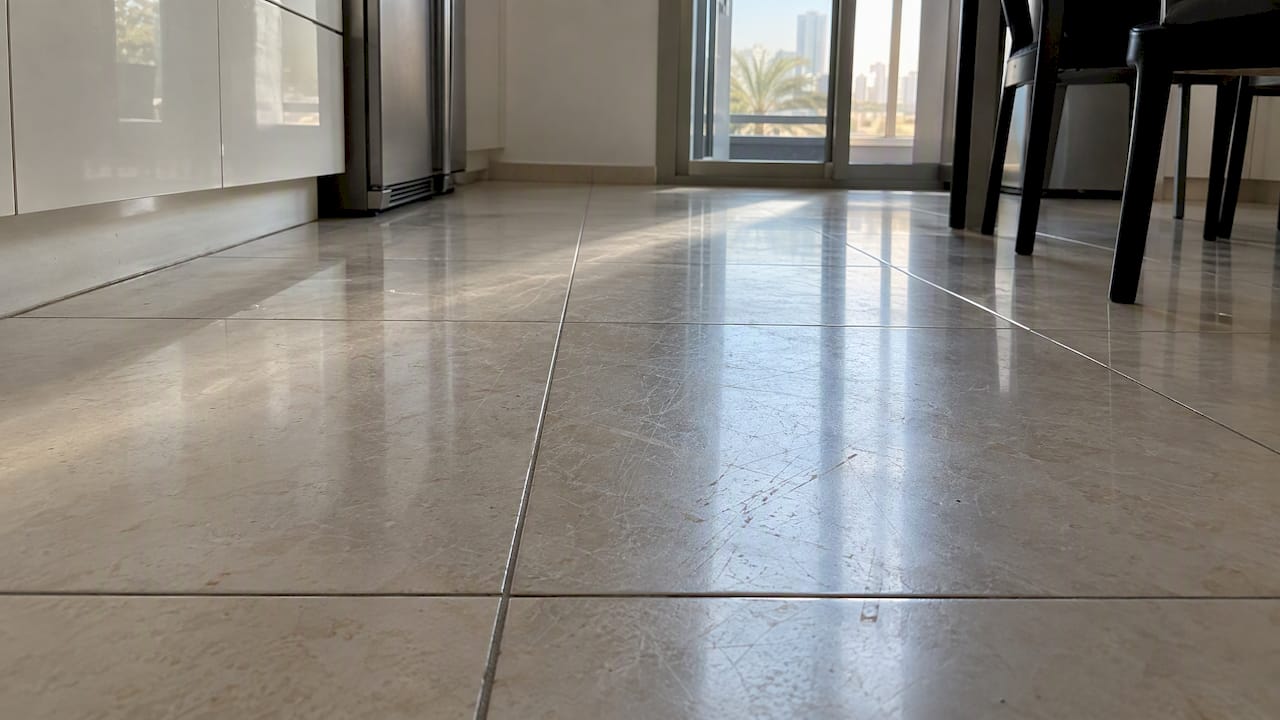
Travertine is also a soft, calcium-based stone. Acidic products, such as some bathroom cleaners, lemon-based cleaners or vinegar, etch it and leave dull patches. Gritty sand, which is everywhere in the UAE, scratches it underfoot. So a travertine floor often has three problems at once: missing filler, a dulled or scratched surface, and stains pulled deep into open pores.
A simple buff cannot solve that. If you polish over open holes, the pads catch on the edges and leave uneven patches around each cavity. That is why the filling stage comes before the shine, not after.
The restoration sequence, stage by stage
1. Inspection and test patch
Before any work begins, the floor is assessed: how many voids, how deep, whether there is an old coating or sealer, whether any tiles are loose or hollow, and whether the stone is a dense variety that will take a polish or a softer one best left honed. Some travertine simply does not hold a high gloss, and an honest contractor will tell you that at this stage.
A test patch in a low-visibility spot lets you see the filler color, the finished sheen and the curing behavior before committing the whole floor. Filler often looks different wet and dry, so judge the color only once it has fully cured.
2. Deep cleaning and stripping
Old sealers, wax, cleaning residue and ground-in dirt are removed first. Filler will not bond properly to a contaminated cavity, and a sealer left in place can leave the finish patchy. Stains are treated at this stage too. Oil, rust and water marks sit differently in the stone and need different treatments, so a one-size cleaner is a warning sign.
If you are dealing with water marks on nearby marble, our guide to removing marble water stains in Dubai covers what is safe to try before calling anyone.
3. Hole filling
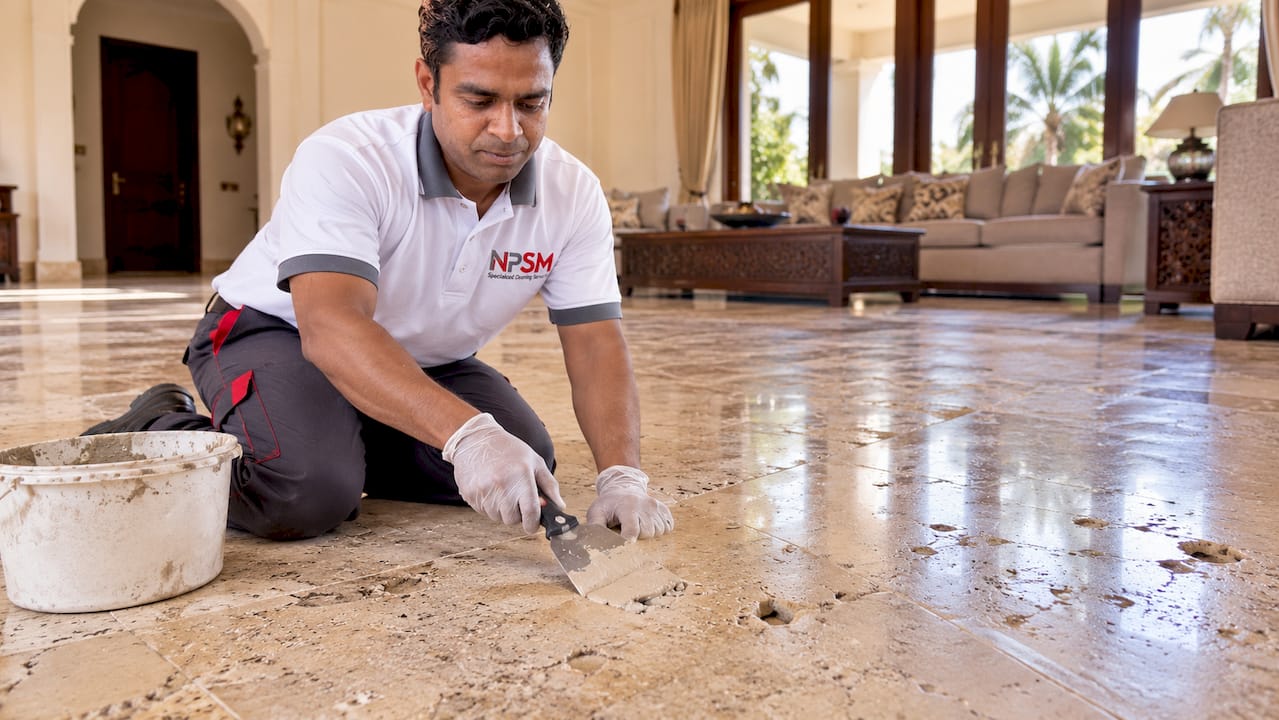
This is the stage that separates a durable job from a short-lived one. The cavities are cleaned out, then filled with a color-matched filler and left slightly proud of the surface so that the later grinding steps can level them flush with the stone.
The two common filler types behave differently:
| Filler | Strengths | Limits | Best for |
|---|---|---|---|
| Cement-based | Easy to apply, low cost | Cannot reach a high polish, wears faster | Honed finishes |
| Epoxy or polyester resin | Stronger, more durable, can be polished to match the stone | More labor-intensive, needs full curing | Polished finishes and high-traffic areas |
Two practical points matter in Dubai. First, humidity in summer and in coastal areas such as Palm Jumeirah, Dubai Marina and Jumeirah can slow the cure of resin. If the resin is not fully cured when the grinding pads touch it, the pads can pull it out of the hole. A good crew waits, rather than working to a schedule. Second, grinding often exposes voids that were hidden under the surface, so a second round of filling is normal. A floor that shows “new” holes after the first grind is not a sign of bad work. It is the stone revealing what was already inside.
4. Grinding
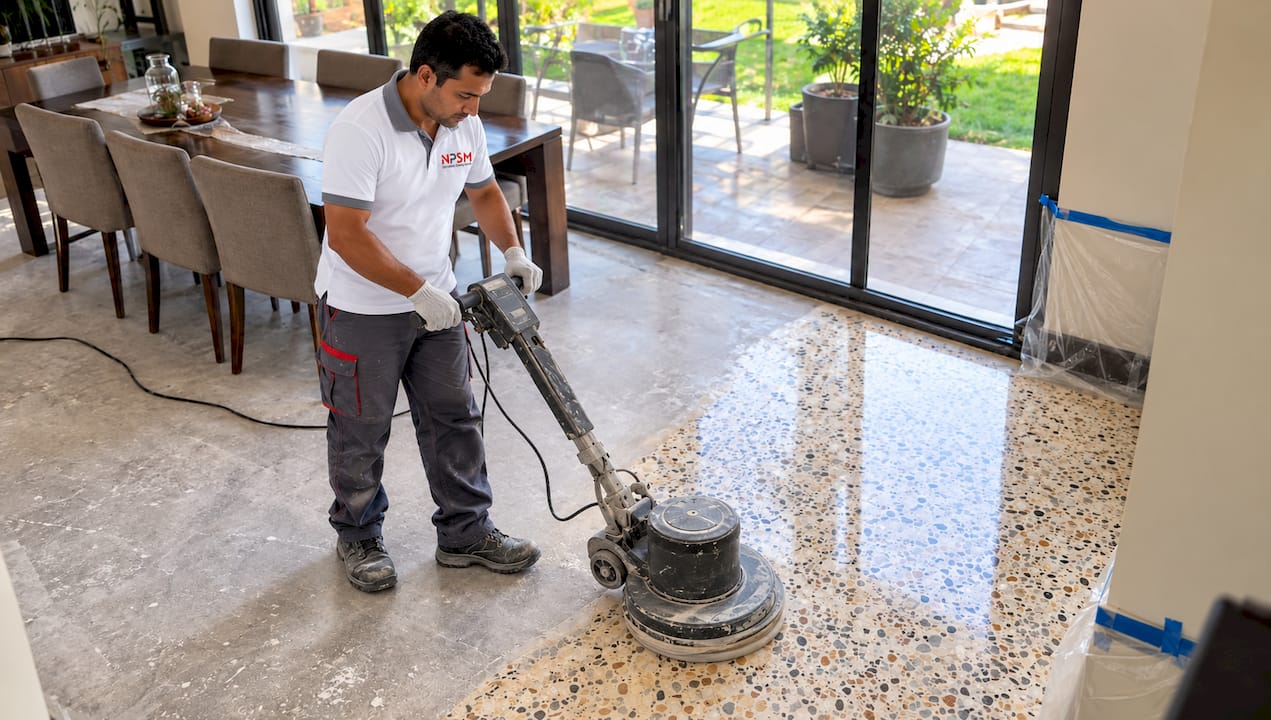
Diamond abrasives, starting coarser and moving finer, flatten the surface. This removes lippage (uneven tile edges), scratches, etching and the old damaged top layer, and levels the cured filler with the stone. The stage is dusty or wet depending on the method, and dust and slurry control is the main difference between a tidy site and a disruptive one in an occupied home. Ask how the crew will protect furniture, skirting boards, doors and lift lobbies.
5. Honing
Honing moves through progressively finer diamond grits to leave a smooth, even, matte-to-satin surface with no deep scratches. For many travertine floors this is the end point, and it is the finish most people choose for a natural, soft look. Honed travertine is more forgiving: small scratches and footprints show less, and it feels less slippery underfoot.
6. Polishing
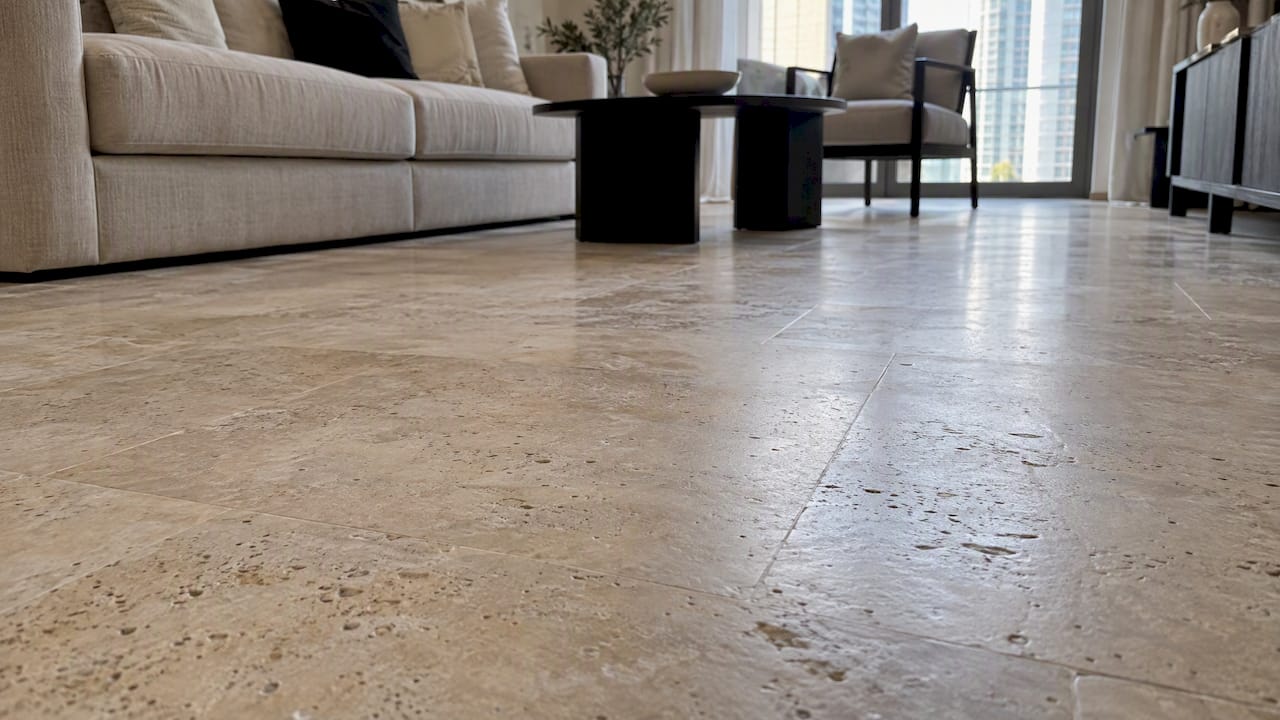
If you want a glossy surface, the process continues through the finest abrasives, sometimes with a polishing compound. The result is deep reflectivity and richer color in the stone. The trade-offs are real: gloss shows scratches and etch marks sooner, and a polished surface is slicker when wet. For bathrooms, pool decks and outdoor travertine, honed is usually the safer choice.
7. Sealing
Grinding opens the stone’s pores, so a penetrating sealer goes on after honing or polishing. It slows liquid absorption so spills can be wiped before they stain. It does not make the stone indestructible, and it does not stop acid etching, so your cleaning habits still matter. Our explainer on what floor sealing is and how it protects a Dubai home goes into sealer types and re-application.
Honed or polished: choosing the finish
| Question | Honed | Polished |
|---|---|---|
| Look | Matte to satin, natural | Glossy, reflective |
| Shows scratches | Less | More |
| Slip resistance when wet | Better | Lower |
| Suits | Villas, bathrooms, entrances, outdoor areas | Formal living rooms, lobbies, low-traffic feature areas |
| Filler needed | Cement-based or resin | Resin preferred |
| Upkeep | Simpler | Needs more careful routine cleaning |
If you are unsure, ask for both finishes on the test patch. Seeing them in your own light, with your own windows and lighting, beats any photo. Dubai’s strong daylight and warm downlights show surface flaws more than you might expect.
What affects the price
We publish a general range for floor polishing and restoration of 25 to 200 AED per sqm, depending on the floor type and the work involved. Our marble polishing and restoration starts from 30 AED per sqm. Travertine is not listed with its own price because the cost depends heavily on the condition of the floor, so we quote after seeing it.
The factors that move a quote the most:
-
Number and size of voids. A floor with scattered small pits costs far less than one where much of the filler has gone.
-
Filler type. Resin takes longer than cement-based filler, and it costs more for that reason.
-
Finish. Honing is quicker than a full polish.
-
Starting condition. Old coatings, deep stains, etching and lippage all add steps.
-
Area and access. Staircases, many small rooms and furnished spaces take longer than an open empty hall.
-
Sealing and follow-up care. Quality sealing adds to the cost but protects the result.
Be cautious of quotes far below the others. Skipping the fill-and-cure stage or the sealer is the easiest way to cut a price, and you only discover it a few months later.
Restoration or replacement?
Replacing travertine means demolition, disposal, new stone, new adhesive, and weeks of disruption, plus the risk that a new batch will not match the rest of your home. Restoration normally costs a fraction of that and takes days rather than weeks. Replacement makes sense when tiles are cracked through, hollow because the adhesive has failed, or damaged by water from below. A proper inspection tells you which case you have. If you are restoring after a fit-out, our post-renovation floor polishing guide explains how to sequence the work around other trades.
Our perspective: where travertine jobs go wrong in Dubai
We see the same mistakes again and again on villa and commercial travertine, and nearly all of them come from rushing the middle of the process.
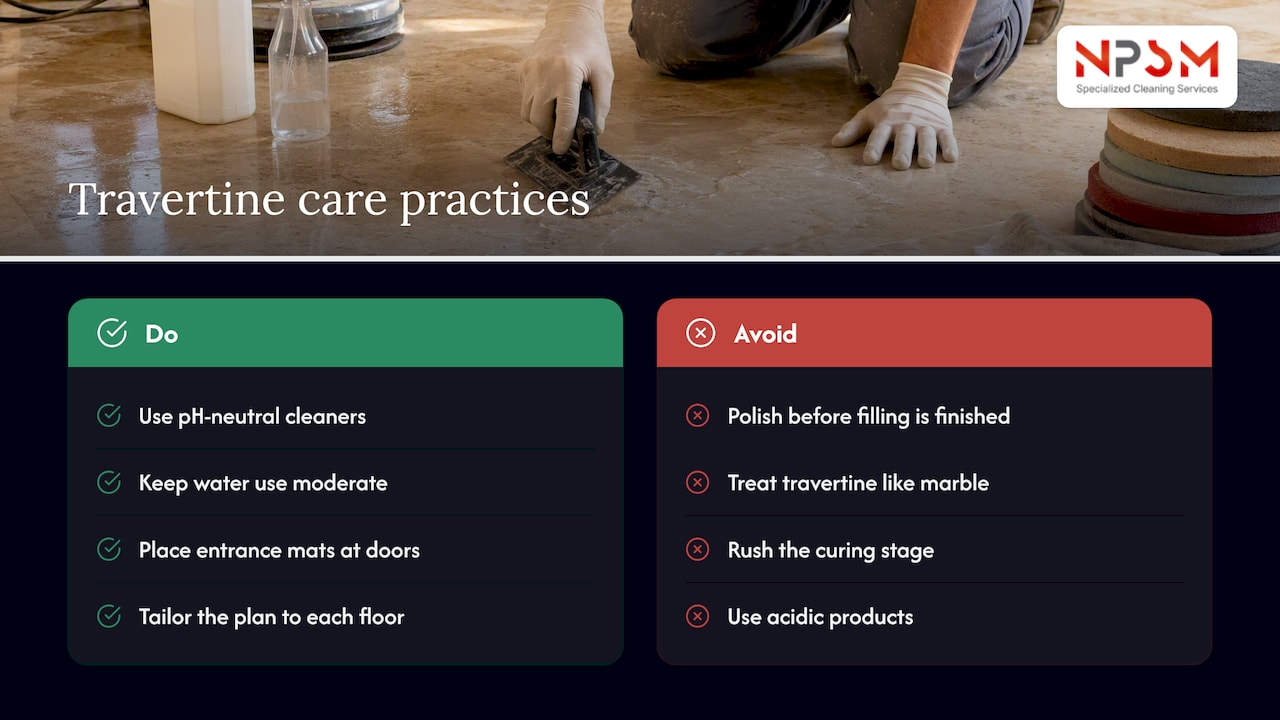
The first is polishing before the filling is finished. It looks good for a week, then the shadows around each hole appear. The second is treating all travertine as if it were marble. Marble can usually be taken to a high gloss with a standard routine. Travertine is softer, more porous and more variable from one batch to the next, so each floor needs its own plan. The third is a lack of patience with curing, which matters even more in humid months.
We tailor each job to the floor type and the property, and we use professional-grade diamond systems and eco-friendly products. We would rather tell an owner that a particular stone should stay honed than promise a mirror finish it cannot hold. After the work, how a floor is cleaned decides how long the result lasts. Use pH-neutral cleaners, avoid acidic products, keep water use moderate and put entrance mats at doors to trap sand. High-pressure water on filled travertine, for example, can wear away the fill over time.
— Qadir
After restoration: keeping the floor looking good
-
Mats at every outside door and on the terrace threshold. Sand does most of the scratching.
-
Dust mop daily, damp mop gently. Avoid soaking the floor or using steam machines.
-
Wipe spills quickly. Coffee, juice, cosmetics and perfume can leave marks even on sealed stone.
-
Use pH-neutral stone cleaners only. Avoid vinegar, lemon, bleach and general bathroom sprays.
-
Put felt pads under furniture.
-
Reseal on schedule. The interval depends on traffic and the sealer used, so ask your contractor for a realistic schedule for your property.
Our marble floor care tips for Dubai villas apply to travertine too, and the broader Dubai floor care guide covers mixed-floor homes.
Questions to ask before you hire
-
Will you do a test patch for filler color and finish before starting the full floor?
-
What filler will you use, and why for this finish?
-
How do you handle cure times in humid weather?
-
Will there be a second filling pass after grinding?
-
How is dust or slurry contained, and how will you protect furniture and finishes?
-
Which sealer, and what aftercare do you recommend?
-
Is the quote fixed, and what is included in it?
A contractor who answers these without hesitation has done this before. One who answers “we just polish it” has probably not.
Restoration for villas, hotels and commercial spaces
The method is the same, but the planning differs. In a villa, the work is usually room by room around the family. In a hotel, retail unit or office, work often runs at night or in phases so that areas stay open. Property and facility managers should ask for a phased schedule, a clear handover sign-off and a maintenance plan, so the restored finish is not undone by an unsuitable daily cleaning contract. We work across residential, hospitality, retail and corporate properties in Dubai and the UAE, and you can see where we operate on our areas we serve page.
Get your travertine floor assessed
If your travertine is pitted, dull, stained or scratched, we can inspect it, show you a test patch and give you a quote for the right finish. See our natural stone polishing and restoration service or browse all our floor polishing and restoration services. If you have marble alongside travertine, our marble polishing and restoration page covers that too.
FAQ
Can travertine holes be filled without replacing the tiles?
Yes. Holes and pits are cleaned out and filled with a color-matched filler, then ground flush with the surrounding stone. Replacement is only needed if tiles are cracked through, hollow underneath or damaged by water from below.
Why do new holes appear after the first grind?
Grinding removes the top layer of stone and can expose voids that were just under the surface. This is normal for travertine, which is why a second filling pass is common before the final honing or polishing.
Should I choose a honed or a polished finish for my villa?
For most villas, honed is the more practical choice: it hides scratches better and is less slippery when wet. Polished suits formal, low-traffic areas where you want gloss. A test patch showing both is the best way to decide.
How much does travertine restoration cost in Dubai?
Our published rate for floor polishing and restoration is 25 to 200 AED per sqft depending on the floor and work, and marble polishing starts from 30 AED per sqm. Travertine has no fixed price because the number of voids, the filler and the finish change the work, so we quote after inspecting the floor.
Do I need to seal travertine after polishing?
Yes. Grinding, honing and polishing open the stone’s pores, and a penetrating sealer reduces how fast liquids soak in. It buys you time to wipe spills, but it does not prevent etching from acids.