
TL;DR:
- Floor restoration repairs and refines floors to restore their original look and structural strength. Moisture, surface scratches, and wear layer thickness determine whether floors can be restored or need replacement. Professional assessment helps property owners in Dubai choose the most cost-effective and sustainable solution.
Floor restoration is the process of repairing, refinishing, or resurfacing a floor to recover its original appearance, structural integrity, and protective finish. The signs you need floor restoration range from visible surface scratches and dull finishes to deeper structural problems like warping, moisture damage, and loose boards. Catching these indicators early is the difference between a cost-effective refinishing job and a full floor replacement. For Dubai property owners managing villas, offices, or hotel suites, restoration delivers better ROI than replacement when the subfloor is structurally sound.
1. What are the most visible signs you need floor restoration?
Surface-level floor damage indicators are the easiest to spot and the most commonly ignored. Scratches, scuffs, and gouges appear first in high-traffic corridors, near entryways, and under furniture. On marble and natural stone, etching from acidic cleaners leaves dull patches that no amount of mopping will fix.
The most reliable DIY check is the water bead test. Water that soaks into the floor rather than beading on the surface means the sealant has failed. A failed sealant exposes the floor material directly to moisture, foot traffic, and cleaning chemicals, accelerating deterioration.
Discoloration is another clear floor wear and tear sign. Dubai’s intense UV exposure fades wooden floors and vinyl near windows, creating uneven color patches that signal finish breakdown. Gray or black staining on wood often means moisture has already penetrated the surface layer.
Pro Tip: Walk your floors in low-angle light, such as early morning sunlight from a window. Raking light reveals surface scratches, dips, and finish wear that overhead lighting completely hides.
Key surface-level floor restoration warning signs include:
-
Deep scratches or gouges that catch a fingernail
-
Dull, flat appearance where the finish once had sheen
-
Discoloration, fading, or gray water stains
-
Rough or splintered texture on wood
-
Grout lines that are cracked, stained, or crumbling on tile floors
-
Visible gaps between boards or planks
Hardwood floors generally need professional refinishing every 5–15 years depending on foot traffic. In Dubai’s high-traffic commercial properties, that cycle shortens considerably.
2. How can moisture problems signal the need for floor repair?
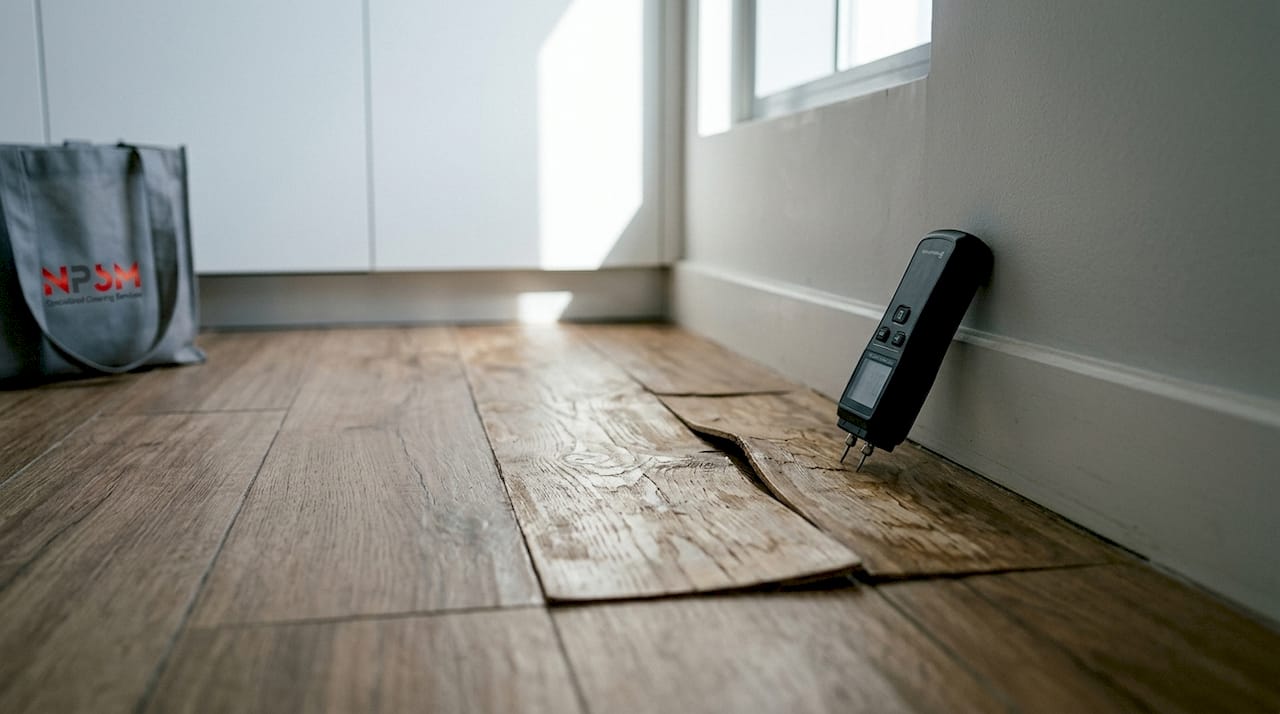
Moisture is the most destructive force acting on floors in Dubai, and it operates silently. Warping, buckling, and cupping in wooden floors are direct indicators of floor deterioration caused by moisture imbalance. Cupping occurs when the edges of a board rise higher than its center. Buckling is more severe, where boards physically lift off the subfloor.
Soft or spongy spots underfoot are a serious floor condition check result. They indicate that the subfloor beneath the surface material has absorbed moisture and begun to weaken. A floor that flexes when you walk on it is not just a cosmetic problem. It is a structural one.
A moisture content reading above 12% in a subfloor signals a moisture problem that must be resolved before any restoration work begins. Proceeding with refinishing over a wet subfloor traps moisture and causes the new finish to fail within months.
Musty odors near floor level are a hidden moisture indicator. In Dubai apartments and villas with ground-floor slabs, condensation from air conditioning systems can migrate into flooring materials without any visible surface sign. The smell appears before the damage becomes visible.
Pro Tip: Do not rely on a single moisture reading. Testing 20 or more locations per 1,000 square feet gives an accurate picture of moisture distribution across the subfloor.
Watch for these moisture-related floor damage indicators:
-
Boards that cup, bow, or buckle
-
Soft or springy spots when walking
-
Persistent musty smell near floor level
-
Dark staining or mold growth at board edges
-
Tiles that crack or pop loose due to subfloor movement
3. When does wear layer thickness determine restoration vs. replacement?
The wear layer is the amount of usable wood above the tongue-and-groove joint in a hardwood plank. When this layer is too thin, sanding removes structural material rather than just the finish. Solid hardwood floors allow 6–10 refinishing cycles, with each cycle removing 1/32 to 1/16 inch of wood. Once the wear layer drops below 1/8 inch, restoration is no longer safe.
Visible nail heads are the clearest sign that sanding limits have been reached. When floors feel unstable or reveal nail heads, the wood above the fasteners is gone. Sanding further would damage the structural layer of the plank.
Exposed tongue-and-groove joints are equally telling. If you can see the interlocking edges between boards at the surface level, the floor has been sanded to its mechanical limit. Any further restoration attempt risks creating uneven surfaces and structural weakness.
Excessive previous sanding reduces restoration options significantly. Poor workmanship in prior refinishing jobs compounds this problem by removing more material than necessary. Dubai property owners buying older villas or commercial spaces should always request a wear layer assessment before committing to restoration.
| Condition | Recommended Action |
|---|---|
| Wear layer above 1/8 inch, no structural damage | Restoration and refinishing |
| Wear layer below 1/8 inch, nail heads visible | Full replacement required |
| Surface scratches, intact sealant failure | Surface polishing or recoating |
| Cupping with moisture content above 12% | Moisture remediation, then assess |
4. What structural signs mean restoration is no longer viable?
Structural floor damage is the point where restoration stops being a practical option. When more than 30% of a floor’s surface shows warping, cupping, or rotting, replacement is the more cost-effective path. Restoring a floor with widespread structural failure costs more in labor and materials than installing new flooring.
Rotting wood, mold colonies, and insect damage are non-negotiable replacement triggers. These conditions compromise the subfloor and the structural layer simultaneously. No surface treatment corrects biological damage to wood fibers.
Loose or lifting tiles, boards that shift underfoot, and persistent squeaking beyond a single board all point to subfloor failure. A squeak from one board is a minor fastener issue. Squeaking across a wide area means the subfloor has separated from the joists or the adhesive bond has failed.
| Damage Type | Restoration Viable? | Action |
|---|---|---|
| Surface scratches and dull finish | Yes | Refinish or polish |
| Localized warping (under 30% area) | Yes | Sand, refinish, and seal |
| Widespread warping (over 30% area) | No | Replace |
| Rotting or mold-affected boards | No | Replace |
| Loose tiles with intact subfloor | Yes | Re-adhere and regrout |
| Subfloor separation or joist damage | No | Structural repair and replace |
Ignoring minor red flags like persistent squeaking or discoloration accelerates the path to full replacement. What costs a fraction of the price as a refinishing job becomes a major capital expense when structural damage sets in.
5. How does professional assessment guide the restoration decision?
Professional floor assessment is the most reliable method for determining whether restoration, refinishing, or replacement is the right path. A trained evaluator examines four factors: wear layer thickness, moisture history, subfloor condition, and long-term performance projection. Professional evaluation covers all four criteria to produce an accurate recommendation.
The assessment process for Dubai properties typically follows this sequence:
-
Visual inspection of the full floor surface for scratches, staining, warping, and finish condition
-
Moisture testing at multiple points across the subfloor using calibrated meters
-
Wear layer measurement to confirm remaining thickness above the tongue-and-groove
-
Structural integrity check for soft spots, loose boards, and subfloor separation
-
Material identification to confirm whether the floor is solid hardwood, engineered wood, marble, vinyl, or tile, since each material has different restoration thresholds
-
Decision framework output with a clear recommendation: restore, refinish, or replace
Dubai’s climate adds a layer of complexity that generic assessments miss. Rapid temperature shifts between air-conditioned interiors and outdoor heat cause wood to expand and contract more aggressively than in temperate climates. Marble and natural stone in coastal areas face salt air exposure that accelerates surface etching. A professional who understands these local conditions delivers a more accurate assessment than a standard checklist.
Many property owners choose replacement when restoration would have recovered near-original aesthetics at a fraction of the cost. Early professional intervention prevents that unnecessary expense. The step-by-step restoration process for Dubai homes confirms that most surface and moderate moisture damage is fully recoverable with the right technique.
Key takeaways
Distinguishing surface wear from structural damage is the single most important step in any floor restoration decision, and early action consistently delivers better results at lower cost.
| Point | Details |
|---|---|
| Surface signs come first | Scratches, dull finish, and failed sealant are the earliest and most treatable floor damage indicators. |
| Moisture is the hidden threat | Subfloor moisture content above 12% must be resolved before any restoration work begins. |
| Wear layer sets the limit | Solid hardwood allows 6–10 refinishing cycles; visible nail heads mean replacement is the only option. |
| 30% damage threshold matters | When more than 30% of a floor shows warping or rot, replacement costs less than restoration. |
| Professional assessment saves money | Expert evaluation of moisture, wear layer, and subfloor condition prevents costly replacement mistakes. |
What I’ve learned about floor restoration decisions in Dubai
Qadir here. After years of working with property owners across Dubai’s villa communities, hotel corridors, and commercial offices, the pattern I see most often is the same: owners wait too long. They notice the dull finish or the faint squeak and assume it is cosmetic. By the time they call for an assessment, the moisture has already reached the subfloor.
The cost gap between early restoration and late replacement is significant. A floor that needed a polish and reseal at year three becomes a full replacement project at year six. That gap is almost always the result of one missed inspection cycle.
Dubai’s climate makes this worse than in most markets. The combination of high indoor air conditioning use and outdoor heat creates constant expansion and contraction stress on every floor material. Marble etches faster near the coast. Wooden floors in ground-floor apartments absorb condensation from chilled slabs. These are not hypothetical risks. They are patterns I see repeatedly.
My honest recommendation is a professional floor condition check every 12–18 months for high-traffic commercial properties and every two years for residential properties. That schedule catches problems at the surface level, where restoration is straightforward and affordable. Waiting for visible structural damage is always the more expensive choice.
— Qadir
Professional floor restoration services in Dubai
NPSM Specialized Cleaning Services LLC provides floor restoration and polishing services across Dubai for marble, hardwood, vinyl, natural stone, terrazzo, and tile surfaces. Whether your property shows early surface wear or more advanced moisture-related damage, the team at FloorPolishing.ae conducts a full assessment before recommending any treatment. Services cover marble polishing and crystallization, wooden floor refinishing, grout restoration, and complete floor refurbishment for residential villas, commercial offices, hotels, and retail spaces. Booking a professional evaluation is the fastest way to know exactly what your floors need and what it will cost.
FAQ
What are the first signs my floor needs restoration?
The earliest floor restoration warning signs are surface scratches that catch a fingernail, a dull or flat finish where shine once existed, and water that soaks into the floor rather than beading. These indicate sealant failure and the need for refinishing.
How often do hardwood floors need professional restoration?
Hardwood floors require professional refinishing every 5–15 years depending on foot traffic levels. High-traffic commercial floors in Dubai may need attention sooner, particularly in lobby areas and corridors.
Can moisture damage be restored without replacing the floor?
Localized moisture damage can often be restored if the subfloor moisture content is brought below 12% before refinishing begins. Widespread warping affecting more than 30% of the floor surface typically requires replacement rather than restoration.
How do I know if my floor needs restoration or full replacement?
The key indicators are wear layer thickness, the percentage of damaged area, and subfloor condition. If nail heads are visible, the wear layer is gone and replacement is needed. If damage covers less than 30% of the surface and the subfloor is dry and stable, restoration is the right choice.
Is floor restoration cost-effective for Dubai luxury properties?
Restoration delivers strong value for luxury properties when structural integrity and the wear layer are intact. Replacing premium marble or hardwood flooring in a Dubai villa costs significantly more than professional polishing, grinding, and resealing the existing surface.