
TL;DR:
- Proper and scheduled floor care significantly extends flooring lifespan by preventing micro-abrasion, moisture damage, and finish wear. Consistent maintenance, including dry cleaning and pH-appropriate chemistry, avoids costly repairs and replacement in high-traffic environments. Professional restoration services can reverse extensive damage when routine cleaning is insufficient, maximizing return on investment.
The role of floor care in longevity is defined as the direct preservation of flooring materials through consistent cleaning, scheduled maintenance, and material-specific treatment protocols that prevent premature wear, staining, and structural degradation. For property owners and managers operating in high-traffic environments, flooring is one of the most capital-intensive assets in a building. Neglecting it does not just affect appearance. It accelerates replacement cycles, increases liability from slip hazards, and erodes property value. The good news is that most floor damage is preventable. Proper maintenance practices, from routine hard surface care to professional restoration, can extend floor lifespan by years and reduce total ownership costs significantly.
What is the role of floor care in longevity?
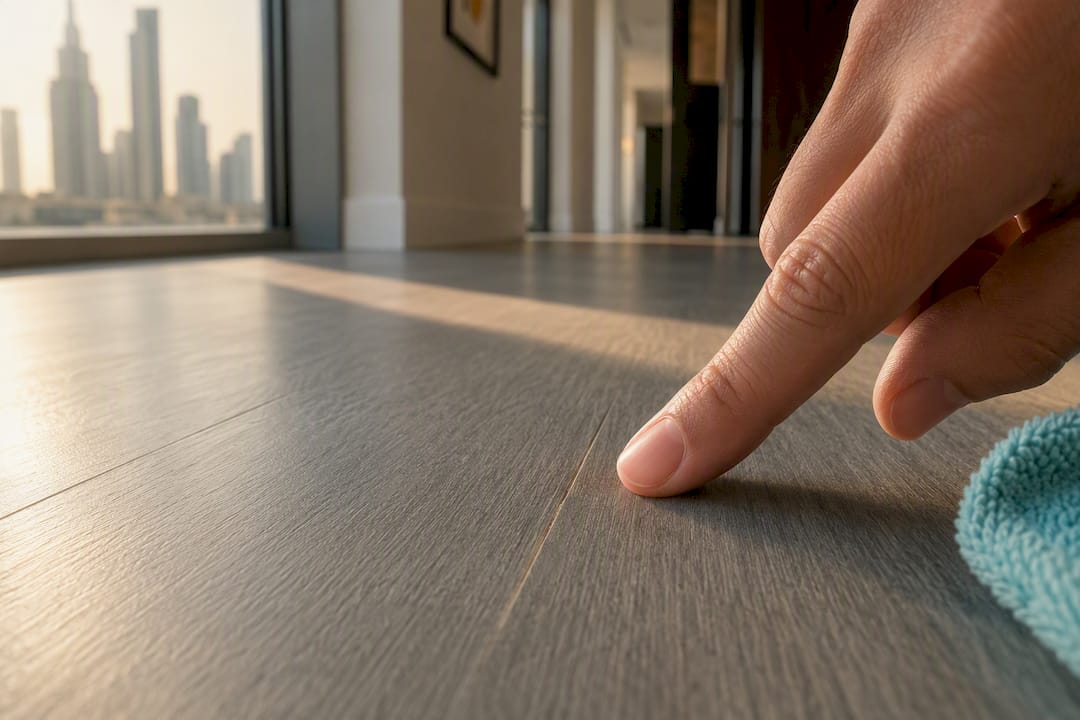
Floor care preserves longevity by removing the two primary causes of premature floor degradation: abrasive soil and moisture damage. Every time a person walks across an uncleaned floor, grit and debris act like sandpaper against the finish layer. Over time, this micro-abrasion strips protective coatings, dulls surfaces, and exposes the base material to staining and structural damage. The importance of floor upkeep becomes most visible in commercial settings where foot traffic compounds this effect daily.
The floor maintenance benefits extend beyond aesthetics. Clean, well-maintained floors reduce slip-and-fall incidents, improve indoor air quality by limiting dust and allergen buildup, and signal professionalism to clients and visitors. In Dubai’s hospitality and retail sectors, where marble, terrazzo, and polished stone are standard, a dull or scratched floor communicates neglect far louder than any other surface in a space.
Understanding the impact of floor care also means recognizing what happens when maintenance is deferred. Finish layers that could be restored with a simple recoat become permanently damaged. Grout lines that needed a quarterly clean become stained beyond recovery. The cost of replacement always exceeds the cost of prevention, often by a factor of five or more.
What are the fundamental floor cleaning techniques that impact longevity?
Proper floor cleaning techniques follow a two-phase protocol: dry removal first, then controlled wet cleaning. Skipping either phase or reversing the order accelerates damage rather than preventing it.
Here is the correct sequence for any hard floor surface:
-
Dry clean first. Sweep or vacuum the entire surface to remove loose debris, grit, and dust. Dry cleaning prevents abrasive grit from being pushed across the floor by a wet mop, which would grind particles into the finish rather than lifting them. This single step is the most commonly skipped in commercial cleaning routines, and its absence is the leading cause of premature finish wear.
-
Select the correct cleaning chemistry. pH compatibility matters across every flooring material. Acidic cleaners damage marble and natural stone. Alkaline cleaners cut through grease on tile but can strip wax finishes on vinyl composition tile (VCT). Neutral pH cleaners are the safest default for most hard surfaces.
-
Damp mop with a thoroughly wrung mop. Excess water is the enemy of hardwood, laminate, and any floor with grout joints. A mop that drips water introduces moisture into seams and subfloor layers, causing warping, swelling, and mold growth over time.
-
Allow complete drying before foot traffic resumes. Wet floors attract soil faster and are a slip hazard. Rushing this step undoes the cleaning work.
Pro Tip: For high-traffic commercial floors, invest in a microfiber flat mop system rather than a traditional string mop. Microfiber lifts and traps particles instead of redistributing them, and it releases significantly less water onto the surface.
The three most common mistakes property managers make are skipping the dry sweep, using the wrong cleaning product for the floor material, and over-wetting the surface. Each of these errors compounds over time. A floor that looks clean after a wet mop without prior sweeping has simply had its abrasive grit redistributed in a thin, wet film that dries back onto the finish.
How does maintenance scheduling enhance floor lifespan in high-traffic settings?
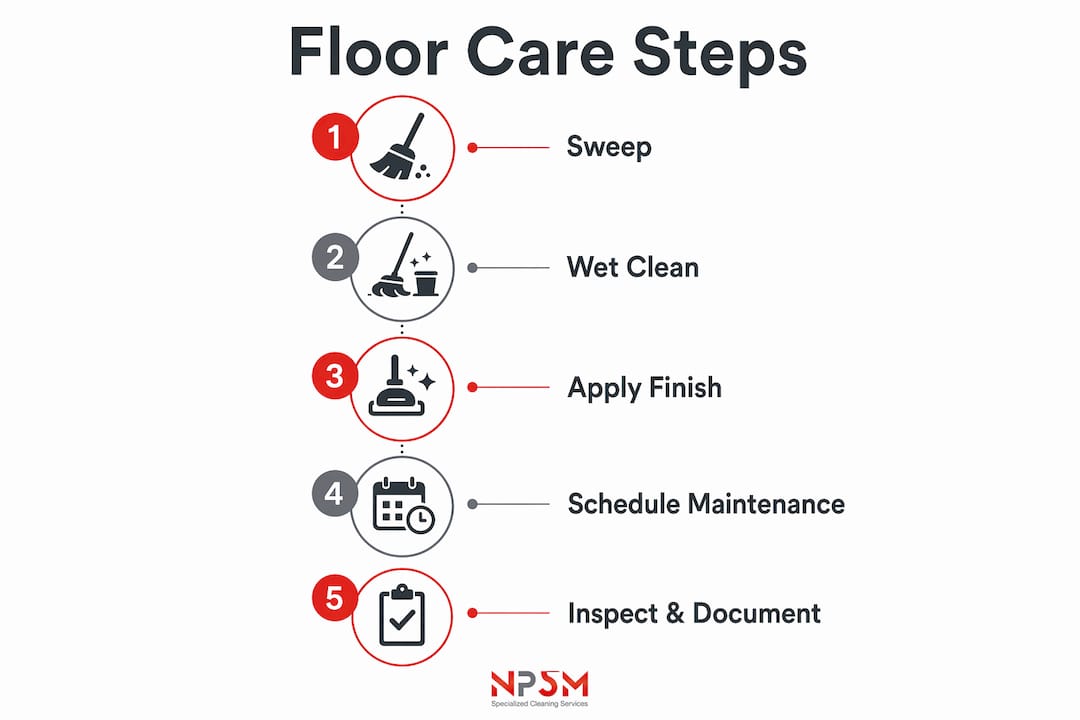
Scheduled maintenance is the difference between a floor that lasts 15 years and one that requires replacement in 7. The concept of “finish management drift” describes what happens when property managers rely on visual inspection alone to trigger maintenance. By the time a floor looks bad, the finish layer is already compromised.
For VCT floors, the industry-standard schedule is clear. Recoating every 3 to 6 months in high-traffic areas replenishes the protective wax layer before it wears through. A full strip-and-refinish cycle is required annually or biannually depending on traffic volume. This matters because burnishing, which uses a high-speed buffer to restore gloss, only works while the finish layer is still intact. Once the finish wears through to the base material, burnishing causes further damage rather than restoring shine.
Key scheduling benchmarks for high-traffic floors:
-
Daily: Dry sweep or dust mop all hard surfaces, spot-clean spills immediately
-
Weekly: Damp mop with appropriate pH-neutral cleaner, inspect entrance mat condition
-
Monthly: Deep clean grout lines on tile, inspect finish integrity on VCT and hardwood
-
Quarterly: Recoat VCT in high-traffic zones, apply sealant to natural stone where needed
-
Annually: Full strip-and-refinish for VCT, professional sanding and recoating for hardwood, scheduled inspections to assess subfloor condition
The financial case for scheduled maintenance is straightforward. A VCT recoat costs a fraction of a full strip-and-refinish job, which itself costs a fraction of floor replacement. Property managers who treat maintenance as a line item rather than a reactive expense consistently report lower total flooring costs over a 10-year period.
Pro Tip: Document your floor’s finish condition with dated photographs at each maintenance interval. This creates a visual record that helps you identify finish management drift before it becomes irreversible damage.
What are the best floor care practices for common flooring types?
The longevity of flooring depends heavily on matching cleaning chemistry and technique to the specific material. Generic cleaning protocols applied across all floor types cause more damage than they prevent.
Hardwood floors require the most careful moisture management of any common flooring material. Vacuuming hardwood first is non-negotiable because dirt acts as an abrasive that scratches the finish with every footstep. Avoid acidic cleaners, steam mops, and any product that leaves a residue. The mop should be barely damp, not wet. In Dubai’s climate, where air conditioning creates low-humidity environments, hardwood also needs monitoring for shrinkage and gapping.
VCT and vinyl floors rely on a layered finish system. The base sealer, finish coats, and top coat each serve a distinct protective function. Using the wrong wax product or applying finish over a contaminated surface traps dirt beneath the coating and creates yellowing. Dust mopping frequency directly determines how long each finish coat lasts. For vinyl floor care in Dubai properties, consistent dust mopping and correct product selection are the two highest-impact practices.
Tile and grout present a different challenge. The tile surface itself is highly durable, but grout is porous and absorbs soil, bacteria, and staining agents. Alkaline cleaners with adequate dwell time, typically 5 to 10 minutes, break down organic soil in grout channels. Scrubbing before the cleaner dries is critical. Sealing grout annually after deep cleaning prevents future absorption.
Carpet in commercial settings requires enzymatic cleaners for organic stains and hot water extraction for periodic deep cleaning. Surface vacuuming removes dry soil but does not address embedded particles or biological contaminants. Extraction cleaning, performed quarterly in high-traffic areas, is the only method that genuinely resets carpet condition.
| Floor type | Primary risk | Key maintenance action |
|---|---|---|
| Hardwood | Moisture and abrasion | Vacuum first, barely damp mop, no acidic cleaners |
| VCT/Vinyl | Finish wear and yellowing | Regular dust mopping, scheduled recoating |
| Tile and grout | Grout staining and porosity | Alkaline cleaner with dwell time, annual grout sealing |
| Carpet | Embedded soil and biological load | Enzymatic spot treatment, quarterly extraction |
Pro Tip: Always test a new cleaning product on a small, inconspicuous area before applying it to the full floor. pH incompatibility can cause immediate finish damage that is visible only after the floor dries.
What overlooked factors do professionals use to protect floor longevity?
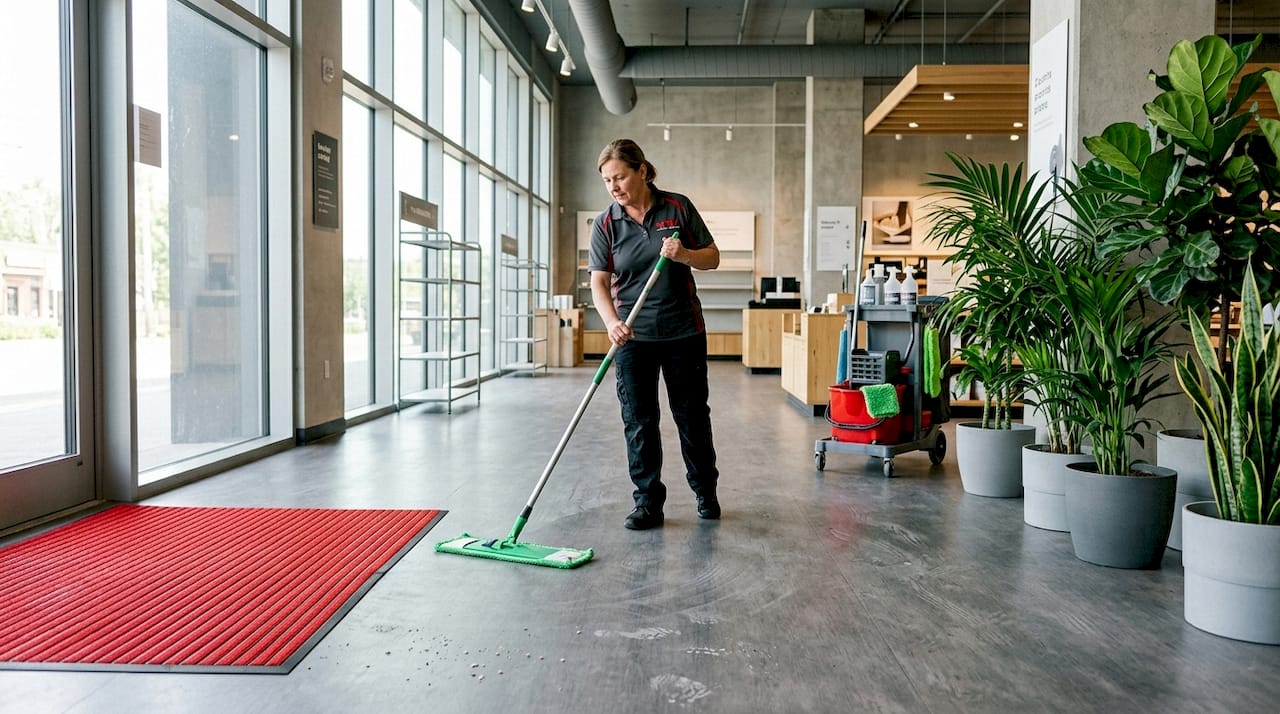
The most impactful floor care decisions happen before a mop ever touches the surface. Soil management at entry points is the single most underutilized strategy in commercial floor maintenance. Entrance mats capture abrasive soil before it migrates indoors, reducing the daily abrasion load on interior floors by a measurable margin. A mat that is not cleaned regularly, however, becomes a soil reservoir that deposits grit onto shoes rather than capturing it.
Professional floor care programs for high-traffic Dubai properties consistently identify three practitioner failures that accelerate floor deterioration:
-
Waiting for visible damage before acting. Delayed maintenance causes irreversible floor damage and dramatically increases restoration costs. Finish layers that could be recoated for a modest fee require full stripping and refinishing once they wear through.
-
Mixing incompatible products. Applying a new wax over a surface cleaned with a stripper residue, or using an alkaline cleaner before a pH-sensitive sealant, creates chemical reactions that cloud finishes and weaken adhesion.
-
Over-wetting during routine cleaning. Excess moisture introduced daily through improper mopping technique accumulates in subfloor layers, causing long-term structural damage that no surface treatment can reverse.
“The floors that last the longest in commercial properties are not the most expensive ones. They are the ones with the most consistent maintenance programs.” This observation from professional floor care practitioners in high-traffic facility management captures the core principle: discipline in maintenance outperforms material quality every time.
The hard surface cleaning checklist approach, where each maintenance step is documented and verified rather than assumed, is the operational standard that separates properties with 15-year floor lifespans from those replacing floors every 5 years.
Key takeaways
Consistent, scheduled floor care is the single most cost-effective strategy for extending floor lifespan in high-traffic properties, outperforming material upgrades and reactive repairs.
| Point | Details |
|---|---|
| Dry clean before wet cleaning | Always sweep or vacuum first to prevent abrasive grit from grinding into the finish during mopping. |
| Match chemistry to material | Use pH-appropriate cleaners for each floor type to avoid finish damage and ensure effective soil removal. |
| Schedule maintenance proactively | Follow recoating and refinishing intervals based on traffic volume, not visual appearance alone. |
| Manage soil at entry points | Maintain entrance mats to reduce abrasive soil migration and protect interior floor finishes daily. |
| Act before damage is visible | Waiting for floors to look bad before intervening guarantees higher restoration costs and shorter floor lifespan. |
Why I stopped treating floor care as a reactive task
After working with property managers across Dubai’s commercial and hospitality sectors, the pattern I see most often is this: a floor that was installed at significant cost gets cleaned inconsistently for three years, then requires a full restoration that costs nearly as much as the original installation. The property manager is frustrated. The floor looks recovered. And then the cycle repeats because the underlying maintenance protocol never changed.
The floor care practices that genuinely extend floor life are not complicated. They are just consistently ignored in favor of more visible facility priorities. What I have found is that the properties with the best-looking floors after five years of heavy use are almost never the ones with the most expensive materials. They are the ones where someone decided to treat floor maintenance as a scheduled, documented program rather than a response to complaints.
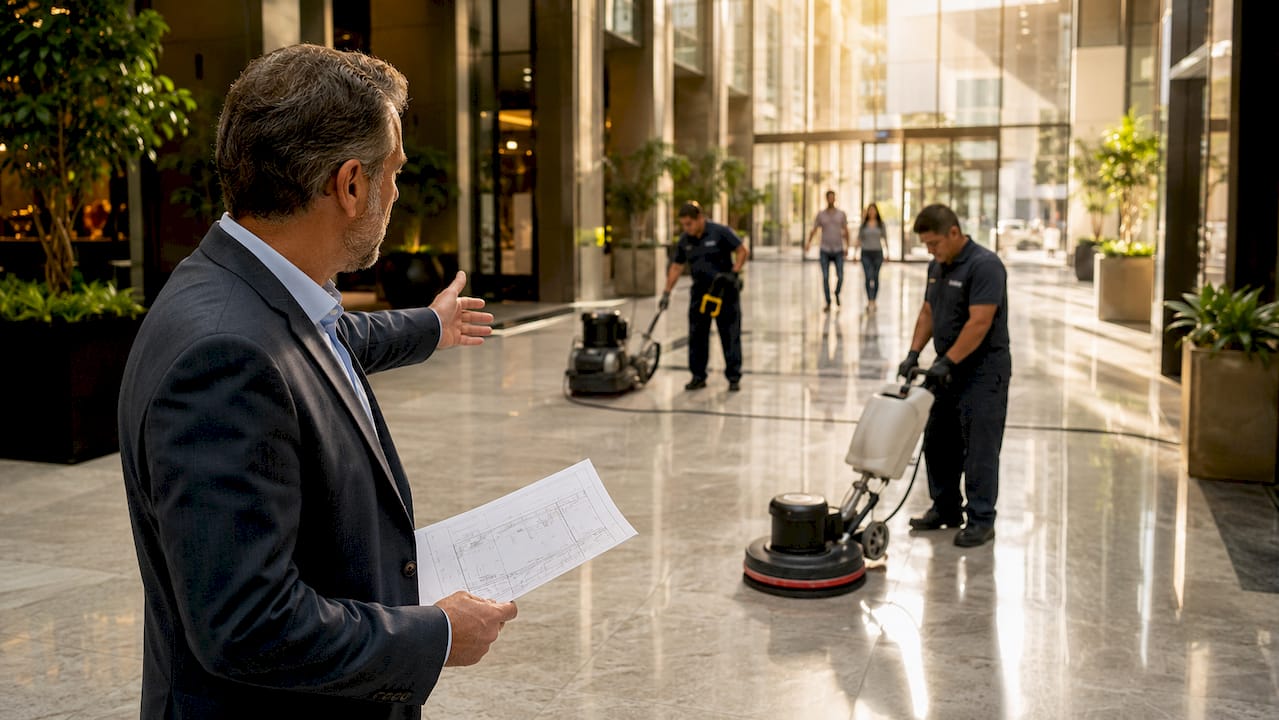
For marble, terrazzo, and natural stone floors specifically, which are standard in Dubai’s premium residential and commercial properties, the gap between a maintained floor and a neglected one becomes visible within 18 months. Etching from acidic spills, loss of reflectivity from micro-scratching, and grout discoloration are all preventable with the right protocols applied at the right intervals. Professional partnerships with specialists like NPSM Specialized Cleaning Services LLC make this practical for property managers who cannot maintain in-house expertise across every floor type.
The best investment you can make in your flooring is not a better product. It is a better program.
— Qadir
Restore and protect your floors with professional expertise
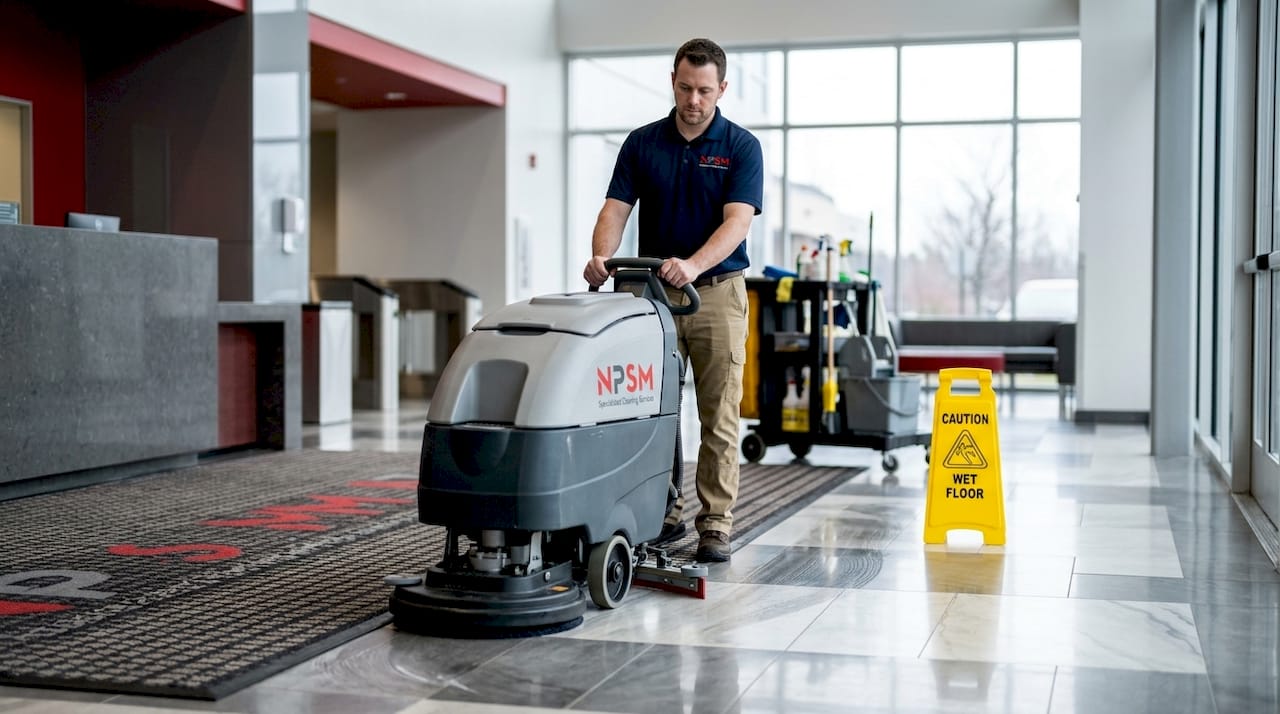
If your floors have already moved past the point where routine cleaning can recover their appearance, professional restoration is the cost-effective path before replacement becomes the only option. NPSM Specialized Cleaning Services LLC, operating through FloorPolishing.ae, provides floor polishing and restoration services across Dubai for marble, vinyl, hardwood, terrazzo, granite, and natural stone surfaces. Their team uses diamond polishing systems and professional-grade equipment to reverse wear, scratching, etching, and finish degradation without replacing the floor. For luxury Dubai properties where flooring represents a significant investment, a professional restoration program paired with an ongoing maintenance plan delivers the best return on that investment. Contact FloorPolishing.ae to assess your floors and build a maintenance program matched to your traffic levels and material types.
FAQ
What is the most important step in floor cleaning for longevity?
Removing loose debris by sweeping or vacuuming before any wet cleaning is the single most impactful step. Skipping this allows grit to act as an abrasive during mopping, which accelerates finish wear faster than foot traffic alone.
How often should VCT floors be recoated in high-traffic areas?
VCT floors in high-traffic environments require recoating every 3 to 6 months to maintain the protective finish layer. A full strip-and-refinish cycle is needed annually or biannually depending on traffic volume and finish condition.
Does pH matter when choosing a floor cleaner?
pH compatibility is critical for every flooring material. Acidic cleaners damage marble and natural stone, while alkaline cleaners can strip wax finishes on VCT. Neutral pH cleaners are the safest default for most hard floor surfaces.
Can entrance mats really extend floor lifespan?
Entrance mats capture abrasive soil before it reaches interior floors, directly reducing the daily wear load on finishes and coatings. Mats must be cleaned regularly to remain effective rather than becoming a source of soil redistribution.
When should a property manager call a professional floor care service?
When routine cleaning no longer restores appearance, or when finish wear has reached the base material, professional restoration is needed before damage becomes irreversible. Scheduling professional assessments annually prevents reaching that threshold unexpectedly.