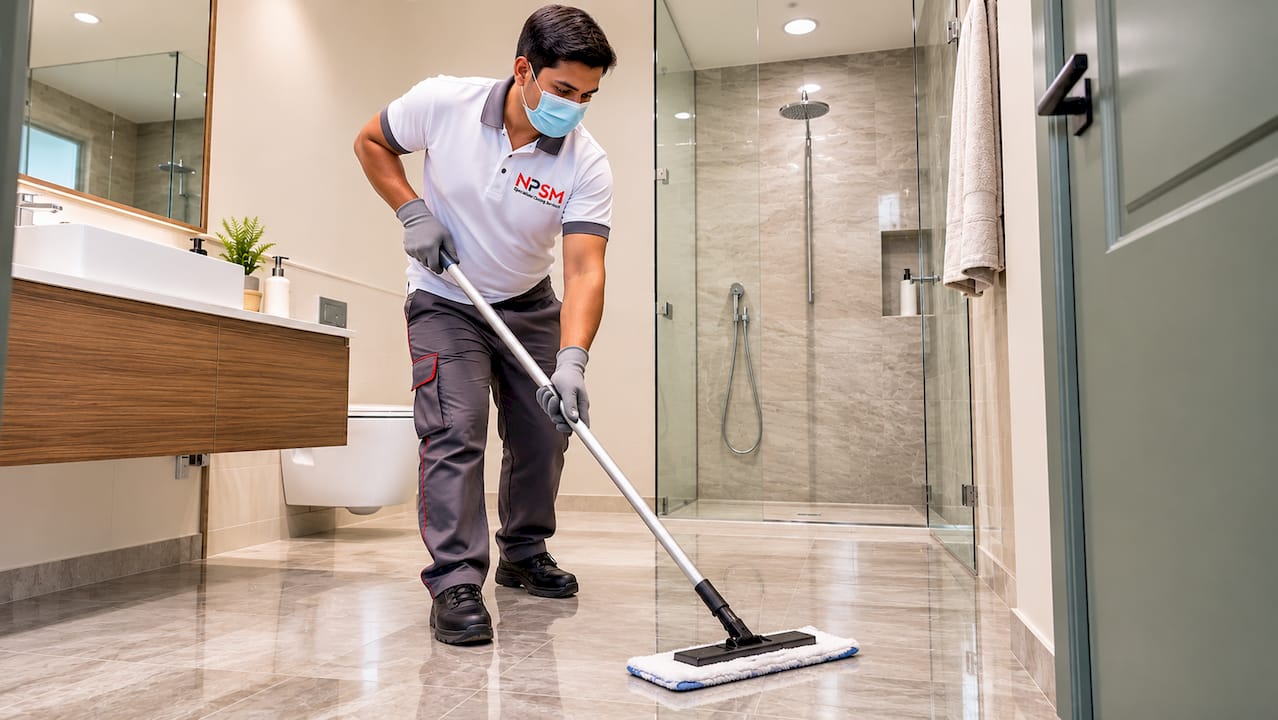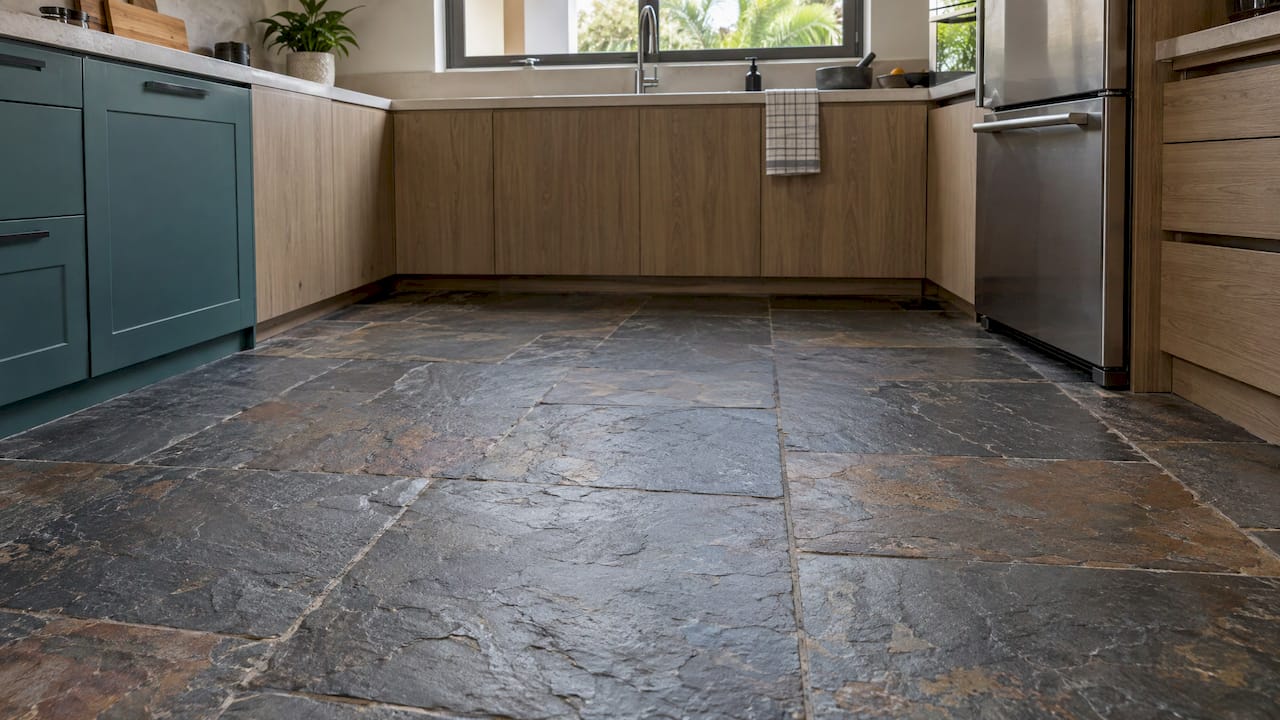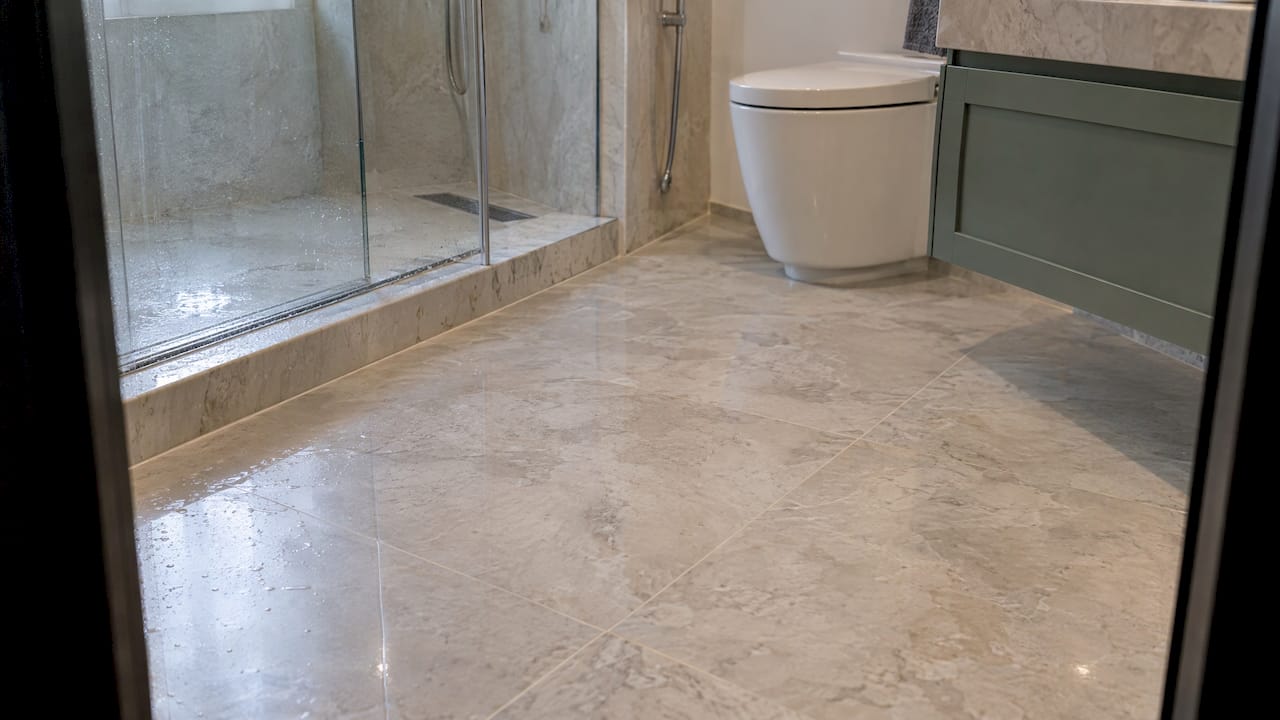

A hotel bathroom floor stays in good condition when three things are right: the cleaning chemistry matches the material, the floor is left completely dry after every service, and the surface is sealed, re-honed or polished on a schedule before wear shows. In Dubai, where hard water, humidity and constant turnover work against every floor, those three habits decide whether a bathroom floor lasts for years or needs replacing early. Below is the routine, the products to avoid, the periodic care, and the point at which professional restoration is cheaper than replacement.
TL;DR
- Clean the floor last, from the farthest corner toward the door, and leave it fully dry. Wet floors cause slips, staining and mould.
- On marble and other natural stone, use only a pH-neutral stone cleaner. Vinegar, limescale removers and bleach sprays etch the surface.
- Seal natural stone on installation and reseal roughly every 12 to 18 months, more often in showers.
- Treat dark grout, dull patches and rising slip complaints as early signs. Restoring is usually far cheaper than replacing.
- Keep cleaning records. Dubai Municipality’s hotel guidelines expect periodic cleaning and disinfection to be documented.
Table of Contents
- Why bathroom floors fail first in Dubai hotels
- Know your floor before you set the routine
- The daily routine, step by step
- Weekly and periodic care
- Marble and natural stone: the chemistry that matters
- Grout, silicone and moisture
- Slip safety on wet floors
- Records and compliance
- When maintenance is no longer enough
- Our marble and bathroom floor services
- Our perspective
- FAQ
Why bathroom floors fail first in Dubai hotels
A guest bathroom floor takes more punishment than almost any other surface in a property. It gets water daily, soap and body-oil residue, hair products, hard-water minerals, and housekeeping chemicals applied at speed. In an occupied room it is cleaned every day. In a city hotel with high occupancy it may be cleaned after every checkout as well.
Dubai adds two pressures. Tap water leaves limescale, and the usual answer to limescale is an acid. Acid is exactly what damages marble, travertine and limestone. Humidity is the second pressure: it slows drying, encourages mould in grout lines, and brings stain marks to porous stone, a point Dubai hotel housekeepers have made themselves in the trade press.
The result is that most bathroom floor problems are not wear. They are the cumulative effect of the wrong product, a floor left damp, or a sealer that has worn off unnoticed. All three are preventable.
Know your floor before you set the routine
A routine written for porcelain will damage marble, and a routine written for marble is slower than porcelain needs. Start with a floor audit: walk every room type and record the material, finish and condition.
| Floor type | Safe daily cleaner | Avoid | Periodic care |
|---|---|---|---|
| Marble, travertine, limestone | pH-neutral stone cleaner, damp mop | Vinegar, lemon cleaners, limescale removers, bleach sprays | Resealing every 12 to 18 months, honing or polishing as the finish dulls |
| Granite | pH-neutral cleaner | Strong acids, abrasive pads | Resealing, occasional polishing |
| Porcelain and ceramic tile | Neutral cleaner, rinsed well | Wax, sticky-residue degreasers, no-rinse products on textured tiles | Grout restoration, deep cleaning |
| Textured or non-slip tile | Neutral cleaner with dwell time, then thorough rinse | Wax, rotary machines above the manufacturer’s limit | Machine scrubbing with a suitable brush or pad |
| Terrazzo | pH-neutral cleaner | Acids, harsh alkalis | Polishing and sealing |
| Vinyl | Cleaner approved for the product | Abrasive pads, heavy solvents | Deep cleaning, polishing where the product allows |
If you are not sure what a floor is, identify it before the first cleaning cycle. Housekeeping staff cannot be expected to guess, and a wrong guess on natural stone is the most common way a bathroom floor is permanently marked.
The daily routine, step by step
The order below follows the clean-to-dirty, top-to-bottom logic used in professional housekeeping standards. The floor always comes last.
- Prepare. Ventilate the room, remove linen and waste, and set up color-coded cloths and mops reserved for the bathroom. Never use a bathroom mop elsewhere. Bathroom floors carry a higher bacterial load than other surfaces, so cross-contamination is the risk that tools are there to prevent.
- Clean the upper surfaces first. Mirror, glass, vanity, basin, taps and shower. Anything that drips lands on the floor, which is still to be cleaned.
- Clean the toilet last with tools reserved for that zone only.
- Dry-clean the floor. Sweep or vacuum loose grit and hair. Grit under a wet mop acts as sandpaper on polished stone and scratches the finish.
- Put out a wet-floor sign if the room or the corridor will be used while the floor is damp.
- Damp-mop with the right solution. Use the diluted product the floor type calls for, working from the farthest point toward the door. Use a clean mop head for every room. A dirty mop head spreads soil and leaves film on the floor.
- Rinse where the product requires it. Residue from cleaners is what makes textured tiles slippery and dull, so rinse with clean water.
- Dry. Squeegee or towel-dry, and pull water toward the drain rather than into corners. A floor that air-dries slowly in Dubai humidity is a floor that stains.
- Check before release. Look behind the toilet, in the corners, around the shower drain and along grout lines. Confirm the floor is dry and has no chemical smell. Then restock and do a final check from the guest’s point of view.
The checks in step 9 are where problems are caught early. A supervisor who looks at drain surrounds and corners every day finds a loose tile, blackened silicone or a stained patch while the repair is still small.
Weekly and periodic care
Daily cleaning removes soil. It does not restore the surface. Hotels that keep floors looking new pair daily cleaning with a rotating program of deeper work.
Trade reporting from the UAE describes this pattern. One Ajman hotel cleans marble, granite and tile daily but polishes on a fortnightly rotation, and a Dubai airport hotel pairs daily buffing with quarterly stripping and crystallization. A Dubai executive housekeeper described weekly polishing for marble in a five-star property. Your schedule depends on traffic and the stone, but the principle is the same: deep work is rotated through the building so that something is always being restored and nothing is left until it fails.
A workable framework for bathroom floors:
- Daily: dry-clean, damp-mop with the correct cleaner, dry, inspect.
- Weekly: machine scrub of high-use or heavy-soil rooms, drain and corner detail cleaning. Where you use an autoscrubber or rotary machine on textured tile, check the manufacturer’s maximum speed first. Some tile makers set the limit at 450 rpm.
- Quarterly: deep clean of grout lines, inspection of silicone joints, review of slip complaints.
- Every 12 to 18 months: resealing of marble, travertine and limestone, and sooner in showers with constant water exposure.
- As the finish dulls: honing and polishing of natural stone, or tile polishing and grout restoration.
Rotating rooms off the market for a day for this deeper work is far easier to plan around than an emergency closure after a guest complaint.
Marble and natural stone: the chemistry that matters
Marble is calcium carbonate, and acids dissolve it. That is why etching, the dull, cloudy patches that look like water rings, appears so quickly when the wrong product is used. In Dubai the temptation is strongest because limescale is a daily problem and most limescale removers are acidic.
The rules are simple:
- Use a pH-neutral stone cleaner for daily damp mopping. Do not use general floor detergents on marble.
- Do not use vinegar, lemon-based products, acidic descalers or bleach-based sprays on natural stone.
- Keep the descaling product for the glass, chrome and fixtures, applied so it never runs onto the floor.
- Wipe spills and product drips promptly, especially around vanities and showers.
- Place mats at doors to reduce grit and water carried between rooms.
- Choose and keep a penetrating sealer. Sealing slows staining by giving you time to wipe a spill before it soaks in. It does not make stone waterproof.
Descaling and disinfection are separate jobs. A standard disinfectant does not remove limescale, and a standard descaler does not disinfect, so a bathroom program normally needs a combined hard-water bathroom product for fixtures and a separate stone-safe product for the floor. Train staff on which bottle belongs to which surface. Monthly chemical training, as some Dubai five-star housekeeping teams run it, is a sensible benchmark because turnover in housekeeping staff is high and the cost of one wrong product on a marble floor is large.
For finish, polished marble is slippery when wet. For new bathrooms and refurbishments, a honed or brushed finish gives better grip than a high-gloss one. If a polished look is important in a wet room, an anti-slip treatment is available. Our guide to matte vs glossy floors explains how to choose.
Grout, silicone and moisture
Grout is often the first part of a bathroom floor to look old, and it is where moisture problems show first. Cement grout is porous. In showers it stains, cracks and can grow mould over time. Silicone at corners and around baths and basins allows for movement, but it has to be renewed once it peels or blackens. Epoxy grout resists water and stains better in wet areas, which is why it is widely recommended for shower floors.
Persistent black grout can mean more than dirt. Mould needs moisture, so dark grout that returns after cleaning may point to poor ventilation or a slow leak. Fix the cause or the stain returns.
For a hotel, the practical approach is to inspect grout during the daily check, deep clean lines quarterly, and restore grout when it is cracked, stained through or crumbling rather than replacing the tile. Our guides to grout cleaning and step-by-step grout restoration cover the process in more detail.

Slip safety on wet floors
Slip resistance is a guest-safety issue first and a liability issue second. Dubai’s building requirements call for wet-area floors that are smooth, hard, non-absorbent and non-slip. Slip resistance is commonly measured with the pendulum test, where higher values mean more grip, and showers and wet areas sit in the higher ranges. Ask the supplier for the rating when specifying new floors.
Maintenance can quietly undo a good specification. These are the usual causes of a floor that was grippy at handover and is not now:
- Cleaner residue. Wax, sticky degreasers and no-rinse products leave a film on textured tile that traps dirt and reduces grip.
- Soap and body-oil build-up. In wet barefoot areas, a mildly acidic cleaner used regularly on suitable surfaces stops this build-up. Check the product against the floor material first, and never on marble or other natural stone.
- Dirt in the texture. Textured and anti-slip tiles trap soil in their grooves, so a flat mop will not clean them. A suitable brush or machine and adequate dwell time do.
- Wrong abrasives. Aggressive pads or fast rotary machines can wear down the texture itself.
If you receive slip complaints from a room, treat that as a maintenance signal: inspect the floor, check what is being used to clean it, and consider deep cleaning or an anti-slip treatment before the next incident.
Records and compliance
Dubai Municipality’s technical guidelines for hotels and resorts expect periodic cleaning and disinfection of hotel facilities and frequently touched surfaces, cleaning records and reports, and hazardous materials, chemicals and disinfectants kept in designated storage. For bathrooms, that means a signed cleaning log by room, a chemical register, and secure storage of products. Public washrooms in a hotel are normally held to a higher frequency than guest rooms, with disinfection at least twice a day and frequent checks in high-traffic areas being a common standard.
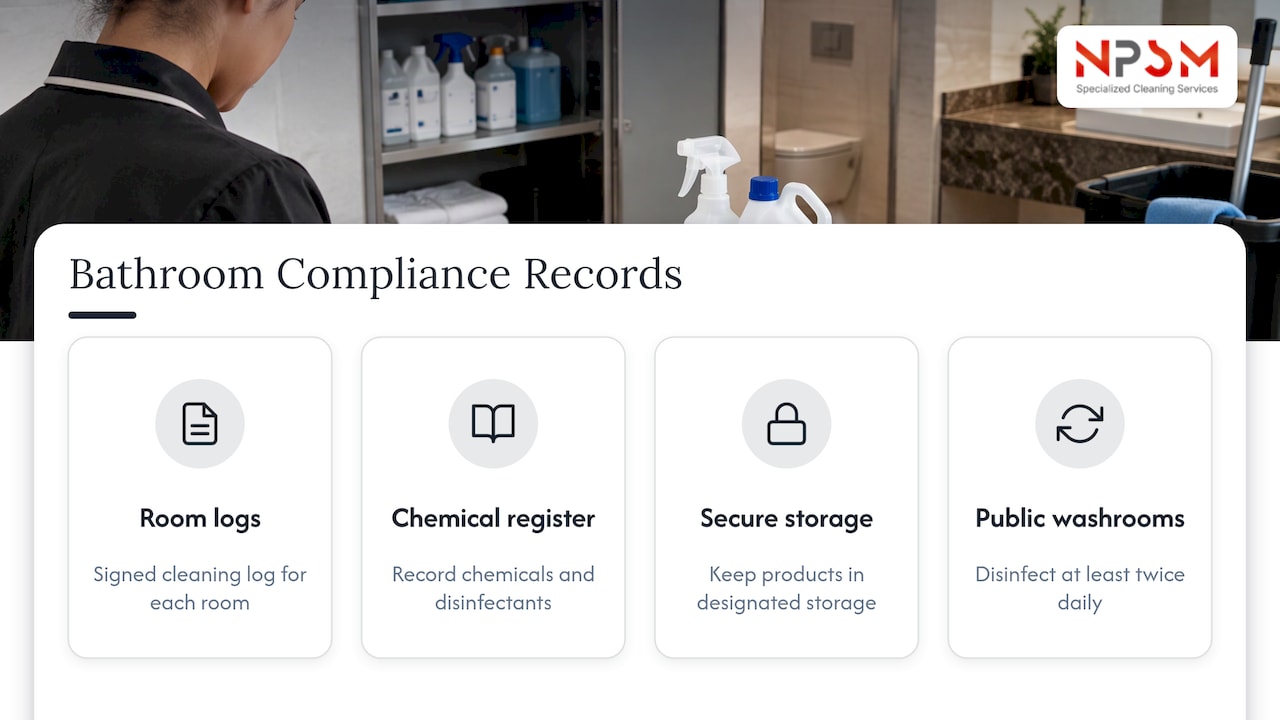
Good records also help your asset management. A log that notes the date a floor was last sealed, honed or re-grouted lets you plan restoration in a controlled way rather than reacting to complaints.
When maintenance is no longer enough
Even a well-run program reaches the point where cleaning cannot bring a floor back. Signs include:
- Etch marks and dull, cloudy areas that remain after proper cleaning.
- Deep stains from water, rust or product spills.
- Scratches that catch light across the room.
- Cracked, stained-through or crumbling grout.
- Lippage or loose tiles around the drain or door.
- A finish that has gone from satin to flat and now feels slippery.
At this stage the choice is usually between replacement and restoration. Replacement means demolition, new material, waterproofing work and weeks of lost room-nights. Restoration of marble, travertine, terrazzo, granite or tile through honing, polishing, grout restoration and resealing is a shorter job on the existing floor. For a hotel, a good plan is to restore a block of rooms at a time. Our guide to hotel bathroom tile restoration and our overview of hotel floor restoration show how this works at property level. For sealing, see what floor sealing does, and for choosing between grinding and polishing, marble polishing vs marble grinding.
Our marble and bathroom floor services
We polish and restore marble, natural stone, granite, terrazzo, tile and vinyl floors in hotels, hotel apartments, villas, offices and retail across Dubai and the UAE. For marble bathrooms we offer stain removal, polishing and buffing, and full restoration and repair, using professional-grade equipment and diamond polishing systems. For tiled bathrooms we offer deep cleaning, tile polishing and re-grouting. Details are on our marble polishing and restoration page and our tile polishing and grout services page. If you manage a property with many bathrooms, our services overview shows the full range.
Our perspective
Most of the bathroom floors we are called to see were not ruined by guests. They were damaged by the wrong product used in good faith, usually an acidic limescale remover on marble, or by a sealer that quietly wore out.
Our advice to hotel and property managers is to treat the floor as an asset with a service life. Match the cleaner to the stone, keep the floor dry, and plan honing, polishing, grout restoration and resealing on a calendar. Each of these is a repair on the surface you already own.
Restoration works on marble, travertine, terrazzo, granite and tile because the surface can be cut back and refinished. That is why we prefer to restore. It keeps the original material, avoids demolition, and costs far less than a new floor. We tailor the method to the floor type and the property, and we use eco-friendly products and certified professionals.
If your floors look tired, ask us to look at them before you budget for replacement.
Qadir
FAQ
How often should hotel bathroom floors be cleaned?
Guest bathroom floors are cleaned daily in occupied rooms and after every checkout. Public washrooms need disinfection at least twice a day, with more frequent checks in busy areas. Deeper work such as machine scrubbing, polishing and grout cleaning runs weekly, monthly or quarterly depending on the material.
What is the best cleaner for a marble bathroom floor?
A pH-neutral stone cleaner, applied with a damp mop and followed by thorough drying. Avoid vinegar, lemon cleaners, limescale removers and bleach-based sprays, because they etch marble. Keep descalers for fixtures and make sure they do not run onto the floor.
How do you clean a non-slip bathroom floor without losing grip?
Use a neutral cleaner, let it sit for the dwell time the manufacturer gives, scrub with a brush or machine suited to the texture, then rinse thoroughly. Avoid wax and products that leave a sticky film. Check the maximum machine speed for textured tile before using a rotary scrubber.
How often should marble bathroom floors be resealed?
Marble, travertine and limestone are normally resealed roughly every 12 to 18 months, and more often on shower floors that are constantly wet. If water no longer beads on the surface, or stains soak in quickly, the sealer has probably worn and it is time to reseal.
Can a stained, dull hotel bathroom floor be restored instead of replaced?
In most cases, yes. Marble, travertine, terrazzo, granite and tile can be honed, polished and resealed, and grout can be restored. We can inspect the floors and advise on what the surface needs. A floor that is cracked through or has failed waterproofing underneath is a different matter and needs a building assessment.