
Slate that has gone dull, patchy or stained can almost always be brought back without lifting a single tile. The key is a correct diagnosis first, then the right sequence: deep cleaning, repair, refinishing and sealing. Slate is a layered, natural stone, so the wrong chemical or the wrong machine can do lasting harm. We restore stone, tile, wood and other floors across Dubai, and for slate we work from the surface in front of us rather than from a fixed recipe. You can see our full range on our floor polishing and restoration services page.
TL;DR
- Dull patches, white haze, dark grout and uneven color that survive a proper clean mean the sealer is worn or the surface needs refinishing, not more scrubbing.
- Slate is not marble. It is usually finished by cleaning, repairing, honing where needed, color enhancing and sealing, not by crystallizing or high-gloss polishing.
- White deposits that keep returning point to moisture, and the moisture source must be dealt with before any sealer goes on.
- Restoration costs depend on area, condition, access and finish. We assess on site and quote from what we see.
- After restoration, neutral stone cleaners and a regular routine protect the result.
Table of Contents
- What slate is, and why it behaves differently from marble
- Signs your slate needs restoration, not just cleaning
- What damages slate in Dubai properties
- Why diagnosis comes before any product
- How professional slate restoration works
- What affects the cost
- Slate beside other floors in the same property
- Keeping restored slate in good shape
- Our perspective
- Ready to restore your slate floor?
- FAQ
What slate is, and why it behaves differently from marble
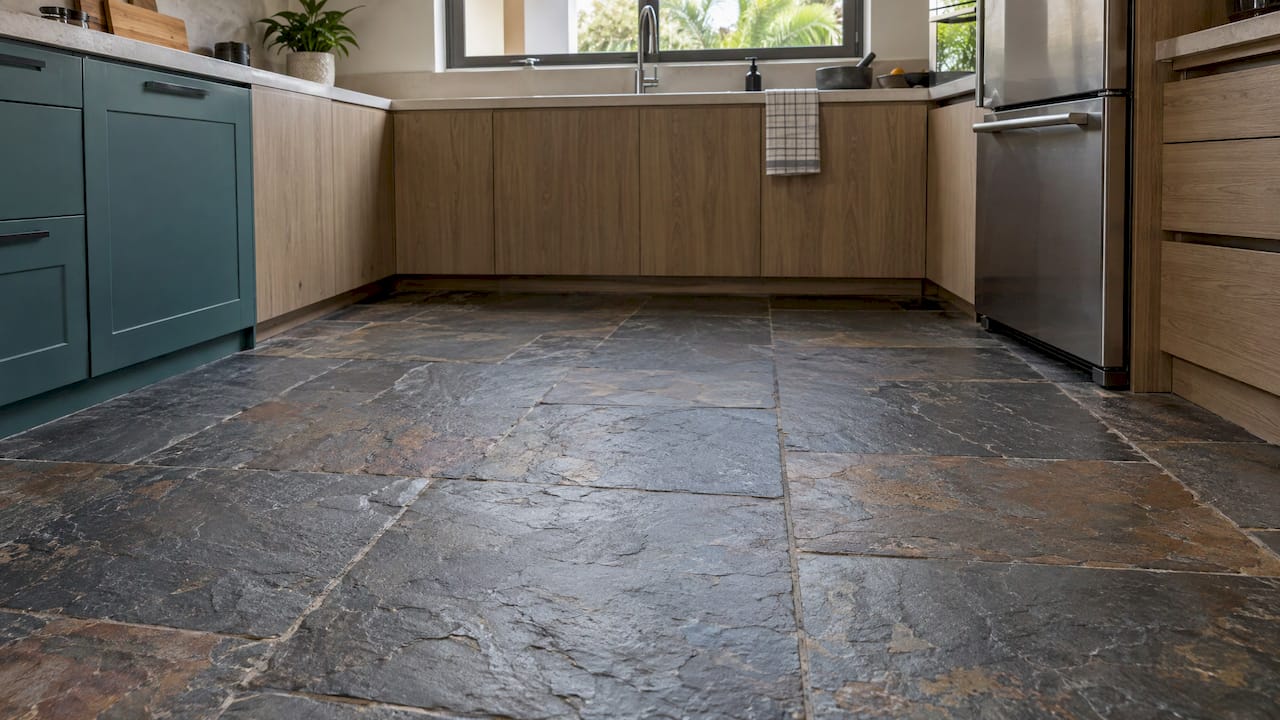
Slate is a fine-grained metamorphic rock that splits into layers. That is why it has the textured, naturally uneven look people choose for villa terraces, entrance halls, pool surrounds, kitchens and some hotel and retail spaces. It comes in two broad finishes: cleft, which keeps the natural split surface, and honed, which is ground flatter.
The layered structure matters for restoration. Marble is a dense, calcium-based stone that responds to grinding and high-gloss polishing. Slate has a matte, textured character, so the goal is not a mirror shine. The goal is even color, a clean surface, sound edges and a sealer that keeps water and stains out. If you are weighing slate against a polished stone, our guide on marble polishing vs marble grinding shows how different the two treatments are.
Signs your slate needs restoration, not just cleaning
A floor that is merely dirty responds to cleaning. A floor that needs restoration does not. Watch for these:
- Dull patches in walkways, kitchens and entrances where traffic has worn the finish.
- White haze or a cloudy film across the surface.
- Dark or stained grout that stays dark after cleaning.
- Uneven color, with some tiles looking lighter or darker than their neighbors.
- Stains that linger after a neutral cleaner.
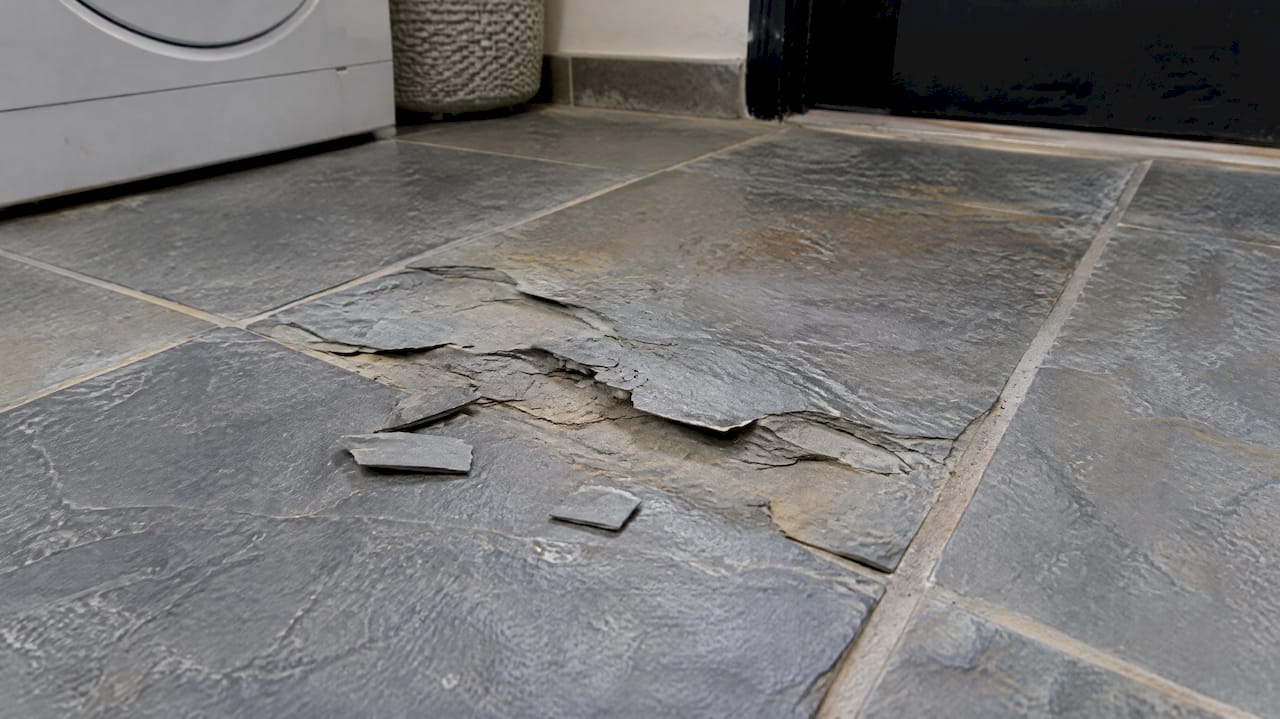
- Flaking, loose layers or rough edges, which are older damage that needs repair before any cleaning or sealing.
A trade magazine on cleaning and restoration groups the first set of signs as worn sealer or deep soil, and the last set as damage that needs repair first.
A simple test patch
Before you decide, sweep or vacuum away grit, then clean a small, hidden area with a neutral stone cleaner, rinse and let it dry. Compare it with the area next to it. If the gloss and color do not return, the problem is in the stone or the finish, not in dirt. Natural stone care guidance warns that repeatedly scrubbing a worn or etched floor can cause more damage, so stop at that point and have it assessed.
What damages slate in Dubai properties
Several causes recur. A stone-care supplier’s slate guide lists unsuitable setting beds, missing movement joints, persistent moisture, harsh cleaners, sealer applied to a damp floor, tracked-in grit, and heavy objects or structural stress.
In Dubai homes and buildings these show up in familiar ways:
- Grit. Fine sand tracked in from gardens, terraces and car parks scratches the surface like sandpaper.
- Wrong cleaners. Acidic or strongly alkaline products, bleach and general-purpose degreasers strip sealer and leave haze.
- Moisture. Pool surrounds, wet areas, irrigation near terrace edges and air-conditioning condensation feed moisture into the stone.
- Sealer problems. Sealer applied over a damp or dirty floor can trap problems or leave an uneven, blotchy finish.
The white deposit question
White powdery marks are often efflorescence: mineral salts carried to the surface by moisture. According to the same slate guide, they can come back if the moisture source stays. Removing the deposit without finding the source only buys time. This is the single most common reason a restoration looks good for a few months and then fails, so a proper moisture check belongs at the start of any job.
Progressive peeling, loose layers or pieces breaking away from the surface (flaking, also called spalling) should be inspected, not brushed off as normal shedding.
Why diagnosis comes before any product
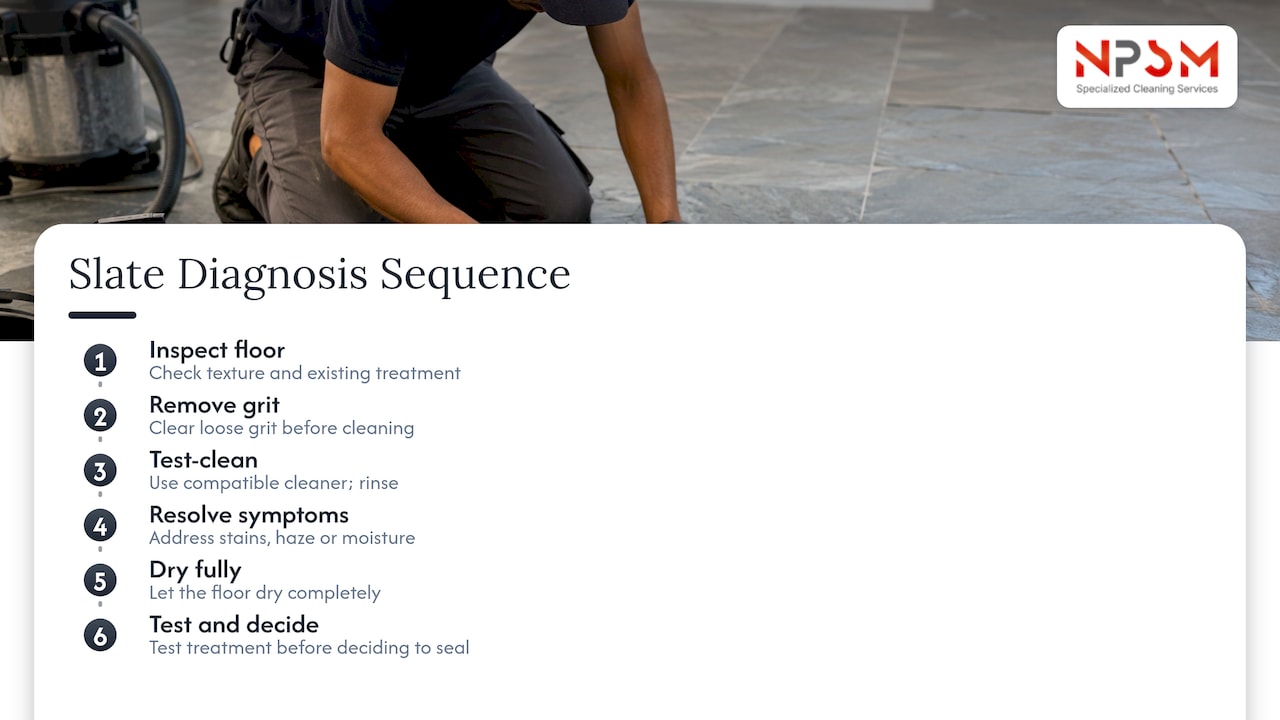
A dull slate floor may be dirty, coated with residue, scratched or covered by an old film. A slate care article makes the point that putting a new product on before identifying the problem can lock in stains, exaggerate uneven color, or create another coating that later has to be stripped. Its diagnostic order is a good model: inspect texture and any existing treatment, remove grit, test-clean with a compatible stone cleaner, rinse, resolve stains, haze or moisture symptoms, dry fully, test the proposed treatment, then decide on sealing.
This is the stage owners tend to skip, and it is where a specialist saves the most money. Sealing the wrong floor at the wrong time costs more to undo than the sealing cost to apply.
How professional slate restoration works
Every floor differs, but the work follows a logical order.
- Inspection. We identify whether the slate is cleft or honed, indoor or outdoor, what has been applied before, and where moisture or structural movement may be present.
- Deep cleaning. Grit, soil and old residues are removed with stone-safe chemistry matched to the floor.
- Stain and haze treatment. Stains, etching marks and haze are treated individually rather than with one aggressive product over the whole floor.
- Repairs. Chips, cracks, loose or lifted pieces and damaged grout are repaired. Tile re-grouting is part of our tile services.
- Surface refinishing. Where scratches or uneven wear remain, the surface is leveled and blended. A published slate guide describes minor scratches being blended with a further stone-oil application, and deeper scratches being sanded through progressively finer grits and then recolored, so no trace remains (UK slate guide).
- Drying and sealing. The floor must be fully dry before a penetrating sealer or color-enhancing treatment goes on. Our guide to the role of sealing natural stone explains why this step protects the work.
- Final inspection and care advice. You receive a clear routine for keeping the finish.
For a broader view of the sequence on other floors, see our step-by-step restoration guide for Dubai homes.
Where a job usually goes wrong
| Step | What goes wrong | Result |
|---|---|---|
| Cleaning | Acidic or harsh product used | Etching, haze, stripped sealer |
| Moisture check | Skipped | White deposits return |
| Refinishing | Wrong abrasive or too aggressive | Uneven, scarred surface |
| Sealing | Applied to a damp floor | Blotchy finish, trapped moisture |
| Curing | Foot traffic too soon | Marks and uneven absorption |
We handle each of these steps for you, from the moisture and surface assessment through to the final seal, so the floor is not returned to use until the finish is ready.
What affects the cost
We do not publish fixed prices, because slate varies too much for a flat rate. A quote is built from:
- Area. Larger floors usually cost less per square meter than a single small room.
- Condition. Light dullness needs less work than flaking, deep scratches or old coatings.
- Finish. Cleft slate and honed slate are treated differently.
- Repairs. Grout work, replacement of damaged pieces and moisture-related fixes add scope.
- Access and timing. Stairs, terraces, occupied hotels and offices, and out-of-hours work all shape the schedule.
For property managers and hotels, restoring in zones keeps areas open to guests and tenants. Restoration is generally far less costly than lifting and replacing slate, and it avoids the dust, delay and disruption of a full re-lay. Send us your floor details through our services page and we assess it and quote from there.
Slate beside other floors in the same property
Most villas and buildings combine finishes. Slate on a terrace may sit next to marble in a lobby, travertine in a bathroom or terrazzo in a common area. Treating them together saves mobilization and gives a consistent look. See our pages on natural stone restoration, travertine restoration and terrazzo restoration.
Keeping restored slate in good shape
Maintenance is simple, and it is what makes the result last in a dusty climate.
- Sweep or dry-mop often to remove grit before it scratches.
- Damp-mop lightly with a gentle cleaner made for stone, tile and grout. Manufacturer guidance, such as Laticrete’s stone care datasheet, advises against highly alkaline, acidic, ammonia-based or abrasive cleaners and bleach.
- Wipe spills promptly, especially oils, juices, coffee and anything acidic.
- Use pH-neutral, stone-safe products and minimal water, as a Middle East stone supplier recommends.
- Use mats at entrances and under planters.
For a wider cleaning routine in luxury properties, read our tile floor cleaning workflow and the complete owner’s guide to slate floor care.
Our perspective
Slate looks forgiving, so owners often reach for the strongest product on the shelf the first time it looks tired. That is usually the moment a repairable floor becomes a harder one.
Our view is that restoration begins with understanding the floor: what finish it has, what has been put on it, and whether moisture is involved. Once that is clear, the work is straightforward, and it is far more economical than replacement.
We tailor each job to the floor type and the property, using professional-grade equipment and eco-friendly products, with certified professionals on the team. For villas, hotels and managed buildings in Dubai, that means a finish suited to the climate and the traffic it will face.
Qadir
Ready to restore your slate floor?
We restore slate and other natural stone, marble, tile, terrazzo, wood and concrete floors for villas, apartments, hotels, offices and retail spaces across Dubai and the UAE. Start with our natural stone polishing and restoration page, or see where we work on our areas served page.
FAQ
Can slate be polished to a high gloss like marble?
Slate is a matte, textured stone, so the aim is even color, a clean surface and a protective seal rather than a mirror shine. A color-enhancing sealer can deepen the tone and give a soft, rich look. Marble is where grinding and high-gloss polishing are used.
How do I know if I need restoration or just a deep clean?
Clean a small hidden area with a neutral stone cleaner, rinse and let it dry. If color and finish do not improve, or you see flaking, loose pieces or recurring white deposits, the floor needs a professional assessment.
Why do white marks keep coming back on my slate?
White deposits are often mineral salts brought up by moisture. If the moisture source remains, they return after cleaning. The source has to be found and addressed before sealing.
Is restoring slate cheaper than replacing it?
In most cases restoration avoids the cost of new material, removal, re-laying and the disruption that comes with them. The exact figure depends on area and condition, so we assess the floor and quote after an inspection.
How long should I wait before using the floor after sealing?
It depends on the sealer and the conditions, so follow the cure time we give you for your floor. Keep heavy traffic, furniture and wet cleaning off the surface until then.