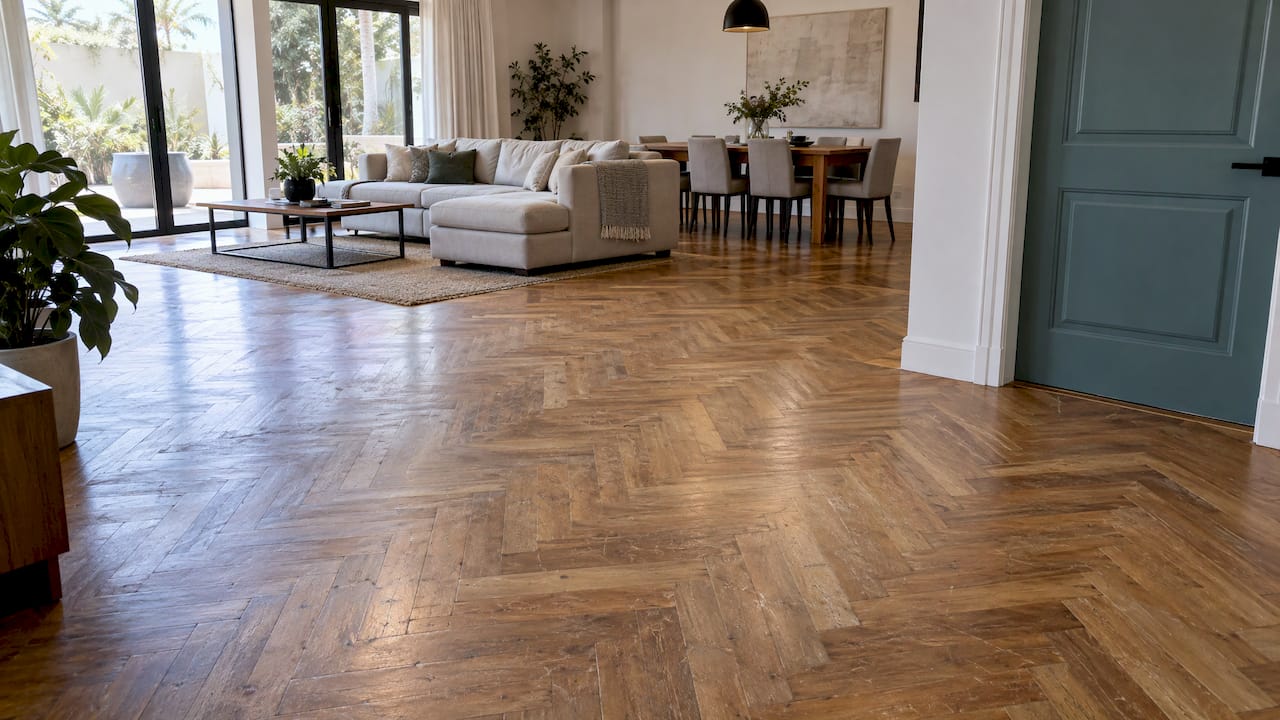

Parquet restoration in Dubai is priced per square meter of floor, and the final figure depends on the condition of the wood, not only the size of the room. A floor that needs sanding, light repair and a new finish costs far less than one that needs board replacement, moisture repair and a full refinish. In almost every case, restoring sound parquet costs a fraction of tearing it out and installing new. We inspect the floor first and quote from what we find, because a number given without seeing the wood is a guess.
This guide is for villa, apartment and penthouse owners, property and facility managers, hotels, offices and contractors who need to budget a parquet job and read a quote with confidence.
TL;DR
-
Parquet restoration is quoted per square meter, with extras for repairs, pattern complexity and access. Two quotes are only comparable when they list the same scope.
-
Condition sets the price: surface wear and dullness are the cheapest case, while water damage, lifted blocks and missing pieces add work.
-
Herringbone, chevron and other intricate patterns take more labor than straight layouts, so expect them to cost more per square meter.
-
Restoring sound parquet usually costs much less than replacing it, and it keeps the original wood and character of the floor.
-
Ask for a written scope that names sanding, repairs, sealing or finishing, furniture handling and cleanup before you approve anything.
Table of Contents
How parquet restoration is priced in Dubai
The standard unit is the square meter. Some contractors quote per square foot, and some quote a fixed project price for a villa or a unit. All three are the same arithmetic in different clothes: measured floor area multiplied by a rate, plus anything the inspection finds that the base rate does not cover.
That is why a headline “from” price tells you little. It describes the simplest case, a sound floor with light wear, and it rarely includes repairs, stairs, skirting or moving furniture. Your own floor will land somewhere above that starting point, and by how much depends on the factors below.
For a rough planning figure, measure the parquet area in square meters, multiply by the per square meter rate you are quoted, then add a line for repairs. Ask for repairs to be listed separately, so you can see what is routine and what is specific to your floor. We publish a pricing guide for wood floors on our wooden floor polishing cost page, and a site visit turns that guide into a figure for your property.
What is included in a parquet restoration
Restoration is a sequence of jobs, and the cost depends on how many your floor needs. The core work usually covers:
-
Inspection. Checking the wood, the wear on the surface, loose or lifted blocks, gaps, and any signs of moisture.
-
Surface preparation. Removing the old finish and light surface damage so the wood is ready to be refinished. On parquet this is done with care, because the top layer of wood is finite.
-
Repairs. Re-fixing loose blocks, filling gaps, and replacing damaged pieces where needed.
-
Finishing. Sealing and polishing the floor so it is protected and has an even look.
-
Cleanup. Removing dust and debris and leaving the space ready to use.
Sanding sits at the center of this list, and it is also where the price and the risk concentrate. Parquet and engineered wood have a limited layer of real timber above the core, and each pass removes some of it. Before any sanding starts, the thickness of that layer should be checked. We explain how in our guide to the thickness test before sanding parquet. If you are unsure whether your floor needs sanding at all, our comparison of sanding and polishing shows which condition calls for which treatment.
Our wood services cover polishing, restoration, parquet restoration and sanding, so one team handles the whole sequence on our wooden floor services page.
The factors that move the price
Six things explain most of the difference between one parquet quote and another.
Floor area
Larger areas usually bring a lower rate per square meter, because setup, equipment movement and mobilization are spread across more floor. A single room costs more per square meter than a whole villa ground floor. Odd-shaped rooms, many doorways and built-in joinery slow the work and can raise the rate.
Condition of the wood
This is the biggest swing factor. A floor that is simply dull and lightly scratched needs the least. Deep scratches, worn-through finish near doors and in kitchens, sun damage near glazing, pet marks and stains need more passes and more time. Dubai villas with large windows often show uneven fading, so the floor may need blending across the room to look consistent.
Repairs
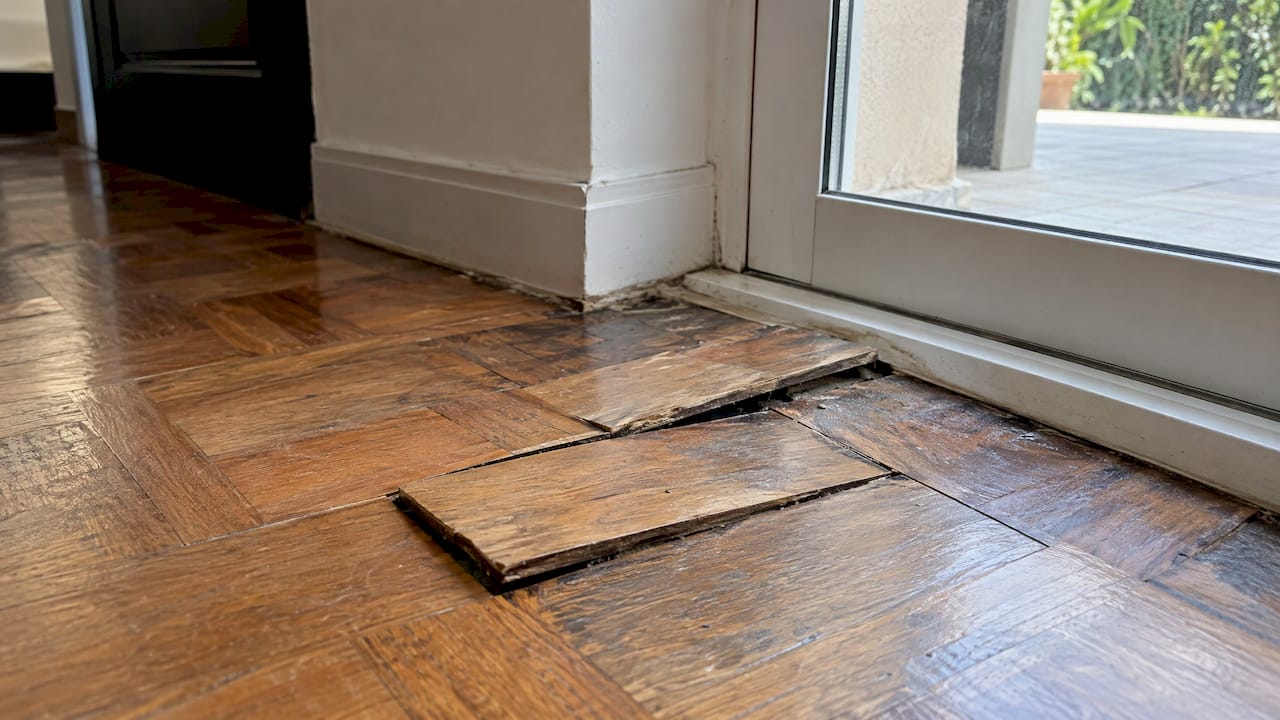
Loose or lifted blocks, open gaps, cracked pieces and areas of moisture damage are billed on top of the base rate. These are the items most likely to surprise an owner, which is why a good quote lists them separately and states how many blocks or how many square meters they cover.
Pattern complexity
Herringbone, chevron, basket weave and borders require more careful work than straight plank layouts, because the grain runs in several directions and edges are more exposed to damage. More skill and time means a higher rate. Parquet is a pattern floor by definition, so most quotes in this category already assume some complexity, but intricate designs and inlays sit at the top.
Finish chosen
The finish changes both appearance and protection. A natural matte look, a satin finish and a high-gloss one differ in products and in the number of coats. Tell the contractor how the room is used. A family kitchen and a showroom lobby need different levels of durability, and a hotel corridor needs more than a bedroom.
Access, furniture and timing
Moving heavy furniture, working around fitted units, stairs, and working floor by floor in an occupied building all change the labor. Commercial sites often need work outside operating hours, which is planned into the schedule and price. Tell the contractor about parking, lift access and building management rules at the start. Many Dubai communities and towers require permits and have set working hours, and a quote that ignores them will change later.
Repair, restoration or replacement
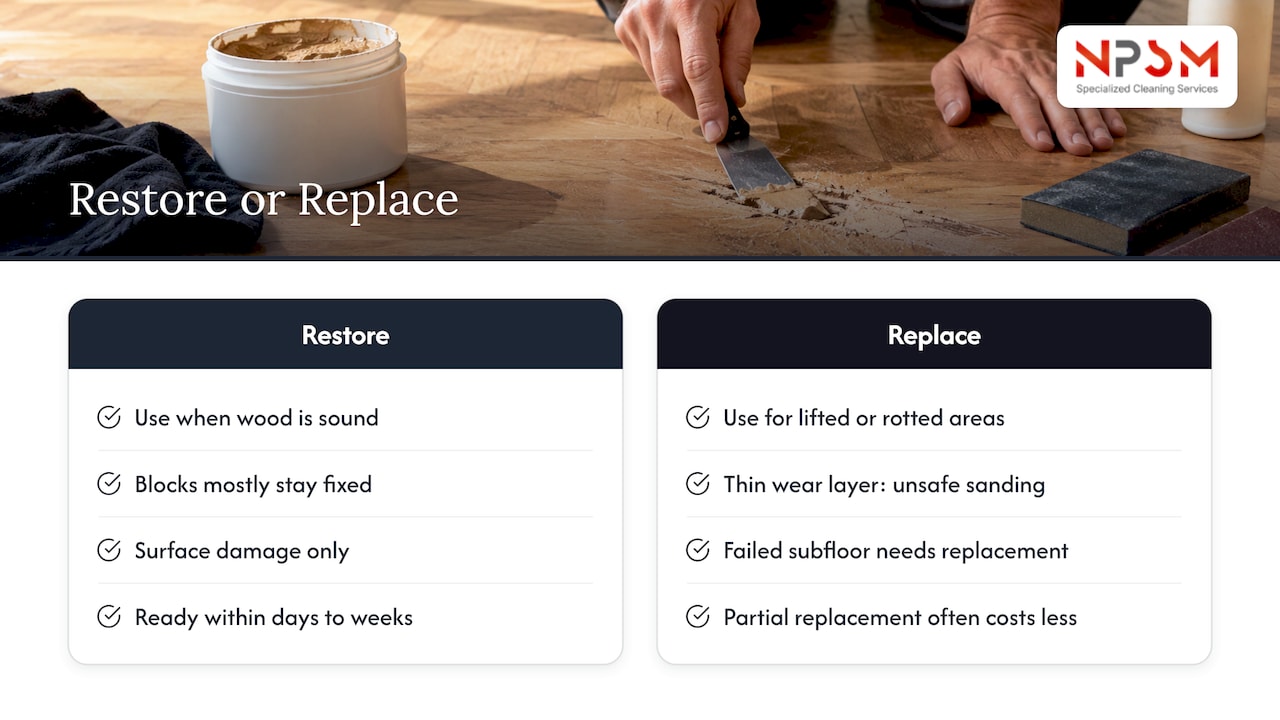
The real question behind most cost searches is whether to restore the floor or replace it. Restoration makes sense when the wood is structurally sound, the blocks are mostly fixed in place, and the damage is on or near the surface. That covers dullness, scratches, worn finish, light staining and fading, which are the most common complaints in Dubai homes and offices.
Replacement becomes the better answer when moisture has lifted or rotted large areas, when the wear layer is too thin to sand safely, or when the subfloor has failed. Even then, partial replacement of the damaged zone followed by blending the whole floor often costs less than lifting everything.
There is also a cost that does not show on the quote: new parquet means removing the old floor, preparing the base, installing, and waiting. Restoration keeps the existing floor in place and works within the existing layout. For landlords and sellers, timing matters too. A refinished floor can be ready within days to a couple of weeks, and our note on wood floor refinishing before listing a property explains how to plan that window.
Subfloor and skirting: the extras people forget
When a floor is lifted, repaired or partly replaced, the surface underneath and the edges around it come into the budget. An uneven base shows through a refinished floor, and the junction between floor and wall is the first place the eye goes. Skirting boards often need refitting or touch-up so the new edge looks clean. If the walls or floor are not straight, the trim has to follow them, which is a craft in itself: scribing skirting to uneven floors shows how installers deal with that problem. Ask whether your quote includes skirting work, because it is a common gap between two quotes that look similar.
What to check in a parquet restoration estimate
A quote is only useful if you can compare it with another. Use this list before you approve work.
-
Measured area. Does the quote state the square meters and how they were measured? Stairs and landings should be named separately.
-
Rate and unit. Is it per square meter, and does it include all steps from preparation to finishing?
-
Repairs. Are repairs priced separately, with a quantity and a unit rate?
-
Finish. Which finish and how many coats? Is the sheen what you want?
-
Furniture. Who moves it, and is it included?
-
Dust and cleanup. Is the area cleaned and left ready for use?
-
Timeline. How many days, and how long before you can walk on the floor and replace furniture?
-
Building rules. Are permits, access and working hours accounted for?
-
Scope limits. What is explicitly excluded?
The cheapest quote is often the one with the shortest scope. If one contractor lists five steps and another lists two, the difference in price is mostly a difference in work.
A worked example of how the quote adds up
Take a villa with a 60 square meter herringbone parquet living and dining area. A transparent quote has four lines: the base restoration rate multiplied by 60, a repair line for a small number of lifted blocks near the patio door, a line for stairs or borders if any, and a line for skirting touch-up. Each line has a quantity and a unit. When the contractor finds more damage after lifting the rug or moving the sofa, the repair line changes, but the base line does not.
Now compare it with a quote that says only “parquet polishing, one total.” You cannot tell whether repairs, the finish or the furniture are in or out. This is where owners end up paying twice. Insist on the line-by-line version, and use the same format when you request a second quote.
Residential and commercial jobs
The method is the same, but the planning differs.
Villas, apartments and penthouses. Owners care most about finish quality, dust control and how many days the house is out of use. Luxury villas often have large continuous floors where a visible join between worked and unworked areas would stand out, so the floor is usually treated as a whole. Our work on luxury interiors reflects that standard.
Hotels, hotel apartments and resorts. The priority is minimal disruption. Work is scheduled by floor or wing and returned to service in sections. Corridors and lobbies take heavy traffic, so the finish matters as much as the surface.
Offices, retail and commercial buildings. Parquet in a reception or boardroom is a statement floor, and downtime costs more than the job. Out-of-hours schedules and clear sign-off steps keep the project on track.
Property managers, developers and investors. Restoration between tenancies or before a sale is a predictable maintenance item. Getting a written scope per unit makes budgets comparable across a portfolio.
Contractors and interior designers. Restoration lets you keep a floor the client already loves while changing the room around it. Agree who handles protection of finished walls and joinery before the floor team arrives.
Why Dubai conditions matter
Wood moves with humidity. Dubai moves between strong air conditioning indoors and heat and humidity outdoors, and sunlight through large glazing fades and dries floors unevenly. These conditions show up as dullness, gaps and finish wear, and they are the reasons most Dubai parquet needs attention. Our team works with these local conditions in mind and provides maintenance and restoration tailored to each floor type and property.
Our view on parquet restoration
Most owners come to us after a first quote that did not make sense to them. A single number, no scope, no mention of what happens if blocks are loose. We think a parquet quote should read like a work order: the area, the steps, the finish and the repairs, each on its own line.
Parquet is worth restoring. It is a real wood floor with a pattern that is expensive to recreate, and in most Dubai homes the damage is in the finish and the surface, not the structure. Restoration keeps what the floor already has and brings back the shine and evenness that heavy use, sun and dry air take away.
We tailor the work to each floor type and property, use professional-grade equipment and eco-friendly products, and work with certified professionals. That is how we aim for a result that lasts, protects the value of the property and keeps maintenance costs down over time.
Qadir
Get a quote for your parquet floor
If you want a figure for your own floor, we offer parquet restoration, wooden floor polishing, restoration and sanding across Dubai for residential and commercial properties. See our wooden floor services, or visit our main services page to see everything we restore, from wood to marble and stone. Send us the floor type, the approximate area and photos of the worst areas, and we will tell you what the floor needs.
FAQ
How much does parquet restoration cost in Dubai?
It is priced per square meter, and the rate depends on the condition of the wood, the pattern and the finish. Repairs such as re-fixing lifted blocks or replacing damaged pieces are added on top. A site inspection gives a figure you can rely on, which a price found online cannot.
Is it cheaper to restore parquet or replace it?
Restoring is generally cheaper when the wood is sound and the damage is on the surface, because you avoid removal, base preparation and new material. Replacement is considered when moisture damage is widespread or the wood layer is too thin to sand safely.
Why do two parquet quotes differ so much?
Usually the scope differs. One quote may include repairs, skirting, furniture moving and a multi-coat finish, while another covers only surface sanding. Compare the line items, not only the total.
How long does parquet restoration take?
It depends on the area, condition and finish. A single room is quicker than a full villa, and floors that need repairs take longer. Allow time for the finish to cure before heavy furniture goes back, and ask your contractor for a day-by-day schedule.
Can parquet be restored in an occupied apartment or office?
Yes, with planning. Work can be phased room by room or scheduled outside business hours, and dust control and access rules should be agreed in advance with the contractor and building management.