
Granite is dense, but it is not sealed for life. Many granite floors, stairs and worktops in Dubai benefit from a penetrating sealer. The right interval depends on the stone’s color, finish and location: indoors, a check every year is sensible, and sun-exposed outdoor stone needs a closer eye. This guide shows how to test your stone, choose a sealer, apply it, set a resealing rhythm for Dubai conditions, and handle marble and limestone questions that come up on the same properties.
TL;DR
-
Run a water test first: if a few drops darken the stone within 10 to 15 minutes, it is absorbing and needs a penetrating sealer. If the water beads, wait.
-
Light and honed granites are the most porous and usually need sealing most often. Dense, dark, polished granites often need very little.
-
Use a penetrating (impregnating) sealer on clean, completely dry stone, wipe off the excess before it dries, and keep the surface dry while it cures.
-
In Dubai, outdoor stone sees UV, heat, sand and coastal humidity, so test it more often than indoor stone and reseal by test result, not by the calendar.
-
Marble is more porous than granite and also etches. Sealing buys you cleanup time, not immunity.
Table of Contents
Does granite need sealing?
Usually it benefits, but not always, and the only way to know is to test your own slab or floor. Granite is a hard, dense igneous stone with low absorption, which is why it resists stains better than marble or limestone. Low is not zero, though. Natural stone industry guidance notes that many granite countertops can benefit from sealing to reduce moisture migration, even if good cleaning habits prevent most staining.
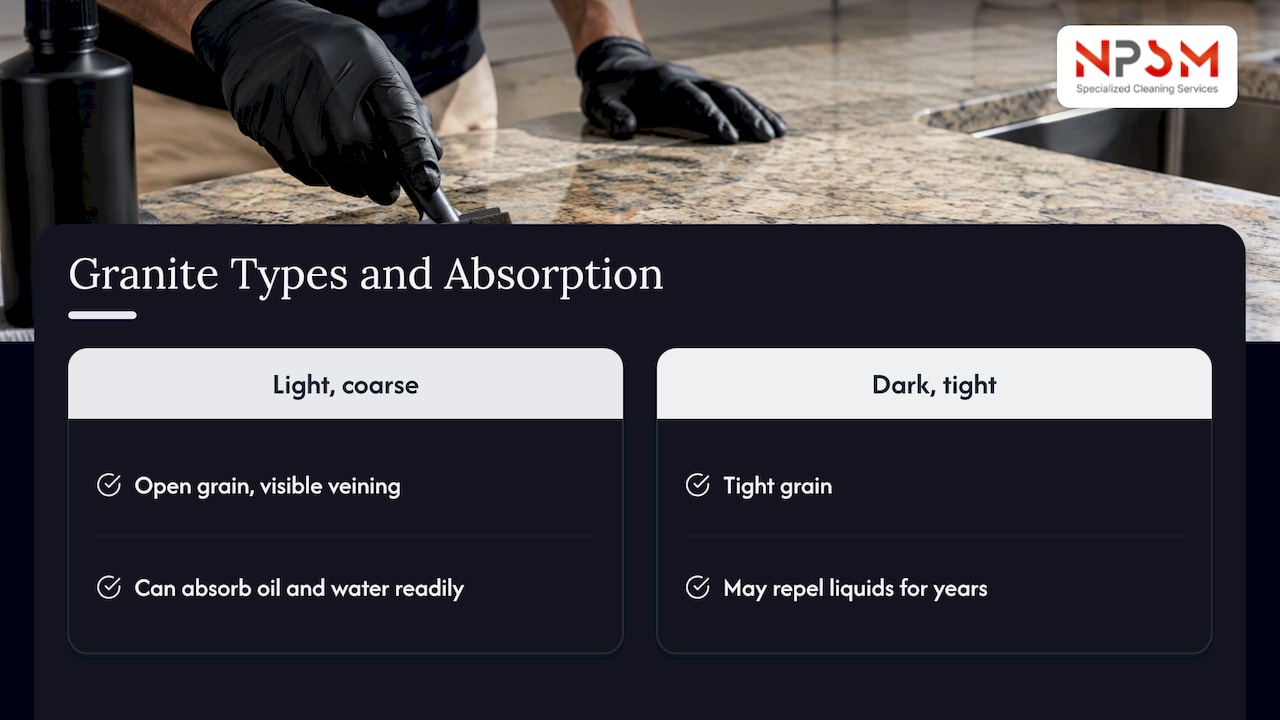
The difference between stones is large. A light, coarse granite with visible veining and open grain can take up oil and water readily. A very dark, tight-grained granite may repel liquids for years. That is why you will see advice ranging from every six months to every few years. Both can be right for different stones.
The water test
This takes ten minutes and costs nothing.
-
Clean the area with a pH-neutral stone cleaner and let it dry fully.
-
Place a few drops of water on the surface, in more than one spot. Test the busiest area, such as beside the kitchen sink, a bathroom vanity, or the entrance hall.
-
Wait 10 to 15 minutes.
-
If the water beads and the stone color stays the same, the seal is working or the stone is dense enough not to need one. If the stone darkens under the drop, it is absorbing and should be sealed.
Repeat the test once a year, and more often on stone that sees sun and washing. Treat the result as your schedule. A seal that still passes does not need renewing just because a year has passed.
Which finishes absorb most
Honed and leathered granite have a more open surface than polished granite, so they generally absorb faster and show stains sooner. Polished granite has a tighter surface, which helps. Light colors show oil and water marks more readily than black or deep green stones. If you are choosing granite for a villa kitchen or an outdoor terrace, finish and color are part of the maintenance plan.
Granite sealer types
For floors, stairs and worktops, the standard choice is a penetrating sealer, also called an impregnator. It soaks into the pores and works from inside the stone, so the surface looks and feels the same and stays breathable. Topical coatings sit on the surface and can change the look and grip of the stone, so they are a different job from sealing.
Within penetrating sealers, the active ingredient affects durability:
| Type | What it is | Typical expectation |
|---|---|---|
| Siloxane or silicon-based | Common, water-based or solvent-based penetrating sealers | Shorter protection, often from about six months up to a few years |
| Fluoropolymer or fluorocarbon resin | Premium penetrating sealers that repel water and oil | Longer protection, often quoted in the range of five to ten years in temperate conditions |
| Solvent-based penetrating formulas | Deep-penetrating, often used on dense stone and heavy-use areas | Depends on the product; follow the manufacturer’s data |
Treat these durations as manufacturer-style ranges for mild climates. Dubai’s sun and heat usually shorten them, particularly outdoors, so plan around the water test.
Two practical selection points:
-
Oil and water protection. Kitchens need oil resistance as well as water resistance. Check the product states both.
-
Food areas. If the stone is a food preparation surface, the sealer should be non-toxic and safe for that use once cured.
Also match the sealer to the stone, not just to “stone”. Granite, marble, limestone and terrazzo have different porosity, and some stones are sensitive to solvents or need specific products. On a mixed property, such as granite floors with a limestone façade, you may need two products.
How to seal granite floors and worktops
Product directions always rule, so read the label of the sealer you buy. The sequence below reflects the common pattern across manufacturer instructions.
1. Clean and dry completely
Use a pH-neutral stone cleaner. Remove grease, soap film and any old sealer residue, because a sealer cannot penetrate through dirt or a surface coating. Then let the stone dry thoroughly. Some stone-care guidance suggests allowing around 12 hours for granite to dry after wet cleaning, and sealing over moisture traps it and blocks absorption. A stone-safe cleaner matters here: acidic cleaners, vinegar, limescale removers and bleach can damage natural stone and should stay out of the routine.
2. Work in small sections
Apply the sealer in sections of roughly one square meter or the size the label gives, with a clean lint-free cloth, applicator pad or low-pressure sprayer. Keep the area wet with sealer for the time on the label so it can soak in.
3. Wipe off the excess
This is the step most people get wrong. Sealer left to dry on the surface can cause hazing or sticky patches. Buff off all unabsorbed sealer with a clean dry cloth before it dries, usually within the window stated on the label (many give about 30 minutes after the final coat).
4. Add coats if the label says so
Many products call for two or three coats on absorbent stone, applied while the previous coat is still wet, or with the minimum wait the label states. Dense dark granite often takes one coat only.
5. Let it cure, then test
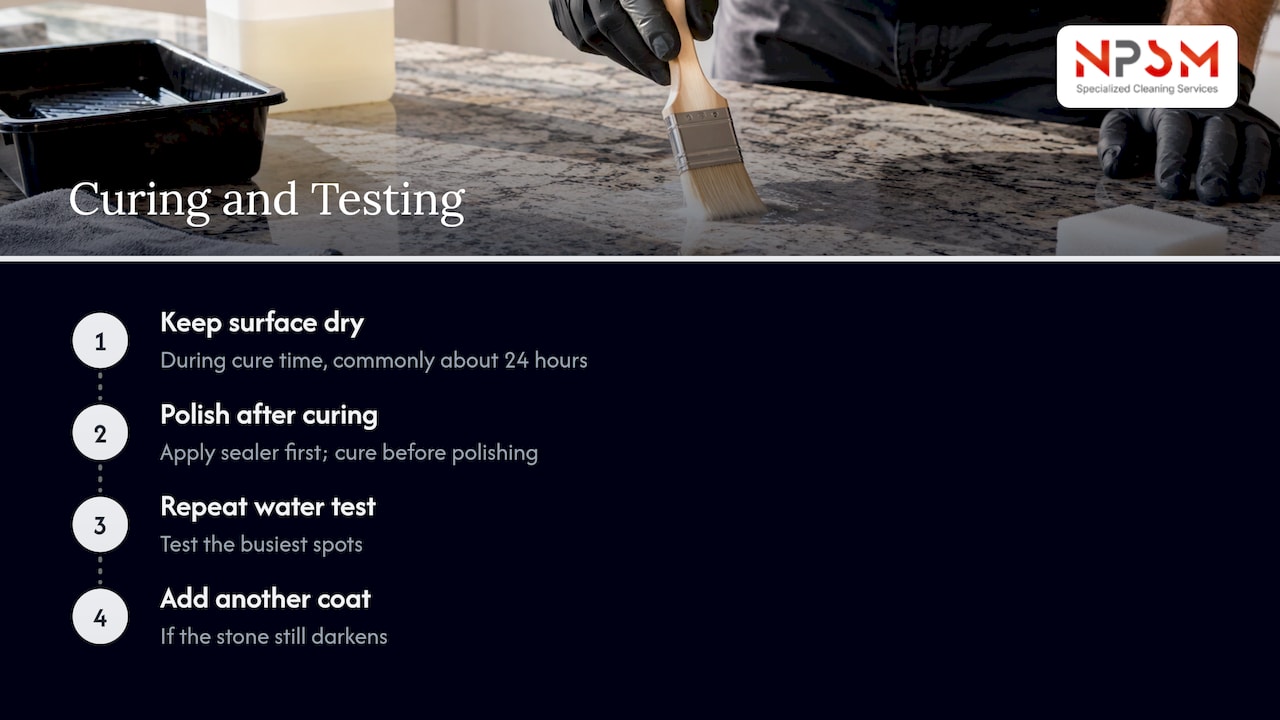
Keep the surface dry for the cure time, commonly about 24 hours, before water, cleaning or regular use. If you plan to use a stone polish too, apply the sealer first and let it cure before polishing. Then repeat the water test in the busiest spots. If the stone still darkens, a further coat is needed.
Floors versus worktops
Floors are larger, take foot traffic, and need even coverage so you do not get visible overlap or patchy gloss. Large villa floors, entrance halls, and staircases are where an even finish is hardest to achieve by hand, and where a machine-assisted professional finish earns its keep. Our granite floor maintenance tips for Dubai homes cover the daily routine that protects the seal between visits.
How often to seal granite in Dubai
The honest answer is a range, and the range depends on four things: the stone’s color and density, its finish, how heavily it is used and cleaned, and the quality of the sealer and application. Published guidance for countertops runs from about every 6 to 12 months on light, porous granite to every few years on dense, polished, well-sealed stone.
A practical starting point for Dubai:
| Location | Starting point | Notes |
|---|---|---|
| Light or honed granite, indoors | Check every 6 to 12 months | Kitchens and wet areas first |
| Mid-tone polished granite, indoors | Check yearly, reseal when the test fails | Often 1 to 3 years between coats |
| Dark, dense polished granite, indoors | Check yearly | May need sealing rarely |
| Granite on terraces, pool decks, balconies | Check every 6 months | Sun, sand and washing wear sealer faster |
The UAE climate is the reason to test more often than a European or North American guide would suggest. Strong UV, high surface temperatures, wind-blown sand that acts like fine sandpaper, and humidity near the coast all wear on both stone and sealer. A sealer that lasts years in a temperate climate can need attention much sooner on a sun-exposed terrace here. Many UAE stone specialists therefore suggest inspecting installed stone every 6 to 12 months and resealing when the stone shows it is absorbing.
Daily habits extend the interval: wipe spills quickly, use pH-neutral cleaner, put mats at entrances to cut sand, and use trivets and coasters on worktops. Our guide to sealing natural stone for homeowners explains the reasoning behind these habits in more detail, and what granite surface protection involves covers the wider options for property owners.
Do you need to seal marble?
Yes, in nearly all cases. Marble is more porous than granite, so liquids soak in and leave stains. Sealing slows that absorption and gives you time to wipe up a spill. It does not stop etching, which is a chemical reaction between acids (lemon juice, vinegar, some cleaners) and the calcium carbonate in the stone. Etched marble shows dull marks that a sealer cannot prevent and only polishing or honing corrects.
How often to seal marble follows the same test-first approach as granite:
-
Indoors: many UAE sources suggest every year or two, with the water drop test deciding. Kitchen counters and bathroom vanities are the first places to fail.
-
Outdoors: marble on terraces and around pools is often resealed once or twice a year in UAE conditions because heat, UV, sand and irrigation wear the sealer faster.
-
Lifespan: a marble sealer lasts as long as the product, the stone and the traffic allow. The manufacturer’s test and reapplication instructions should drive the schedule, not a fixed date.
If marble is already dull or etched, the order matters: restore first, then seal. Sealing over etching locks in a dull surface. Our marble polishing and restoration service handles stain removal, polishing, and full restoration, and our marble floor care tips for Dubai villas show how to keep the finish between visits. If you are unsure whether you need polishing or deeper work, read marble polishing versus marble grinding.
Limestone: stain removal and exterior sealing
Limestone is softer and more porous than granite, and it is acid-sensitive. That shapes both stain removal and sealing.
Removing stains from limestone
-
Identify the stain. Oil, organic (coffee, tea, food), rust, metal (copper, bronze) and water marks each need a different approach. Guessing is how stone gets damaged.
-
Start gentle. Use a pH-neutral stone cleaner or mild soft soap and water. Never use vinegar, limescale removers, bleach or aggressive all-purpose cleaners. Acids attack limestone immediately.
-
Use a poultice for stains that have soaked in. A poultice is an absorbent powder or paper pad mixed with a suitable cleaning agent for the stain type. It is spread over and slightly beyond the stain, covered with plastic and left to dry so it draws the stain out of the stone. Technical conservation guidance for rust stains suggests layers no thicker than about a quarter inch and a drying time around 48 hours, then removal with a wooden or plastic spatula to avoid scratching. The process may need repeating.
-
Rinse and let dry. Then judge whether the surface is dull or etched. Etching needs honing or polishing, not more cleaner.
-
Seal after the stone is clean and dry. If an acidic product was ever used, the surface needs neutralizing before sealing.
Rust and metal stains are the ones owners most often make worse. They need specific poultice chemistry and care, which is why these jobs are usually worth handing to a stone restoration team.
Exterior limestone sealers
For limestone on façades, terraces and pool surrounds, use a penetrating, breathable sealer that is UV stable and rated for exterior use on limestone. Breathability matters because moisture vapor needs to escape from the stone. A film-forming coat can trap it.
Dubai-specific points:
-
Light, dense, low-porosity stone with a textured finish tends to perform best outside. Dark or very porous stone degrades faster and can get too hot to walk on barefoot.
-
Some suppliers advise that outdoor paving of dense stone does not always need sealing, while highly porous stone does. Test first.
-
Porous stone outdoors usually needs more frequent resealing than product literature written for milder climates assumes.
-
Near the coast, salt-laden air adds to the load, so wash regularly with fresh water and a neutral cleaner.
Our guide to exterior marble maintenance in Dubai applies equally to outdoor limestone and granite.
What does granite sealing cost in Dubai?
We do not publish fixed prices, because the job is priced by the surface, not by a standard rate. No two properties match, so a quote after seeing the stone is the accurate route. These factors move the price:
-
Area. A kitchen worktop and a 400 square meter villa ground floor are different scales of work.
-
Condition. Clean, intact stone needs cleaning and sealing. Stained, etched or scratched stone may need polishing or honing first.
-
Stone type and finish. Honed and light granite is more absorbent and may need extra coats.
-
Location. Outdoor stone needs a UV-stable exterior sealer and often a deeper clean.
-
Access and scheduling. Stairs, tight spaces, occupied hotels and offices with after-hours work affect time on site.
-
Product choice. Longer-lasting sealer systems cost more per square meter than basic ones.
When you ask for quotes, give the area, the stone type if you know it, the finish, indoor or outdoor, and photos of any stains. That lets a restoration team give you a figure that will hold.
Our perspective
Most sealing problems we see in Dubai are not product failures. They are sequence failures. Stone sealed while still damp, sealer left to haze on the surface, or a dull, etched floor sealed before it was restored.
We approach granite, marble and limestone as a system: assess the stone, test absorption, clean with stone-safe products, restore the surface if it needs it, then seal with a product chosen for that stone and that location. A villa terrace in full sun and a penthouse floor in air conditioning are different jobs, and we treat them that way.
Sealing is also cheaper than the alternatives. A floor that stays protected and maintained avoids the deep restoration, and in the worst cases the replacement, that neglect leads to. That is why we recommend property owners, managers and developers set a test-based schedule instead of waiting for stains to appear.
Our team works with diamond polishing systems, professional-grade equipment and eco-friendly products, tailored to each floor type and property.
Qadir
Get your stone tested and sealed
If your granite, marble or limestone is stained, dull, or failing the water test, our team can assess it, restore it where needed and seal it for Dubai conditions. See our granite and natural stone restoration services for what we cover, or contact us through the main site for a quote on villas, apartments, hotels, offices and retail spaces.
FAQ
Does granite need sealing?
Often yes, but it depends on the stone. Light and honed granites absorb the most and usually benefit from sealing. Dense, dark, polished granites may need little. Put a few drops of water on the surface and wait 10 to 15 minutes: if it darkens, seal it.
How often should I seal granite and marble in Dubai?
Check indoor granite yearly and reseal when the water test fails, which can be anywhere from one to several years. Marble indoors is often resealed every year or two. Outdoor stone in the UAE usually needs checking every six months because of heat, UV and sand.
Should I polish or seal granite first?
Seal first, let the sealer cure for the time on the label (commonly about 24 hours), then polish. If the stone is dull, scratched or etched, restore it before sealing so the sealer does not lock in the damage.
Can I use any cleaner on sealed stone?
No. Use a pH-neutral, stone-safe cleaner. Vinegar, limescale removers, bleach and aggressive all-purpose cleaners can damage natural stone and strip sealer, and acids etch marble and limestone straight away.
What affects the cost of sealing granite in Dubai?
The main factors are the area, the stone’s condition, its type and finish, whether it is indoors or outdoors, and access. We quote after seeing the stone, since the job may also include cleaning or polishing before sealing.