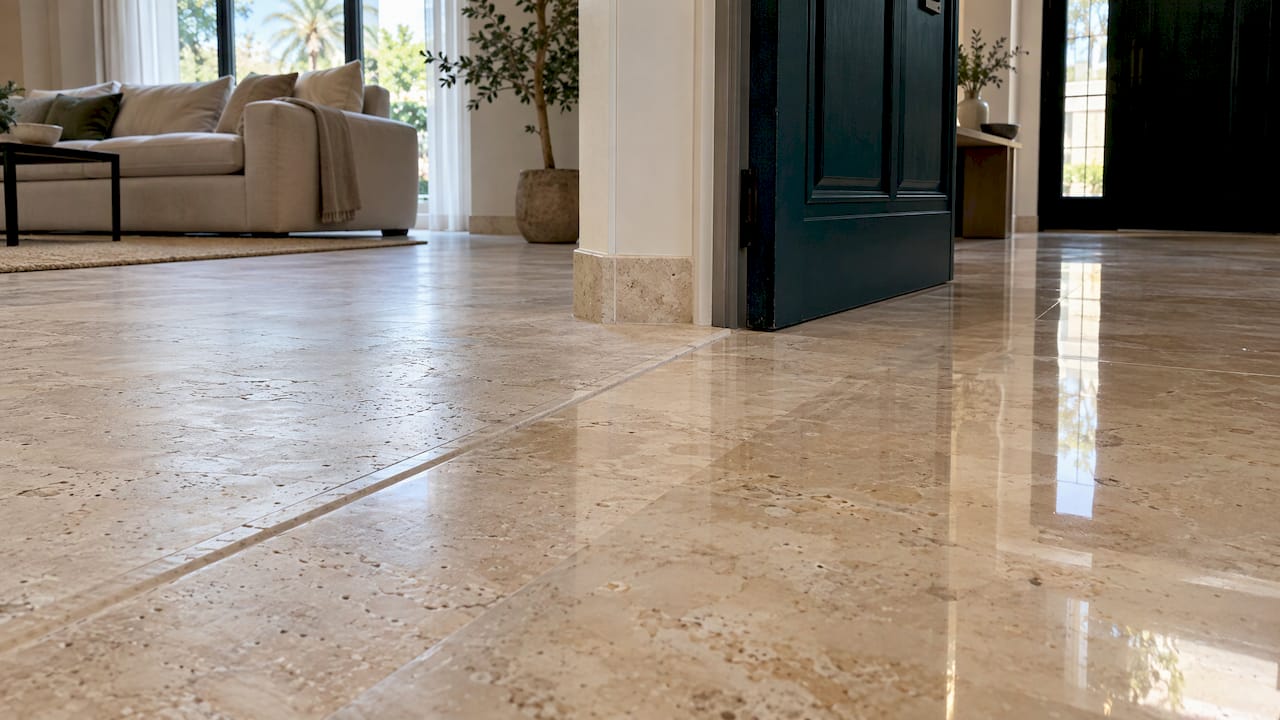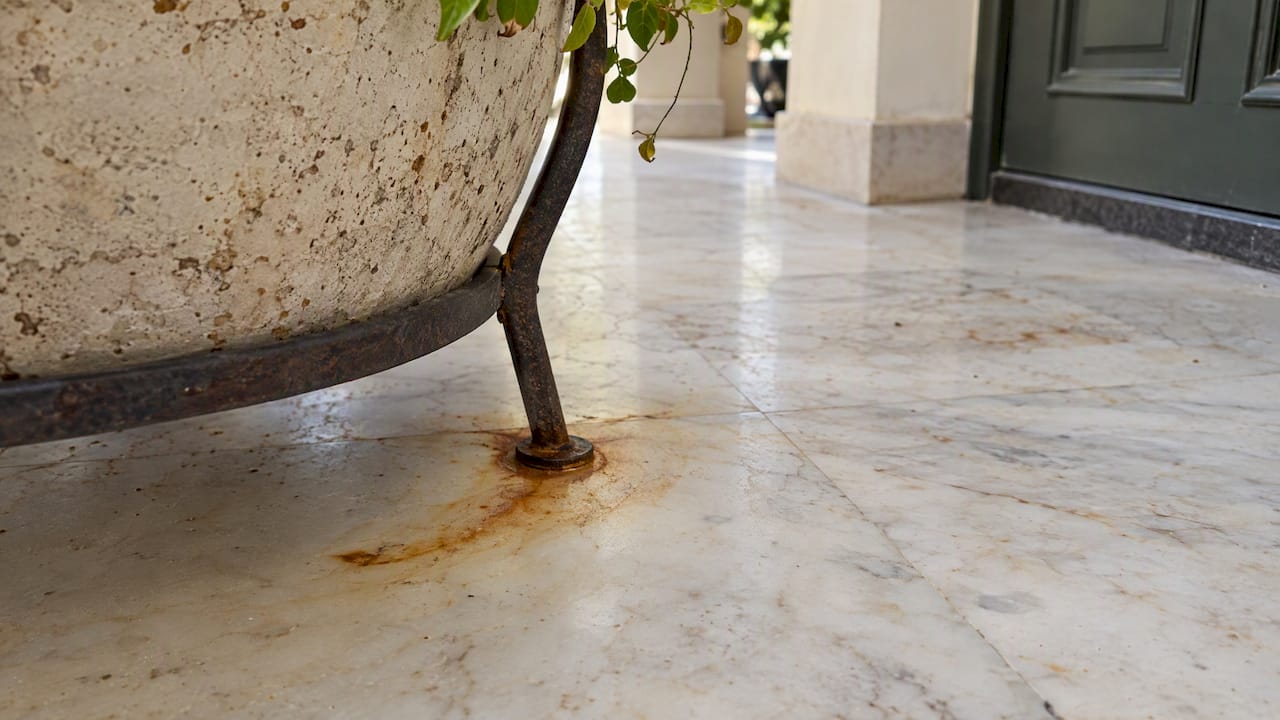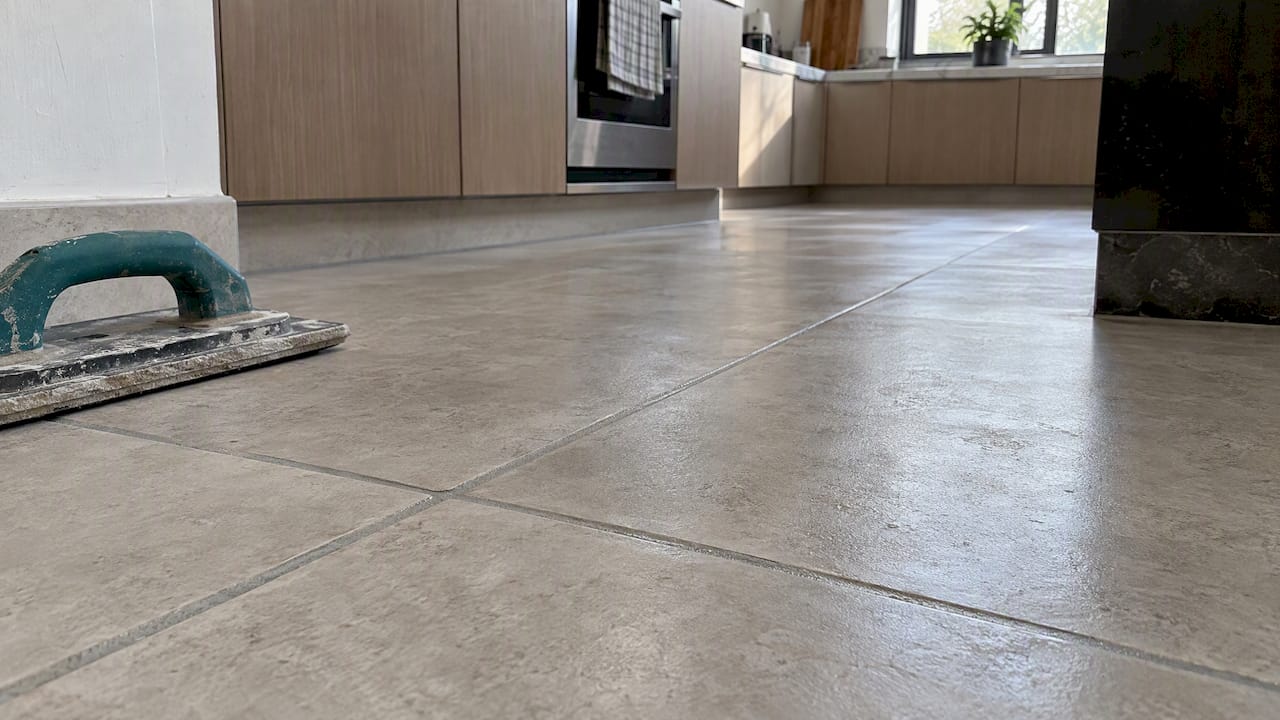

For most dry residential floors and walls, a good cement grout does the job and costs far less. Epoxy grout is the better pick where water, grease, chemicals or heavy cleaning are part of daily life: shower floors, pools, commercial kitchens, hotel bathrooms and busy lobbies. The right choice depends on the room, the tile, the joint width and who will maintain it. This guide walks through each factor so you can decide before the tiler arrives, or before you book a re-grouting job.
TL;DR
- Cement grout is porous, easy to install, forgiving and low in cost. It needs sealing and will stain over time.
- Epoxy grout is made from resin and hardener. It is close to non-porous, highly stain resistant and usually needs no sealing, but costs several times more and is harder to install.
- Choose by exposure: cement for most dry living areas, epoxy for wet, greasy or high-traffic commercial spaces.
- Sanded cement grout suits wider joints, unsanded suits narrow ones, and both behave differently from epoxy.
- Epoxy terrazzo and cement terrazzo follow the same logic: different binders, different weight, colour range and upkeep.
Table of Contents
- What each grout actually is
- Epoxy grout vs cement grout at a glance
- Sanded, unsanded and “cementitious” explained
- Where cement grout is the right call
- Where epoxy grout earns its place
- What epoxy and cement grout cost
- Installation and curing: why the tiler matters
- Can you put epoxy grout over cement grout?
- Cement terrazzo vs epoxy terrazzo
- Cleaning and maintaining each type
- How to decide: a quick checklist
- Our perspective
- Re-grouting and floor restoration with us
- FAQ
What each grout actually is
Cement grout is a cementitious powder. You mix it with water on site, spread it into the joints and wipe the surface clean. It is a single-component product, which is why it is so common and why most tilers handle it with confidence. Because it is cement-based, it is porous. Water, oils and pigments can travel into it, which is why it is sealed after curing and resealed from time to time.
Epoxy grout is a two-part or three-part system: epoxy resin, a hardener, and a filler such as fine sand or silica. The parts are mixed in exact proportions and used within a limited working time. Once cured, the joint is dense and chemically resistant. Water does not soak in, and household stains largely stay on the surface where they can be wiped off.
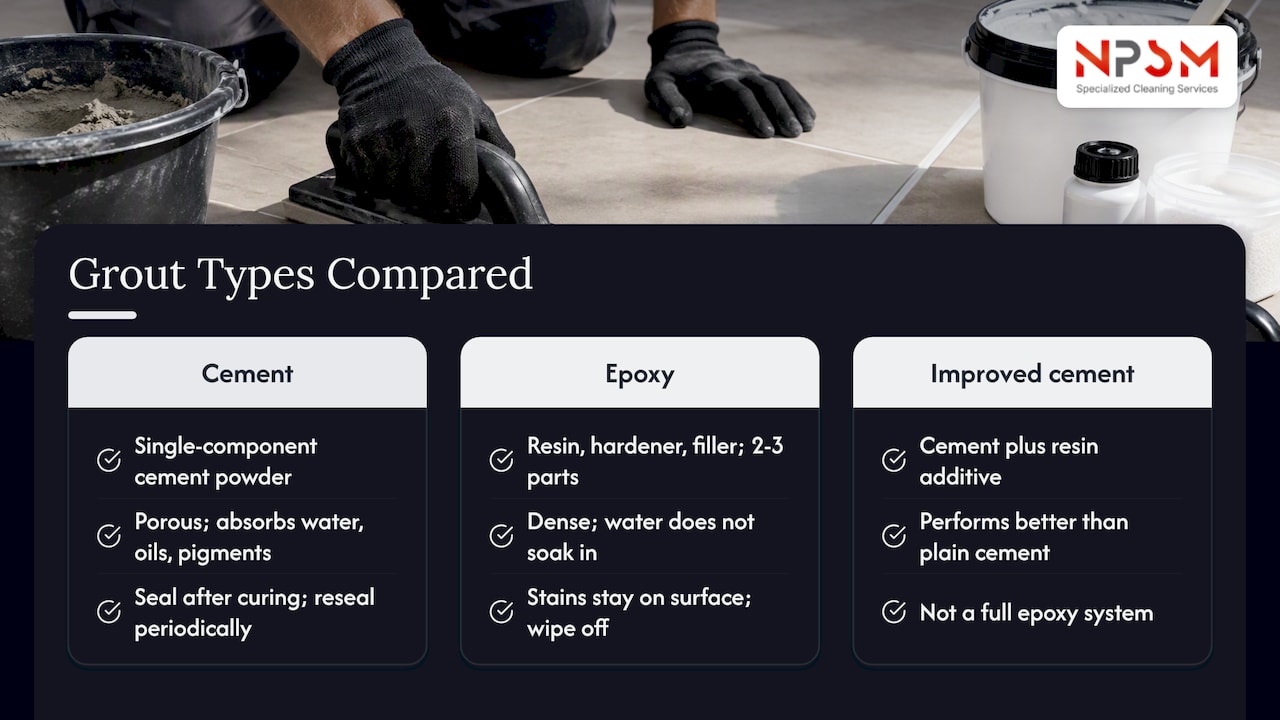
A third product sits between them: epoxy-emulsion or “improved” cement grouts, which blend cement with a resin additive. These perform better than plain cement but are not the same as a full epoxy system, so check the data sheet before assuming a product marketed as “epoxy” is a true resin grout.
Epoxy grout vs cement grout at a glance
| Factor | Cement grout | Epoxy grout |
|---|---|---|
| Base material | Cement, sand, additives | Epoxy resin, hardener, filler |
| Porosity | Porous, absorbs water and stains | Very low absorption |
| Sealing | Needed after install and periodically | Usually not needed |
| Stain resistance | Moderate, depends on sealer | High |
| Chemical resistance | Limited, affected by acids | High |
| Ease of installation | Easy, forgiving | Demanding, short working time |
| Cure time | Short | Longer before heavy use |
| Material cost | Low | Several times higher |
| Colour consistency | Can fade or darken unevenly | Generally stable |
| Typical use | Living rooms, bedrooms, dry walls | Showers, pools, kitchens, commercial wet areas |
The table shows why neither grout wins outright. They solve different problems.
Sanded, unsanded and “cementitious” explained
If you searched for epoxy versus sanded grout, note that sanded grout is a type of cement grout, not a competitor category. Cementitious grout comes in two common forms:
- Sanded grout contains fine sand. The sand adds bulk and helps prevent shrinkage cracks, so it is the standard choice for joints roughly 1/8 inch (about 3 mm) or wider.
- Unsanded grout has no sand and a smoother texture. It is used for narrow joints and for delicate surfaces that sand could scratch, such as polished marble or glass.
Epoxy grout also contains filler, but it is a different chemistry. It does not depend on cement hydration, so it does not shrink or crack in the same way when installed correctly.
Tile suppliers in the UAE also classify cementitious grouts by performance, with improved grades offering lower water absorption and higher abrasion resistance than basic grades. If you are specifying for a hotel, a clinic or a mall, ask for the grade in writing rather than accepting “standard grout”.
Where cement grout is the right call
Cement grout is not the budget compromise it is sometimes made out to be. For many Dubai homes it is the sensible specification.
- Villa and apartment living areas. Porcelain or marble in dry rooms rarely faces the exposure that justifies epoxy pricing.
- Wall tile away from splash zones. Feature walls, kitchen backsplashes behind a hob with a good extractor, and bedroom walls.
- Polished natural stone. Unsanded cement grout in a colour matched to the stone gives a soft, unified look and is easier to adjust on site.
- Projects where flexibility matters. Cement grout is easier to tool, clean and correct if a tiler makes a mistake.
- Budgets with many square metres. On a large villa, the grout cost difference adds up quickly.
The condition is maintenance. Cement grout should be sealed after it cures and checked periodically. In a city with fine dust, strong cleaning habits and frequent use of mops, unsealed grout lines darken fast. Dubai’s dust and humidity settle into the joints, and the lines are usually what makes a clean floor look dirty.
Where epoxy grout earns its place
Epoxy grout justifies its price when the joint is under stress.
- Shower floors and wet rooms. Constant water exposure is what breaks down cement grout first. Epoxy resists absorption and mould staining better.
- Swimming pools and water features. Chemically treated water and constant immersion favour a resin joint.
- Commercial kitchens. Grease, hot water and strong degreasers are hard on cement. Epoxy tolerates them far better.
- Hotel bathrooms and spa areas. Guests expect white or pale joints to stay clean-looking, and housekeeping teams use strong products daily.
- Hospitals, labs and food prep areas. Where hygiene rules call for non-absorbent joints.
- Light-coloured grout on heavy-traffic floors. Lobbies, retail units and corridors where cement lines would grey quickly.
Epoxy is also the usual answer for homeowners who are tired of resealing and scrubbing. Choosing it for a master bathroom or a utility room is often a sound decision, as long as a competent installer applies it.
What epoxy and cement grout cost
Expect epoxy material to cost several times more per kilogram than cement grout. In the UAE, a 10 kg pack of a well-known epoxy grout retails at several hundred dirhams, while cement grout is sold in bags at a small fraction of that. But the material price is only part of the story.
The installed price depends on:
- Labour skill. Epoxy has a limited working time and must be cleaned from the tile surface quickly. It takes longer and needs an experienced hand.
- Joint width and depth. Wider, deeper joints use more material. Epoxy consumption climbs sharply on large-format tiles with wide joints.
- Area to be covered. Bathrooms are small, so the premium is modest. Whole-villa floors are a different calculation.
- Preparation. Old grout must be raked out cleanly and the joint cleared of dust before re-grouting.
- Tile type. Polished stone and glossy porcelain need extra care to avoid scratching or haze.
- Access and site conditions. Occupied buildings, hotel floors and working hours affect scheduling.
A useful way to compare: the lifetime cost. Cement grout costs less on day one but adds resealing, deep cleaning and eventual replacement. Epoxy costs more on day one and often reduces upkeep. Which is cheaper over ten years depends on the room and how it is used.
Installation and curing: why the tiler matters
Cement grout is forgiving. You can add a little water to adjust workability (though too much weakens the mix), correct mistakes and clean the surface at a relaxed pace.
Epoxy is the opposite. The components must be mixed in exact ratios, you cannot thin it with water without ruining it, and the working time is short. Residue that cures on the tile face is very difficult to remove. Epoxy also takes longer than cement to reach full strength, so heavy use or aggressive cleaning should wait. Uncured epoxy can irritate skin, so installers wear chemical-resistant gloves.
For property owners, the practical advice is simple:
- Ask the installer how many epoxy jobs they have done recently.
- Ask to see a finished joint, not just a data sheet.
- Confirm who is responsible for cleaning haze from the tile face.
- Do not mix grout brands or systems in one area without checking compatibility.
If you are dealing with cement haze or adhesive left on tile after an install, our guides on removing cement haze without etching and removing tile adhesive residue explain the safe first steps.
Can you put epoxy grout over cement grout?
In practice, the answer is: not as a simple coat. Epoxy needs a clean, sound joint to bond to. Spreading it over old cement grout that is dirty, sealed, crumbling or only partly cleaned leads to poor adhesion, peeling and a joint that looks worse than before.
The correct method for replacing cement grout with epoxy is:
- Rake out the old grout to a consistent depth, usually at least two-thirds of the tile thickness or according to the epoxy manufacturer’s data sheet.
- Vacuum all dust and debris from the joints.
- Clean the joints so they are free from sealer, soap film and oil.
- Make sure the substrate is fully dry.
- Apply the epoxy to the full depth, then clean the tile faces promptly.
There are thin epoxy-based grout colouring and joint-refresh products, but they are a surface finish, not the same as a structural epoxy joint. If joints are loose, hollow-sounding or the tiles are cracked, re-grouting alone will not fix the problem and the tiles may need lifting.
Cement terrazzo vs epoxy terrazzo
Readers also ask how the cement and epoxy comparison applies to terrazzo. The principle is the same: the binder around the marble or glass chips determines weight, colour, cleaning and where it can be used.
| Factor | Cement terrazzo | Epoxy terrazzo |
|---|---|---|
| Binder | Cement matrix | Thin-set epoxy resin matrix |
| Thickness and weight | Often thicker and heavier | Thinner and lighter |
| Colour range | Mostly earthy, natural tones | Bright, wide colour palette |
| Chemical resistance | Moderate | High |
| Surface | Needs polishing and sealing | Easily cleaned surface |
| Outdoor use | Some systems suitable | Usually kept indoors |
In a Dubai context, epoxy terrazzo is common in modern commercial interiors where weight and colour matter, while cement terrazzo shows up in traditional or heritage-style finishes and in older buildings. An epoxy binder does not mean the floor is maintenance-free. Neutral-pH cleaning and appropriate surface protection still matter for the stone chips and the finished surface. Our checklist on preventing terrazzo stains is written for facility managers who look after these floors daily.
Cleaning and maintaining each type
Cement grout
- Seal after the grout has cured, and reseal periodically. The more water and traffic the area sees, the more often.
- Use pH-neutral cleaners for routine washing. Strong acids can attack the cement and damage nearby stone, especially marble and limestone.
- Acidic cleaners are sometimes used to remove cement residue after installation, but they are never appropriate on polished marble or terrazzo.
- Deep clean discoloured lines with a suitable grout cleaner and a soft brush. Our complete guide to grout cleaning in Dubai covers the process.
Epoxy grout
- No sealing is normally required.
- Use neutral detergents for daily cleaning and keep the surface free of build-up. Residue left on a smooth joint can attract dirt.
- Avoid aggressive abrasives that dull the surface.
- Rinse thoroughly after using alkaline degreasers in kitchens.
On natural stone, remember that the grout is only half the problem. Dull marble and etched surfaces need their own treatment, and the causes of dull marble floors are worth checking before you blame the joints.
How to decide: a quick checklist
Work through these questions in order:
- Is the area constantly wet or exposed to chemicals? Choose epoxy.
- Is it a commercial kitchen, pool, spa or hotel bathroom? Choose epoxy.
- Is it a dry living space with polished stone or large tile? Improved cement grout is usually enough.
- Is the joint very narrow (under 1/8 inch)? Use unsanded cement grout or a product made for fine joints.
- Is the joint 1/8 inch or wider? Use sanded cement grout or epoxy.
- Will you reseal on schedule? If not, lean toward epoxy.
- Is the installer experienced with resin systems? If not, the best epoxy product will still give a poor result.
For a villa, a sensible split is common: improved cement grout in bedrooms and majlis areas, epoxy in master bathrooms, wet rooms, the kitchen splash zone and around outdoor pools.
Our perspective
We restore floors across Dubai, and grout is where we see the most avoidable disappointment. Owners spend heavily on marble, porcelain or terrazzo, then judge the whole floor by the colour of the joints. A beautiful stone surface with grey, stained lines looks tired, however well it was polished.
Our view is that the question should never be “which grout is best” in the abstract. It is “which grout suits this room, this tile and this maintenance routine”. In many villas, a properly sealed cement grout is entirely sound. In hotel bathrooms, spa areas and busy commercial floors, we are happy to see epoxy specified, because those spaces take punishment that cement was never designed for.
What we have learned is that the finishing matters as much as the material. Cement haze left on tile, uneven joint depth and rushed cleaning all show up later as dull patches and staining. That is why our work on tile, marble and stone combines re-grouting, deep cleaning, polishing and sealing as one process instead of separate jobs. The joints and the tile face should be treated as one surface.
If you are unsure, have the floor assessed before you pick a product. A short site visit usually settles the question.
— Qadir
Re-grouting and floor restoration with us
If your joints are stained, cracked or crumbling, we can help. Our tile polishing, deep cleaning and re-grouting services cover ceramic and porcelain floors, and our marble polishing and restoration team handles stone floors where joint colour and surface finish need to match. Marble polishing and restoration starts from AED 30 per sqm, and our wider floor polishing and restoration range is published at AED 25 to 200 per sq ft depending on the floor and the work involved. Contact us through our services page for an assessment of your property.
FAQ
Is epoxy grout better than cement grout?
Epoxy is better at resisting water, stains and chemicals, so it suits wet and high-exposure areas. Cement grout is easier to install, costs less and works well in dry rooms when sealed. Better depends on where the grout will be used.
Can I put epoxy grout on top of cement grout?
Not reliably. Epoxy needs to bond to a clean, sound, dry joint, so the old cement grout should be raked out to depth first. Applying it over dirty or sealed grout often leads to peeling and discoloured lines.
Is sanded grout the same as cement grout?
Sanded grout is one type of cement grout. It contains sand and suits joints about 1/8 inch or wider, while unsanded cement grout is used for narrower joints and delicate surfaces. Epoxy is a different product made from resin and hardener.
Does epoxy grout need sealing?
Usually no. Epoxy grout is close to non-porous, so it does not need a sealer the way cement grout does. It still needs regular cleaning with suitable neutral products to stop residue building up.
What is the difference between cement and epoxy terrazzo?
Cement terrazzo uses a cement binder, is often thicker and heavier, and comes in earthy tones. Epoxy terrazzo uses a thin resin binder, is lighter, offers brighter colours and has an easily cleaned surface. Both still need correct cleaning and surface protection.