
Most dull, scratched or cracked terrazzo in Dubai does not need replacing. A specialist can grind away the worn surface, fill cracks with a matched matrix, polish the floor back to a uniform sheen and seal it. The result depends on one thing owners often skip: separating cosmetic wear, which polishing fixes, from structural movement, which it does not. This guide explains how to tell the two apart, what a sound restoration sequence looks like, and how to choose and brief a contractor so the quote you sign is the price you pay.
TL;DR
-
Terrazzo is restored by grinding, filling, polishing and sealing. Replacement is rarely necessary for surface wear.
-
Polishing fixes dullness and shallow scratches. It does not fix settling, hollow spots or deep structural cracks.
-
Exact color matching of repairs is often impossible, because the stone chips in each floor are natural. Agree expectations before work starts.
-
Ask for an onsite sample, a written crack-by-crack plan and a quote that states what is included for substrate preparation.
-
Basic floor maintenance in Dubai does not need a building permit, but your contractor should hold a valid trade license.
Table of Contents
What terrazzo restoration actually involves
Terrazzo is a binder, either cement or epoxy, packed with marble, granite or glass chips. It is poured, ground and polished, which is why it can be restored: the wear layer is thick enough to be ground again. The National Terrazzo & Mosaic Association guide specification covers repair, restoration and re-finishing of these floors, and it is the reference most professional methods follow.
In practice, “restoration” covers four separate jobs, and a quote should name which ones you are buying:
-
Cleaning and stain removal. Lifting embedded dirt, old sealer, wax or coatings.
-
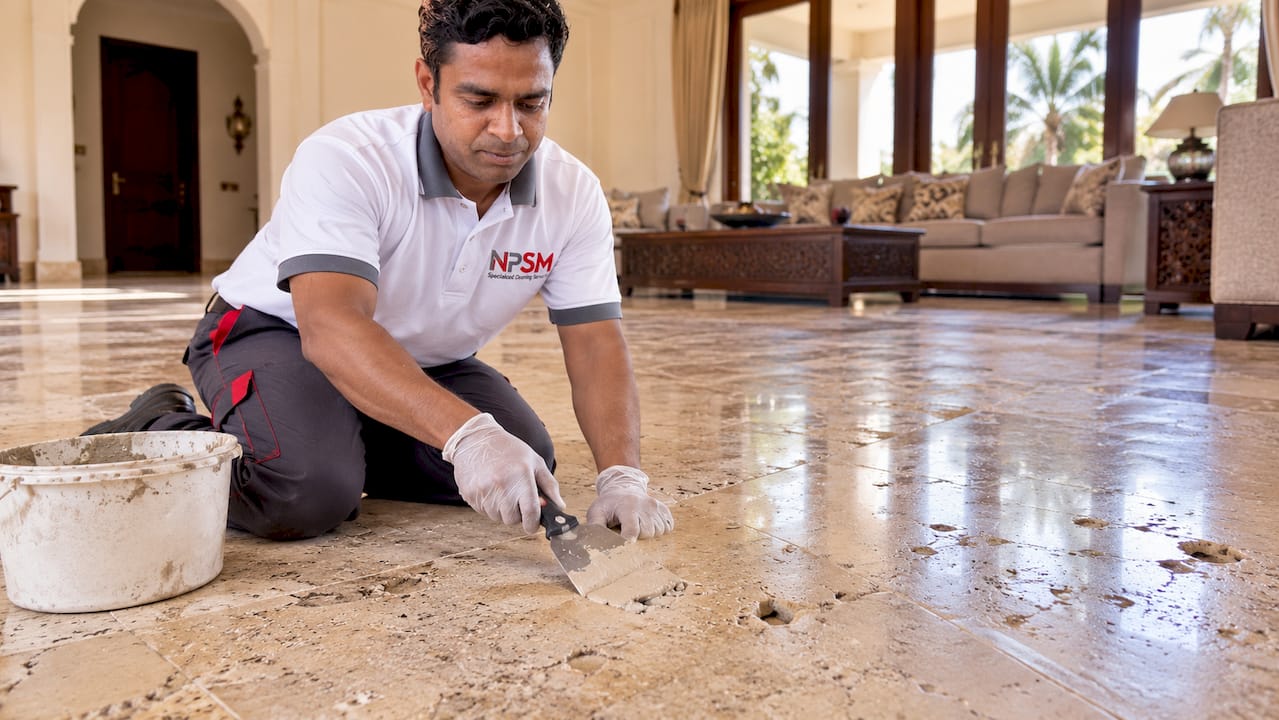
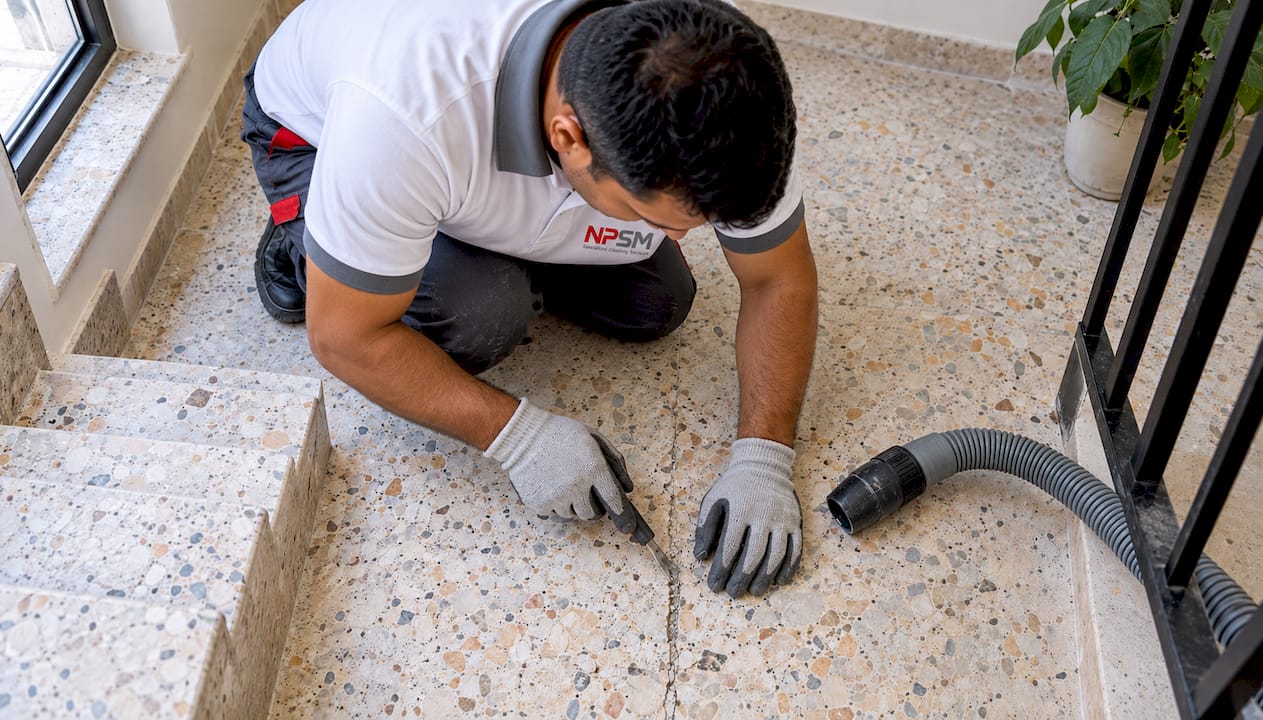
Crack and void repair. Cleaning out damaged areas and filling them with a matched matrix.
-
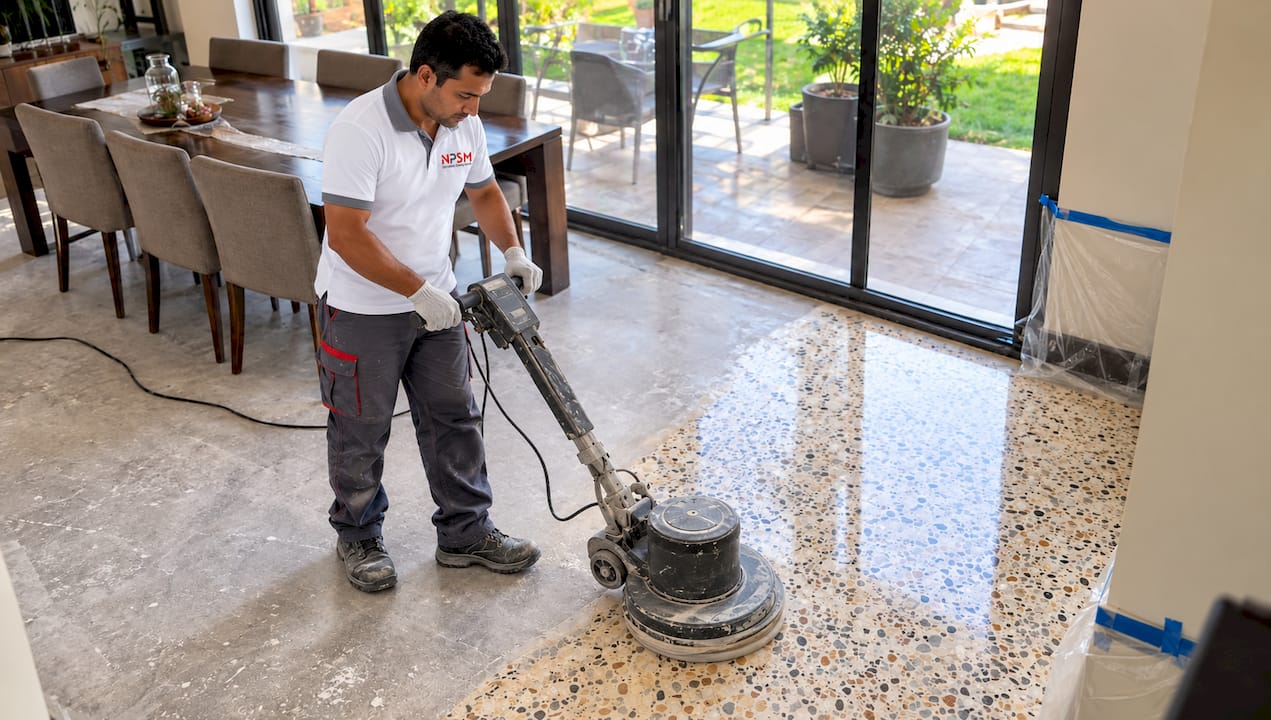
Grinding and polishing. Removing a thin layer with diamond abrasives in progressively finer stages, until the surface is smooth and even.
-
Sealing. Applying a penetrating sealer so the finished floor resists staining.
Some floors need only steps 1, 3 and 4. Others, such as older villas with movement cracks or a floor that has been patched badly, need all four plus some preparation of the base underneath.
Is your floor a polishing job or a repair job?
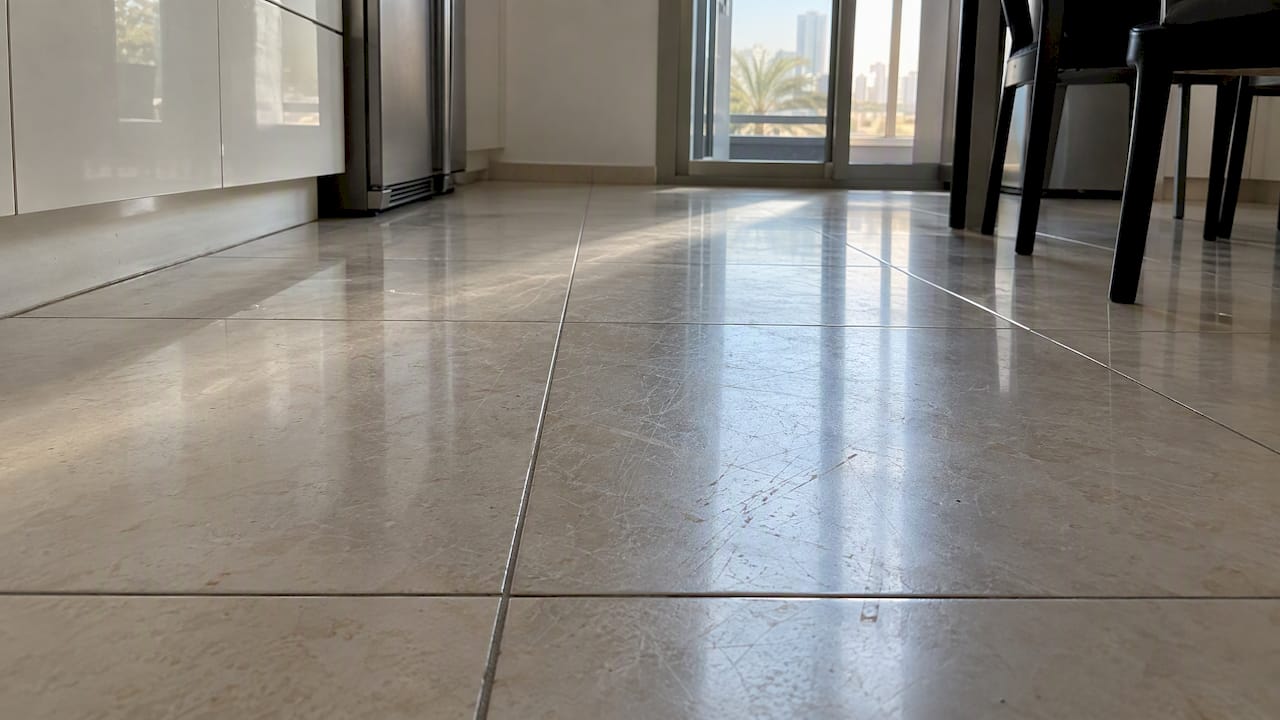
Walk the floor in daylight, ideally with the curtains open and a low light source to the side. Low-angle light shows surface texture and ridges that overhead lights hide.
Signs that point to polishing
-
A general dull or cloudy look, especially along corridors and in front of doors.
-
Fine scratches and swirl marks from sand tracked in from outdoors.
-
Light rings or etched patches where something acidic sat on the surface.
-
A floor that sounds solid underfoot and has no visible cracks or only hairline lines.
If your floor shows these, surface work is likely enough. Our guide to the signs you need floor restoration lists the wider warning signs for Dubai properties.
Signs that point to repair
-
Cracks you can catch a fingernail in, or that have lifted at one edge.
-
Cracks that follow a straight line across rooms, often over joints in the slab or where two pours met.
-
Chips or missing aggregate, and patches from earlier repairs that have changed color.
-
Hollow sounds when you tap with a coin or the handle of a screwdriver.
The NTMA guidance mentioned above treats hairline cracks as those under 1/32 inch. The GSA terrazzo repair specification uses that figure when it describes how cracks are classified and treated. A hairline crack can often be dealt with during grinding. Anything wider needs to be cleaned out and filled.
Signs of a structural problem
Settling, cracks that keep reopening after repair, and large areas that sound hollow point to something below the surface: movement in the slab, moisture, or a poorly prepared base. Grinding and polishing will make these floors look better for a short time, then the problem returns. An honest contractor will tell you this before quoting, and may suggest a structural or building consultant look at the slab first. If a contractor promises a “like new” floor over visible settlement, treat that as a warning.
The restoration process, step by step
A good restoration follows a fixed order. Ask any contractor to describe theirs and compare it with this sequence.
1. Inspection and crack mapping
The contractor walks the floor with you and marks every crack, chip and hollow area. Each gets one agreed action: no action, repair, or replacement. The NTMA guidance recommends exactly this joint walk-through before work begins, because it prevents arguments about the finished look. Get the map in writing or as photos with your signature or messages confirming it.
2. Protection and preparation
Furniture is moved or covered, skirting and walls are masked, and dust control is set up. Grinding generates fine slurry or dust, so in an occupied apartment ask how it is contained. Wet grinding keeps dust down but needs slurry collection. Dry grinding with vacuum extraction is cleaner for finished interiors. Ask which method will be used and why.
3. Crack and void repair
The difference between a repair that lasts and one that returns is preparation. The crack must be cleaned out fully before it is filled, so the filler bonds to sound material rather than dust. The GSA specification describes filling with a matrix matched to the existing floor. For epoxy systems, it also describes using a mesh or isolation membrane to bridge cracks so they do not telegraph back up to the surface. It is an optional upgrade, but a worthwhile one where the base is likely to keep moving.
4. Grinding in stages
Grinding uses diamond abrasives, starting coarse to remove damage and levelling high spots, then moving through finer grits. According to the GSA specification, stages typically begin at 24 to 40 grit and finish at 80 to 200 or more. Skipping a stage leaves scratches that show as haze after polishing. A contractor who talks in stages and grit sequences is working the way the specification expects.
5. Polishing and sealing
Final polishing brings out the depth and contrast of the stone chips. A penetrating sealer then goes on to reduce staining. Penetrating sealers protect from within the surface rather than forming a film, so the floor looks natural rather than plastic. Ask which sealer is used, how long it needs to cure, and when you can put furniture back and walk on the floor normally.
Repairs: what to expect from color matching
Terrazzo chips are natural mined stone, and the floor has aged since it was laid. This means a new patch will rarely be a perfect twin of the old floor. The NTMA guidance is blunt on this: color matching existing aggregates may not be possible. A skilled contractor blends the matrix and the chips to get as close as they can, and after the whole floor is ground and polished, the patch usually settles into the field.
Two habits help you here:
-
Ask for an onsite sample finished in the actual light of your space. A sample should match the floor as it looks today, not the original manufacturer swatch.
-
Keep the expectation honest. Your goal is a patch you cannot find from standing height, not one that survives a magnifying glass.
If your floor has a pattern with brass or zinc divider strips, make sure repairs stay within the divided panels and the strips are cleaned and left intact.
Why Dubai floors wear the way they do
Dubai conditions are particular. Fine desert dust and sand act as an abrasive underfoot, so entrances and corridors dull first. Villas with large glass openings get strong sun, which fades some binders and makes uneven polishing stand out. Air conditioning cycles and humidity on the coast can drive moisture into slabs. Floors in holiday homes with irregular occupancy often show the effect of neglect followed by an intense cleaning, which strips sealer.
Commercial floors are a different case. Hotel lobbies, malls and corporate offices see foot traffic that wears terrazzo evenly in lanes, and the work is usually scheduled at night or in phases. If you manage such a property, ask contractors about phased working, noise limits and how they will keep areas open to the public.
For day-to-day care, use pH-neutral cleaners, place mats at entrances, and avoid acidic products and harsh bleach. These recommendations are standard for stone-based floors, and they extend the time between restorations.
Do you need a permit in Dubai?
For most owners, no. Under Dubai’s Administrative Resolution No. (109) of 2022 on licensing maintenance basic maintenance means repairing non-structural defects, and polishing or replacing non-structural floor elements falls on that side. It does not require a formal building permit as long as the work does not involve structural changes to the main elements or the facade.
What you should still do:
-
Ask the contractor for a valid trade license covering building maintenance or specialized cleaning.
-
If you live in a managed community or tower, tell the building management first. Many require a notice, a contractor pass, insurance details and approved working hours, and some restrict noisy work or lift use. Check your own community rules.
-
If a contractor proposes breaking out and relaying sections of slab, treat that as a different category of work and ask who is taking responsibility for it.
How to choose a terrazzo contractor
The search results for this topic are crowded with directories, general fit-out firms and marketplaces. Many are generalists. Terrazzo is a specialist surface, so judge on evidence, not on the size of an advert.
Questions to ask before you shortlist
-
Have you restored terrazzo, not just marble or tile? Ask for photos of finished terrazzo floors, ideally with an address type similar to yours.
-
Which grinding stages and sealer do you use? The answer should be specific.
-
Will you map and agree each crack before work starts? If the answer is vague, move on.
-
Can you finish an onsite sample? A sample in your lighting is the best protection against disappointment.
-
What is included for preparing the base? More on this below.
-
Who does the work? Ask whether your floor is handled by your own team or subcontracted, and who supervises.
-
What do you guarantee, and in writing? Warranties on polish are limited, because traffic and cleaning habits matter, but a contractor should state what they stand behind.
-
Do you hold the right license, and how do you handle building management requirements?
Red flags
-
A price quoted by phone with no site visit.
-
A promise of a perfect, brand-new floor regardless of condition.
-
No mention of cracks, hollow spots or the base.
-
Pressure to book immediately, or a very low rate that excludes sealing.
-
Reluctance to show a sample.
If you want to compare approaches for other stone floors, our article on marble polishing vs grinding vs crystallization explains why the surface process matters as much as the machine.
Reading a quote: what changes the price
Price for terrazzo depends on area, condition, the amount of crack repair, and how much preparation the base needs. We publish a general range of 25 to 200 AED per sqft for floor polishing and restoration across our services, and marble polishing starts from 30 AED per sqm. Terrazzo has no published price, because a fair figure comes only after we inspect the floor.
The largest source of surprise is hidden preparation. Experts in the Dubai market point out that quotes sometimes leave out substrate preparation, and levelling needs then appear after the job starts. So ask in writing:
-
Does the quote include crack cleaning and filling, and for how many linear meters?
-
Does it include levelling or leveling of high and low spots?
-
Is sealing included, and which sealer?
-
Is there a day rate or a per-area rate for extra work if the floor turns out worse than expected?
-
Are moving furniture, waste removal and building management fees included?
Our perspective
We restore floors in villas, apartments, hotels and commercial buildings across Dubai, and terrazzo is one of the surfaces where honest advice matters most. Owners often come to us believing the floor is finished and must be ripped up. In many cases it is not: the surface is simply worn or poorly maintained, and a careful grind, polish and seal brings it back at a fraction of the cost and disruption of replacement.
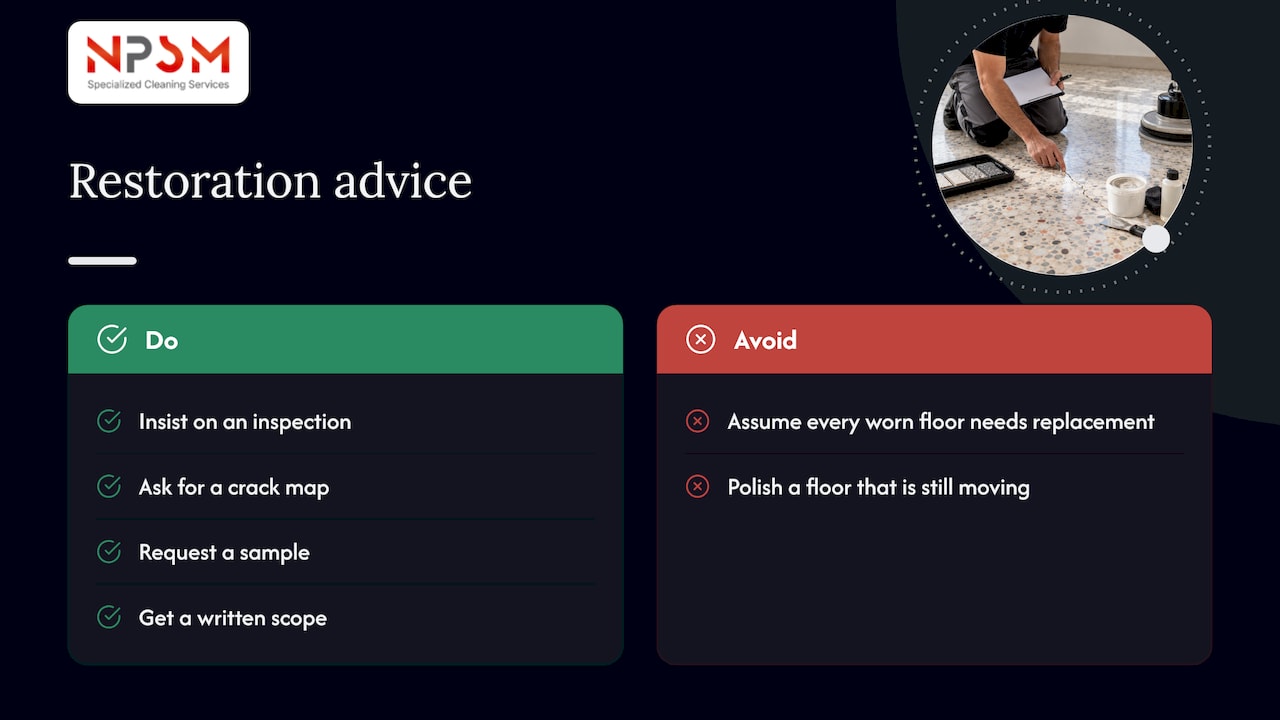
The other side is equally true. When a floor has real movement beneath it, we say so. Polishing a floor that is still moving is a short-term cosmetic fix, and we would rather tell you that on the first visit than have you call us back in a year. We tailor the method to each floor type and property, we work with professional-grade equipment and diamond polishing systems, and we use eco-friendly products where the job allows.
Our advice to any owner is simple: insist on an inspection, a crack map, a sample and a written scope. A contractor who welcomes all four is usually one you can trust.
— Qadir
Terrazzo restoration with us
We offer terrazzo floor polishing and restoration alongside natural stone, granite and marble work for villas, apartments, hotels, offices and retail spaces across Dubai. Details are on our terrazzo and natural stone restoration page. If you are planning a handover or fit-out, the post-renovation floor polishing guide explains timing, and our step-by-step restoration guide walks through what happens on site. To arrange an inspection, start from our services page.
Before you book: a short checklist
-
Photograph the floor in daylight and mark the problem areas.
-
Tap-test suspect areas and note any that sound hollow.
-
Check your building’s contractor rules and working hours.
-
Get an inspection, not a phone quote.
-
Agree the crack map and the action for each item in writing.
-
Approve a sample in your own light.
-
Confirm what is included for preparation, sealing and waste removal.
-
Plan a cleaning routine with pH-neutral products and entrance mats after the work.
FAQ
Can terrazzo be restored instead of replaced?
Usually yes, when the problem is surface wear, scratches, dullness or localized cracks. Terrazzo is ground and polished during installation, so it can be ground and polished again. Replacement is only worth considering for severe structural failure or large areas of debonded topping.
How long does terrazzo restoration take?
It depends on area, condition and the amount of repair. A small apartment with surface wear is far quicker than a large villa with many cracks, and sealers need cure time before furniture goes back. We confirm the schedule after inspecting the floor, because a fixed number given blind is rarely reliable.
Will repaired cracks be invisible?
Often close to it, but not guaranteed. Terrazzo aggregates are natural stone and the floor has aged, so an exact match may not be possible. A sample and an agreed crack map set realistic expectations before work starts.
Do I need a permit to polish my terrazzo floor in Dubai?
Polishing is basic maintenance of a non-structural element, and Dubai’s rules on maintenance licensing do not require a building permit for it, provided no structural elements or facades are altered. You should still use a licensed contractor and follow your building or community management’s requirements for contractor access.
What should a terrazzo quote include?
It should list the area, the crack and void repairs, the grinding and polishing stages, the sealer, and what is covered for preparation or leveling of the base. Anything left out should be stated as an extra with a rate, so there are no surprises mid-job.