
TL;DR:
- Facility management flooring services in Dubai involve specialized programs that maintain and restore floors to ensure safety and durability amid extreme environmental conditions. Proper assessments, tailored maintenance, and proactive restoration extend floor lifespan and reduce long-term costs, especially in high-traffic environments. Implementing risk-informed, usage-based schedules with safety testing optimizes floor performance and minimizes liability exposure.
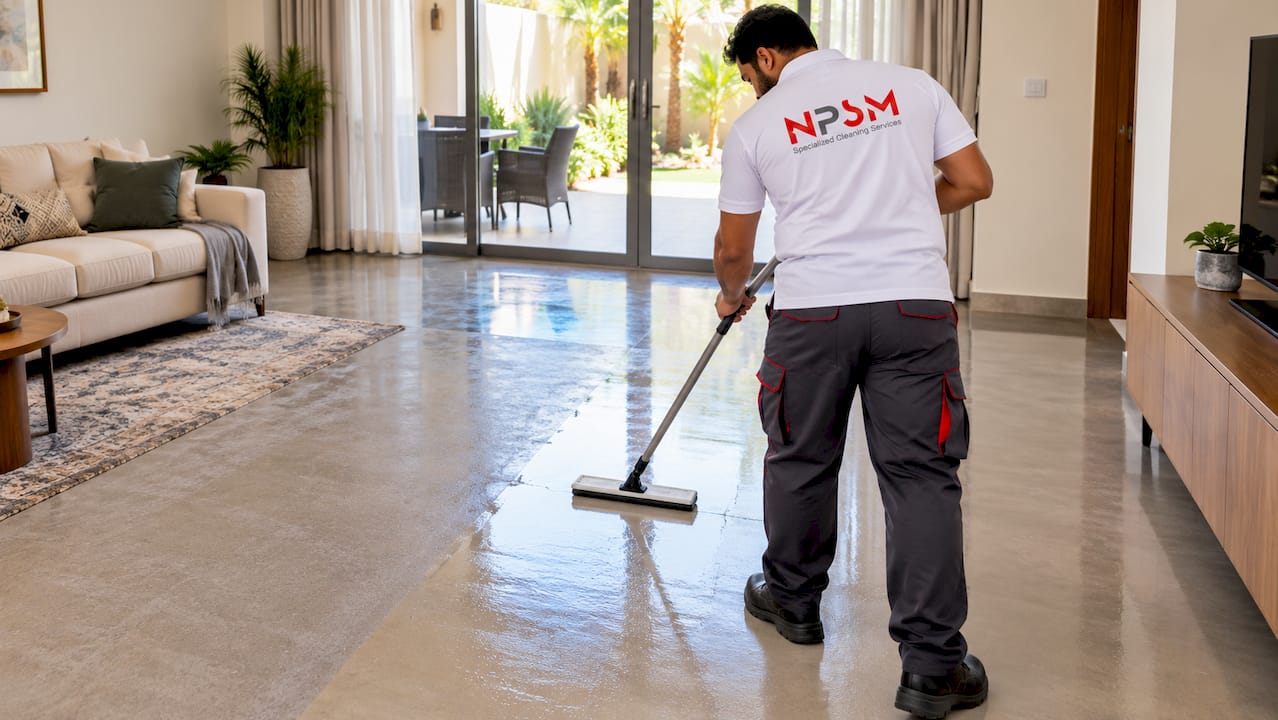
Facility management flooring services are specialized programs that maintain, restore, and protect commercial and residential floors to preserve safety, appearance, and long-term durability. For property and facility managers in Dubai, these programs are not optional extras. Dubai’s extreme heat, sandy air, and high foot traffic in malls, hotels, offices, and residential towers accelerate floor wear at a rate most standard cleaning schedules cannot address. NPSM Specialized Cleaning Services LLC, operating through FloorPolishing.ae, delivers tailored commercial flooring solutions across Dubai that align maintenance spend with actual asset life and risk, not just surface appearance.
What are facility management flooring services and why do they matter?
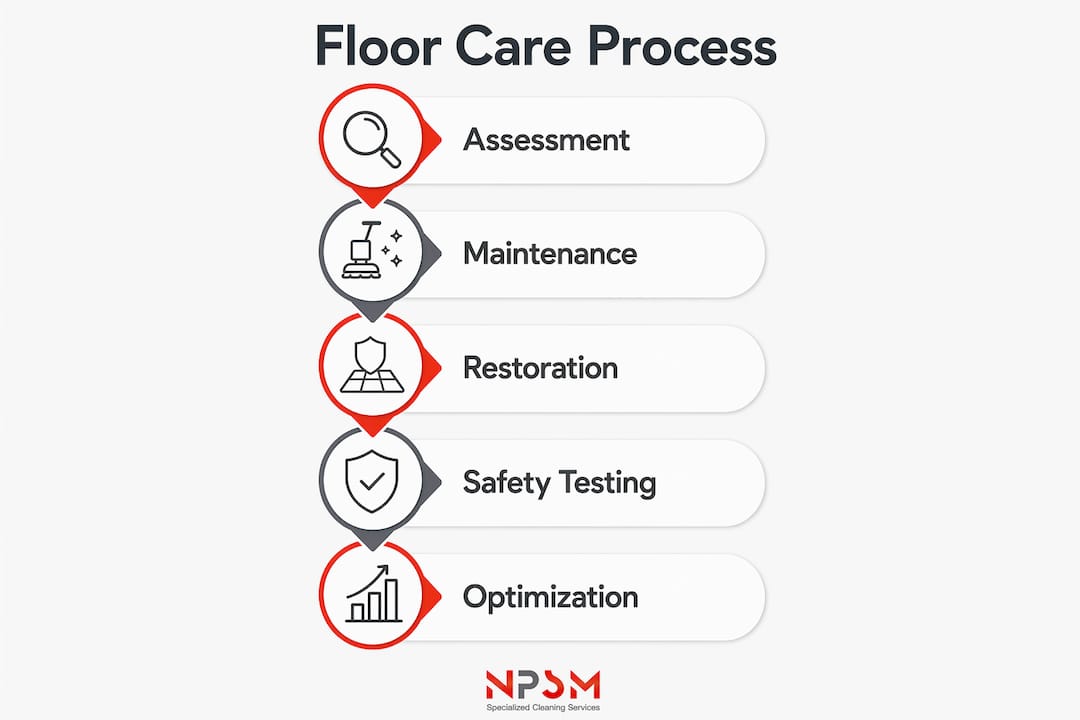
Facility management flooring services cover the full lifecycle of a floor: assessment, routine maintenance, deep cleaning, restoration, and protection. The industry term for this structured approach is a floor care program, and it applies to every surface type from marble lobbies to vinyl hospital corridors. Structured floor care links maintenance spend directly to asset life extension and risk management. That connection matters because replacing a marble floor in a Dubai hotel lobby costs far more than restoring it through a scheduled polishing program.
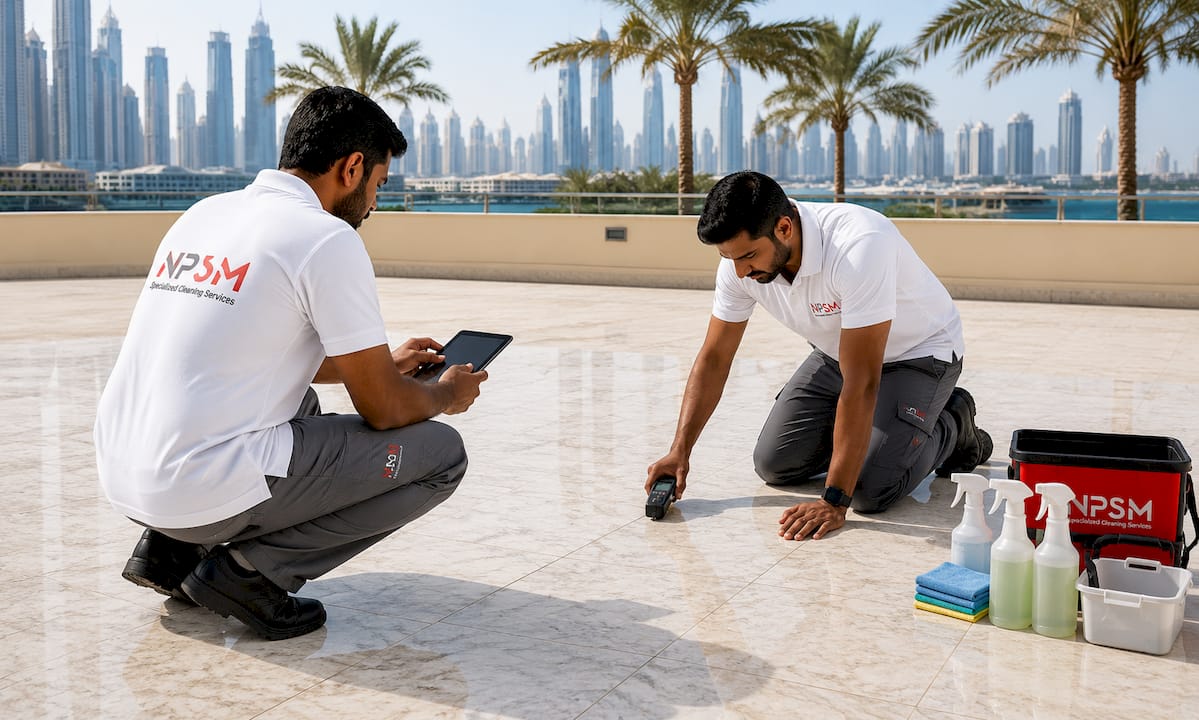
Dubai’s commercial environment creates specific pressure points. Sand particles tracked in from outside act as abrasives on polished stone. High humidity near coastal zones promotes grout degradation. Air-conditioned spaces with rapid temperature changes cause wood to expand and contract. A generic floor care program built for a temperate climate will fail here. The right program starts with knowing exactly what you have, where the stress points are, and what each surface needs.
How do tailored floor assessments and audits optimize maintenance programs?
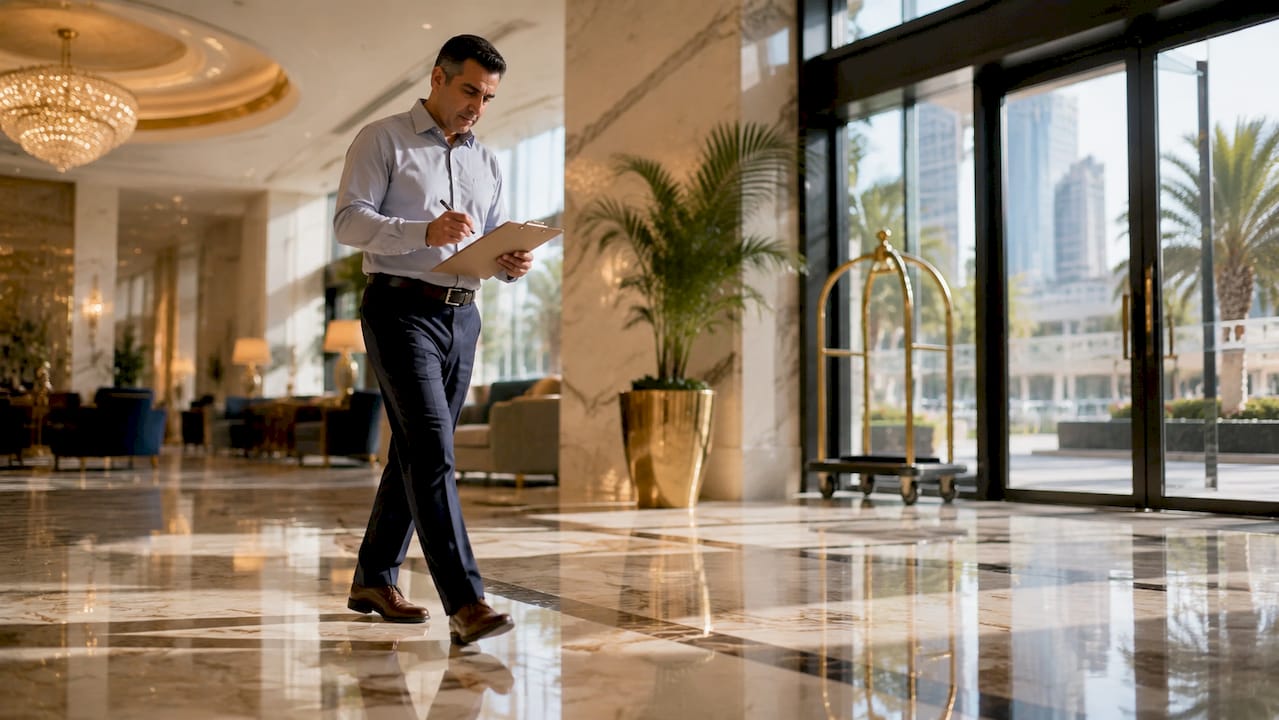
A professional floor condition assessment begins with a site survey lasting 30–60 minutes. That time covers floor material identification, current condition grading, traffic pattern mapping, and safety risk documentation. Skipping this step is the single most common reason facility managers overpay for floor care or end up with damage that a proper audit would have caught early.
During the audit, a qualified technician evaluates:
- Material type and finish: Marble, granite, terrazzo, VCT, vinyl, wood, and tile each require different chemistry and equipment.
- Traffic zones: High-traffic corridors need more frequent attention than storage rooms or back-of-house areas.
- Safety risks: Worn finishes, cracked grout, and uneven surfaces create slip and trip hazards that expose property owners to liability.
- Contamination sources: Kitchen grease, construction dust, and chemical spills each degrade floors differently.
Transparent pricing and clear proposals are the direct output of a thorough audit. When a contractor can show you exactly what was found and why each service is recommended, hidden fees become far less likely. Demand an itemized proposal before signing any floor care contract.
Pro Tip: Ask your floor care provider to walk the property with your facilities supervisor during the audit. Two sets of eyes catch failure points that a solo technician might miss, and your supervisor’s operational knowledge adds context that improves the final maintenance plan.
What are the best practices for maintaining different facility flooring types?
Floor maintenance services are not one-size-fits-all. Each material has a specific chemistry, finish type, and wear pattern that determines the correct cleaning protocol. Using incorrect pH cleaners degrades wax or sealants and damages flooring surfaces. That damage is often invisible at first, then suddenly catastrophic when the protective layer fails completely.
Marble and natural stone
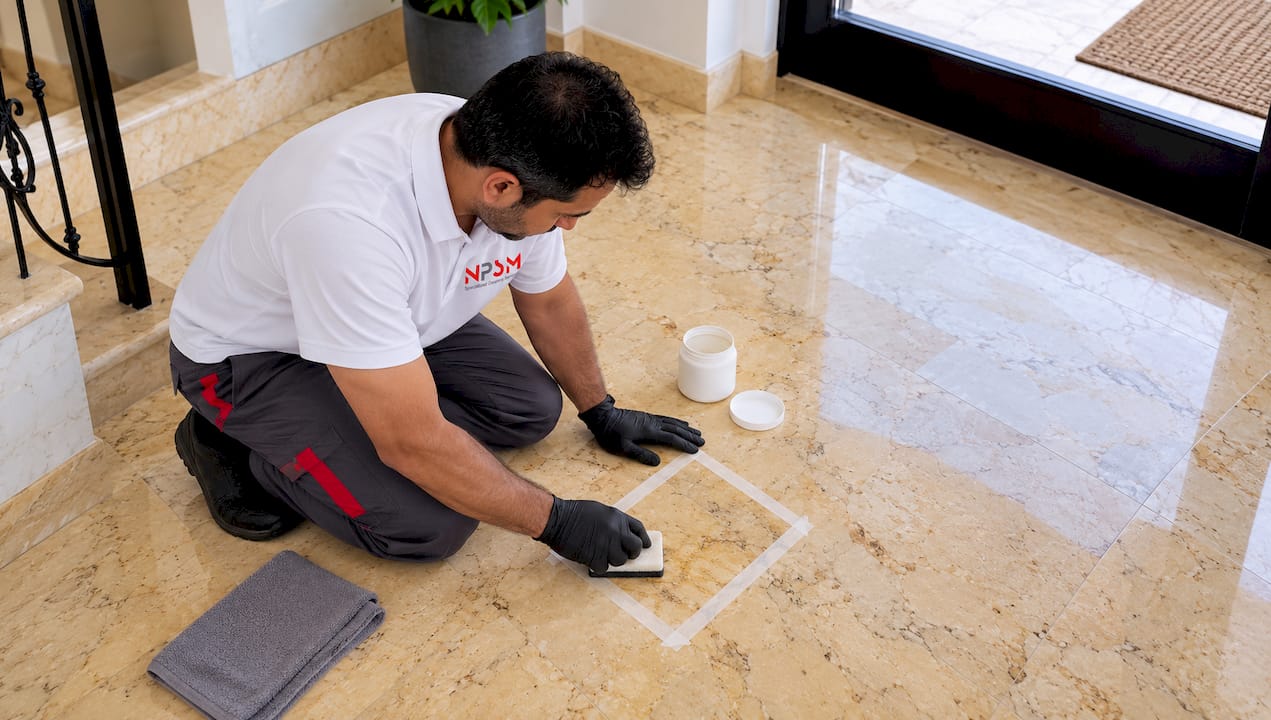
Marble requires neutral pH cleaners only. Acidic products, including many common bathroom cleaners, etch the surface and create dull patches that require professional re-polishing to correct. Daily dust mopping removes the sand and grit particles that scratch polished stone under foot traffic. Scheduled crystallization treatments restore the molecular bond of the surface and extend the time between full polishing cycles.
Vinyl composite tile (VCT) and vinyl plank
VCT floors in hospitals, schools, and retail stores rely on polymer-based floor finish for their shine and protection. Daily dust mopping prevents grit from grinding through the finish layers. Scheduled burnishing with a high-speed machine restores gloss between full strip-and-wax cycles. Stripping should only happen when the finish is visibly yellowed or built up unevenly, not on a fixed calendar schedule.
Wooden floors
Wood floors in Dubai offices and residential villas need moisture-controlled cleaning. Wet mopping introduces water that swells wood fibers and causes warping. Dry or lightly damp microfiber mopping is the correct daily method. Customized cleaning plans that address specific contamination and wear patterns prevent the scratches and discoloration that make wooden floors look aged before their time.
Tile and grout
Tile surfaces are durable but grout lines are porous and absorb stains rapidly in kitchen and bathroom environments. Alkaline degreasers work well on ceramic and porcelain tile, but grout requires a separate targeted treatment. Sealing grout after deep cleaning dramatically extends the time before the next deep clean is needed.
Pro Tip: Link your maintenance schedule to actual usage data, not a generic calendar. A conference room used three days a week needs different attention than a hotel lobby that runs 18 hours a day. Usage-based scheduling consistently outperforms fixed-date programs on both cost and floor condition.
How do professional floor restoration and polishing extend floor life and improve safety?
Restoration is the intervention that happens when routine maintenance is no longer enough. Effective floor restoration methods include stripping, waxing, burnishing, and polishing, each suited to specific floor conditions and types. Choosing the wrong method wastes money and can cause additional damage.
The table below maps the most common restoration processes to the floor types they serve and the primary benefit each delivers.
| Restoration method | Best suited for | Primary benefit |
|---|---|---|
| Diamond grinding and honing | Marble, granite, terrazzo | Removes deep scratches and levels uneven surfaces |
| Crystallization | Marble, limestone | Restores surface hardness and high-gloss finish |
| Strip and wax | VCT, vinyl plank | Removes built-up finish and resets protective coating |
| Burnishing | VCT, vinyl, concrete | Restores gloss and compacts finish layers |
| Sanding and refinishing | Hardwood, engineered wood | Removes surface layer and applies fresh sealant |
| Grout restoration | Ceramic, porcelain tile | Cleans, re-colors, and seals grout lines |
Safety is the most underappreciated benefit of professional restoration. Slip-resistance testing is a required component of any responsible commercial floor care program. Worn finishes reduce traction, and a single slip-and-fall incident in a Dubai commercial property can generate liability costs that dwarf the entire annual floor care budget. High-traction finishes applied after restoration bring surfaces back into compliance with safety standards.
For high-traffic floor care in environments like shopping malls or hospital corridors, restoration cycles should be scheduled proactively based on measured surface condition, not after visible damage appears. Waiting until a floor looks bad means the structural integrity of the finish is already compromised.
How can facility managers develop cost-effective, risk-sensitive flooring maintenance plans?
A maintenance plan that ignores risk is just a cleaning schedule. A plan that maps floor types and traffic patterns to objective maintenance cycles is a genuine asset management tool. The difference shows up in your annual budget and in the condition of your floors three years from now.
Follow these steps to build a plan that works for Dubai’s commercial and residential environments:
- Inventory every floor type and zone. Document material, square footage, finish type, and current condition for each area. This is your baseline.
- Classify zones by traffic intensity. Separate high-traffic public areas from moderate-traffic offices and low-traffic storage or utility spaces.
- Assign maintenance frequencies by zone. High-traffic zones need daily dust mopping, weekly damp mopping, and monthly deep cleaning. Low-traffic zones can operate on longer cycles.
- Schedule restoration interventions proactively. Use surface condition assessments, not calendar dates, to trigger polishing, stripping, or refinishing work.
- Integrate floor care with your broader facility systems. Coordinate with your cleaning team, safety officer, and building management system so floor work does not disrupt operations.
- Review and adjust quarterly. Walk the floors with your supervisor every quarter and compare observed condition against your baseline. Adjust frequencies where the data shows drift.
The most common pitfall is reactive maintenance. A facility that only calls for floor care when a surface looks damaged is already paying more than necessary. Reactive repairs cost significantly more than scheduled restoration because the damage is always deeper by the time it becomes visible. Integrating professional floor care into your facility’s annual budget as a fixed line item, rather than an emergency expense, is the structural change that protects your flooring investment.
Pro Tip: When evaluating floor care providers, ask specifically about their approach to eco-friendly flooring choices and chemical management. Providers who use low-VOC, biodegradable cleaning agents protect both your occupants and your building’s air quality, which matters especially in enclosed, air-conditioned Dubai facilities.
Key takeaways
Facility management flooring services deliver the most value when they combine precise site assessment, material-specific maintenance, proactive restoration, and risk-driven scheduling into a single coordinated program.
| Point | Details |
|---|---|
| Start with a site audit | A 30–60 minute assessment identifies material type, traffic zones, and safety risks before any work begins. |
| Match chemistry to material | Neutral pH cleaners protect marble and wood; incorrect products degrade finishes and trigger costly repairs. |
| Restore before damage deepens | Proactive polishing and crystallization cost less than reactive repairs after finish failure. |
| Include slip-resistance testing | High-traction finishes after restoration reduce liability and bring surfaces into safety compliance. |
| Schedule by usage, not calendar | Traffic-based maintenance cycles outperform fixed-date programs on both cost and floor condition. |
What I’ve learned about floor care in Dubai’s facilities
The most persistent mistake I see facility managers make is treating floor condition as a visual problem. If it looks clean, it must be fine. That logic fails in Dubai faster than anywhere else I have worked. Sand abrasion and temperature cycling degrade protective finishes at the molecular level long before the surface looks dull. By the time a marble lobby looks tired, the finish has been compromised for months.
The second issue is training. Facility teams often know how to clean but not how to maintain. There is a real difference. Cleaning removes visible soil. Maintenance preserves the finish that protects the floor underneath. A team that mops marble with the wrong cleaner twice a day is actively shortening the floor’s life while appearing to care for it. Investing in a half-day training session on material-specific protocols pays back in reduced restoration costs within a year.
The third observation is about supplier relationships. The best floor care outcomes I have seen come from facilities that treat their floor care provider as a partner, not a vendor. That means sharing occupancy data, flagging new contamination sources, and reviewing condition reports together. Providers who understand your building’s rhythm give you better advice and catch problems earlier.
The role of floor care in longevity for high-traffic properties is not a soft benefit. It is a measurable financial return. Facilities that run structured floor care programs consistently spend less on flooring over a ten-year period than those that rely on reactive replacement. That is the argument that wins budget approval every time.
— Qadir
Restore and protect your Dubai facility’s floors with expert care
NPSM Specialized Cleaning Services LLC delivers professional floor restoration across Dubai for marble, wooden, vinyl, tile, terrazzo, and natural stone surfaces in offices, hotels, retail stores, hospitals, and residential properties. Every project begins with a complimentary site assessment and a transparent, itemized proposal. Whether your facility needs a one-time restoration or a structured annual floor care program, the team at FloorPolishing.ae builds a plan around your specific floor types, traffic patterns, and budget. Contact NPSM Specialized Cleaning Services LLC today to schedule your free site survey and receive a customized maintenance proposal.
FAQ
What does a facility management flooring service include?
Facility management flooring services include site assessment, material-specific cleaning, scheduled maintenance, restoration treatments such as polishing and crystallization, and safety testing. The scope is tailored to each property’s floor types, traffic levels, and condition.
How often should commercial floors in Dubai be professionally restored?
Restoration frequency depends on traffic intensity and floor type. High-traffic marble lobbies in Dubai hotels or malls typically need professional polishing every 6–12 months, while moderate-traffic office floors may need attention every 12–18 months based on condition assessments.
Why is slip-resistance testing part of a floor care program?
Slip-resistance testing identifies surfaces where worn finishes have reduced traction to unsafe levels. Restoring high-traction finishes after testing reduces the risk of slip-and-fall incidents and the liability exposure that comes with them in commercial facilities.
What is the difference between floor cleaning and floor maintenance?
Floor cleaning removes visible soil and surface contamination. Floor maintenance preserves and restores the protective finish that shields the floor material from wear, staining, and damage. Both are necessary, but maintenance determines how long a floor lasts between major restoration cycles.
Can restoration replace the need for floor replacement in Dubai facilities?
Professional restoration extends floor life significantly and is far more cost-effective than replacement for most surface types. Marble, terrazzo, hardwood, and VCT floors that appear heavily worn can often be fully renewed through grinding, polishing, or refinishing without the disruption and expense of full replacement.