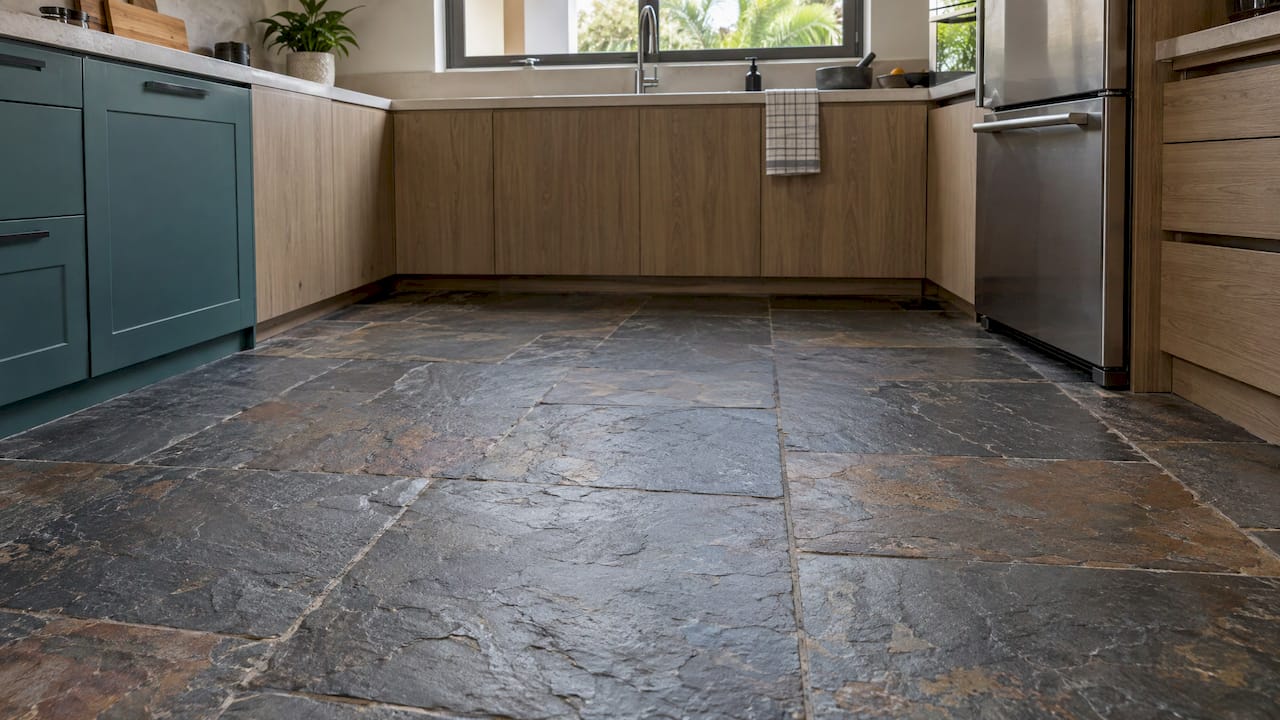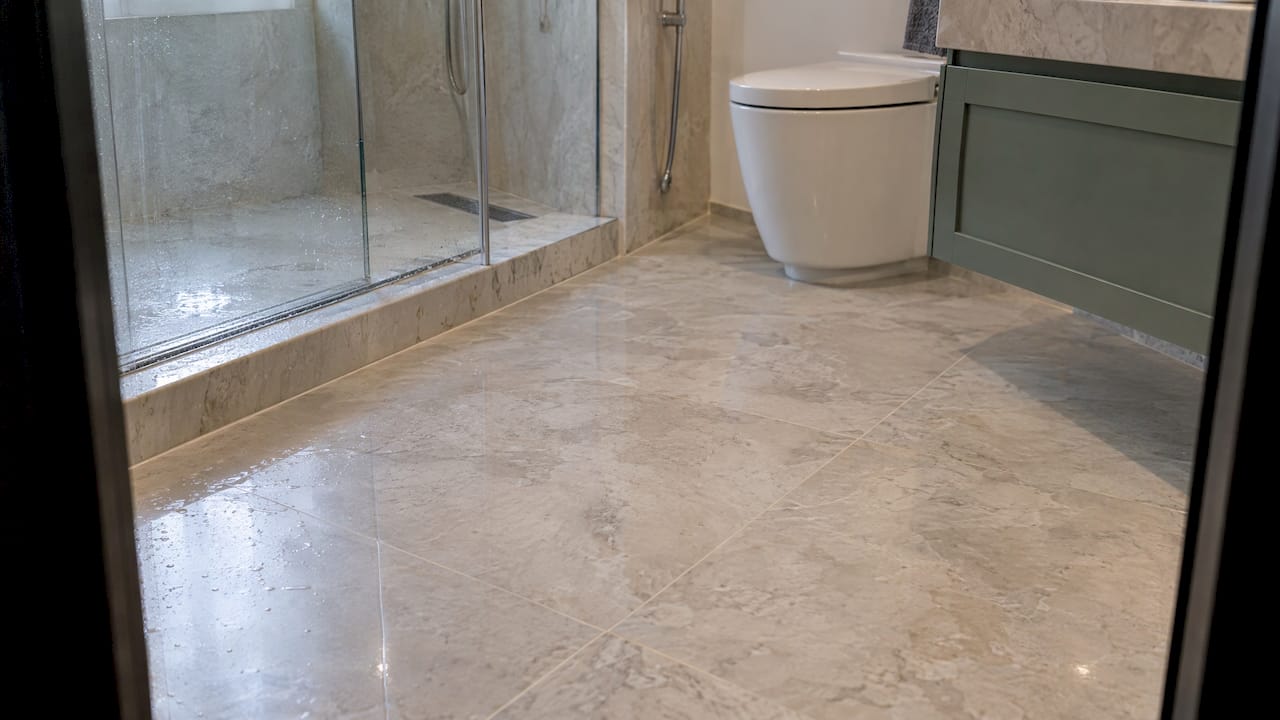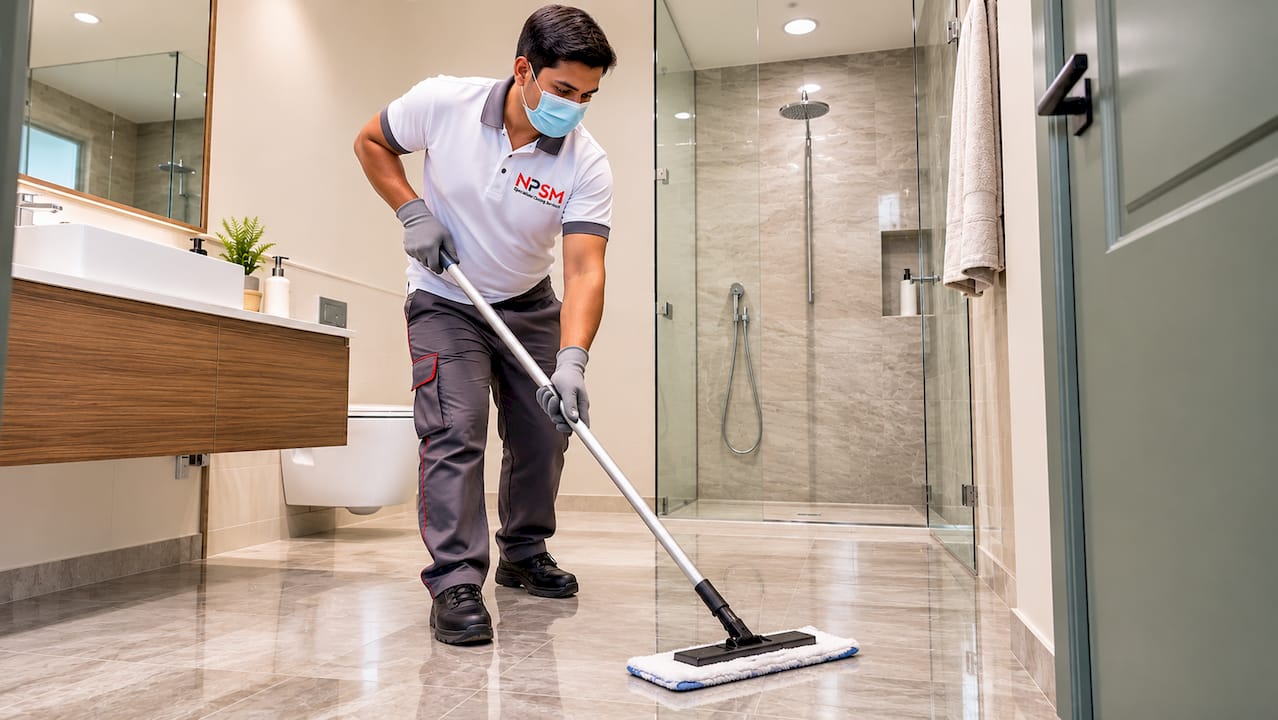

An anti-slip treatment changes the surface of a floor so shoes and bare feet grip it when it is wet. On polished marble, stone, terrazzo and glazed tile, that means altering the finish itself, so the grip you gain and the look you keep are decided together. The best result comes from one team that can hone, polish, seal and restore the floor, and that is how we approach it at FloorPolishing.ae. Below: the methods, what each does to appearance, how grip is measured in the UAE, and how to plan the job for a villa, apartment, hotel or commercial building.
TL;DR
-
Polished marble, terrazzo and glossy porcelain are slippery when wet. Treatment adds micro-texture so water cannot form a continuous film under the sole.
-
Texture and gloss pull against each other. Any method that makes a smooth floor grip when wet will reduce shine, so decide the target finish first.
-
In the UAE, grip is measured with a pendulum test (EN 13036-4:2011). Wet indoor level floors should reach a Pendulum Test Value (PTV) of 35 to 45, and showers and pools 45 or more.
-
Match the method to the location: entrance lobby, bathroom, stairs, kitchen and terrace each need something different.
-
Treat and restore in one programme. Honing, polishing and sealing are part of our marble, stone and tile services.
Table of Contents
Why polished floors become a slip risk in Dubai
Dubai interiors lean heavily on high-gloss marble, large-format porcelain and polished terrazzo. They look exceptional, and they have a smooth, tightly closed surface. When a film of water, mopping solution, sunscreen residue or pool water sits on that surface, the sole floats on it instead of gripping.
The places where it matters most are predictable:
-
Villa entrances and foyers, where people walk in from pool decks, gardens and car parks.
-
Bathrooms, wet rooms and shower floors.
-
Marble staircases, especially at the nosing, the edge of each step.
-
Hotel lobbies, spa corridors and restaurant kitchens passages.
-
Retail and office entrances that are mopped during opening hours.
The Dubai Health Authority’s Health Facility Guidelines make the point for healthcare buildings: stone and terrazzo may not be slip resistant, and where they are used in foyers and lobbies they may be treated with non-slip chemicals to improve slip resistance. The same guidelines say ceramic tiles with suitable slip resistance can be used in bathrooms, and that smaller tiles generally give more grip because they have more grout lines. Healthcare is a stricter setting than a private villa, but the logic carries over to any property with a glossy floor and wet traffic.
How anti-slip treatment works
Most treatments for stone and tile do not add a layer. They modify the top of the floor so that it has microscopic channels and pores. When water reaches the surface, it drains into that texture instead of forming a film, and the sole makes contact with the floor itself. Product documentation for this type of solution lists marble, granite, travertine, ceramic, porcelain, mosaic stone, concrete and polished floors as treatable surfaces.
There are three broad routes, and it helps to know which one a proposal describes:
| Route | What it does | Effect on appearance | Typical use |
|---|---|---|---|
| Surface etching (chemical) | Micro-roughens the surface of the stone or tile | Reduces gloss, leaves a matte look | Lobbies, bathrooms, wet areas |
| Mechanical honing or grinding | Diamond abrasives cut the surface to a controlled, finer-textured finish | Satin or matte finish, evenly controlled | Marble, terrazzo, natural stone floors |
| Applied coating or textured finish | Adds a gritty layer on top | Visible layer, can wear or peel over time | Industrial, garages, ramps |
A coating adds a new layer that can wear, blister or peel. A surface solution acts inside the floor’s own surface and does not change colour or pattern. For interior marble and stone in homes and hotels, that difference is why most owners prefer to work on the stone itself rather than cover it.
What treatment does to the look of your floor
This is the question that decides most projects. The UK Health and Safety Executive, which publishes some of the most cited guidance on this subject, says that etching smooth surfaces such as ceramic tile, terrazzo and natural stone can significantly improve slip resistance, but that reaching good wet-condition resistance almost always destroys the gloss and leaves a matte, dull finish. It also says treated surfaces need careful maintenance, and that modifying a surface by etching, blasting or grinding can shorten the service life of the flooring.
So the practical rule is simple: anti-slip performance on a polished floor is bought with some of the shine. What you control is how much, where, and how evenly.
-
Evenness. A patchy treatment shows as cloudy blotches on marble. An even, honed finish across the whole run, wall to wall, reads as a deliberate satin floor.
-
Zoning. Treat the wet-risk zones (entrance, bathroom, stair treads) and keep a polished finish where footfall is dry, with the transition planned at a natural break such as a threshold or change of room.
-
Recovery. After honing, the stone can be re-polished to a softer sheen and sealed, so the floor looks cared for, not damaged. The sealing step protects against stains, which matters on honed marble because a honed surface is more open than a mirror polish.
This is where hiring a restoration team rather than a single-purpose treatment applicator pays off. Grinding, honing, polishing and sealing are core to what we do on marble, natural stone, terrazzo and tile, so the grip, the sheen and the stain protection are planned as one job. If your marble is already slippery, our guide to the slippery marble floor fix walks through what helps stone and what harms it.
Safety first: chemical etchants are for trained professionals
Some etching products are acid-based. HSE guidance warns that etchants based on hydrofluoric acid carry serious risks, including severe skin and bone damage and cumulative harm to organs, and notes it has not encountered an effective chemical treatment that improves slip resistance without etching chemicals of this kind. Acids also react with marble and limestone, which are calcium-based and can be damaged quickly by the wrong product or a wrong dilution.
For property owners, the safe approach is straightforward: the treatment is carried out by trained operators, with the area closed off and ventilated, and the method is chosen for the specific stone. Do not allow cleaners, handymen or building staff to apply acid-type products to marble or terrazzo. If someone is exposed to an etching product, treat it as a medical emergency and call 998 for an ambulance in Dubai.
Match the method to the room
The DHA guidelines frame slip resistance as something that depends on footwear, activity, gait, contamination and environment, not just on the floor. That is why one method does not suit a whole property.
Entrance halls and lobbies
Large marble foyers take the most wet traffic and the most visible wear. Honing the whole foyer to a satin finish, then sealing, gives uniform grip and a consistent look. In hotels and offices, schedule the work in phases so one entrance always remains open.
Bathrooms and wet rooms
Bathroom floors see soap, shampoo and bare feet. Smaller tiles and textured finishes give more grip, and the DHA guidelines say as much for bathrooms. Where existing tiles are glossy porcelain or ceramic, a tile-specific treatment and re-grouting can improve both grip and appearance. See our tile polishing and restoration services and the practical guide to hotel bathroom floor maintenance.
Marble staircases
Stairs are where a slip becomes a serious fall. Treads and nosings should be treated evenly, with no polished strip left at the edge. Our team handles marble staircase polishing and restoration as part of the same service as the main floors.
Terrazzo and natural stone
Terrazzo, granite and travertine each respond differently to abrasion and to chemicals. Terrazzo in corridors and car park lobbies is common in Dubai residential towers and commercial buildings, and a honed finish keeps grip while allowing stain prevention to continue. Our natural stone, terrazzo and granite services cover this range, and the terrazzo stain prevention habits help facility teams keep the floor performing after treatment.
High-traffic commercial floors
Malls, retail stores and hospitality corridors wear unevenly. Grip is lost first on the routes people walk most. Plan treatment with a maintenance cycle so the same zones are reviewed regularly, as covered in our high-traffic floor care guide for Dubai properties.
How grip is measured in the UAE
You should not have to rely on how a floor feels underfoot. In the UAE, wet slip resistance is assessed with a pendulum test to European Standard EN 13036-4:2011. A rubber slider swings across the wet floor, and the instrument records a Pendulum Test Value. A slippery floor reads close to zero, and higher numbers mean more grip.
The UAE Universal Design Code (February 2017) sets the targets by environment. As interpreted in UAE testing guidance:
| Surface condition | Required PTV |
|---|---|
| Dry, indoor, level | 15 to 35 |
| Dry, inclined (5% slope or more) | 35 or more |
| Wet, indoor, level | 35 to 45 |
| Wet, inclined | 45 or more |
| Streets, swimming pools, showers | 45 or more |
A separate dry friction test classifies a floor as D1 (recommended) or D0 (less slip resistant). The mean of the results must be at least 0.40, and no single result below 0.35, for D1. Dry testing does not suit external surfaces that can become wet; wet pendulum testing is right for those.
Three points make the numbers useful to you:
-
Test the right location. A pool-side marble terrace and an internal corridor sit in different categories of the code.
-
Test before and after. An accredited slip-testing laboratory can measure the existing floor, and again after treatment, so you have a figure and not an opinion. This matters for developers handing over units, hotels documenting risk, and property managers building an audit record.
-
Expect change over time. The UK Slip Resistance Group notes that a floor has no single absolute slip resistance value: results vary with the test method, and performance changes through the floor’s life with wear, cleaning and footwear. Re-testing at intervals is the sound practice.
When you gather proposals, ask each to state the expected slip-resistance improvement, the visual change, how easy the floor will be to clean afterward, and the expected life of the treatment. Proposals that answer these four points are comparable; proposals that do not are not.
Requirements for Dubai buildings
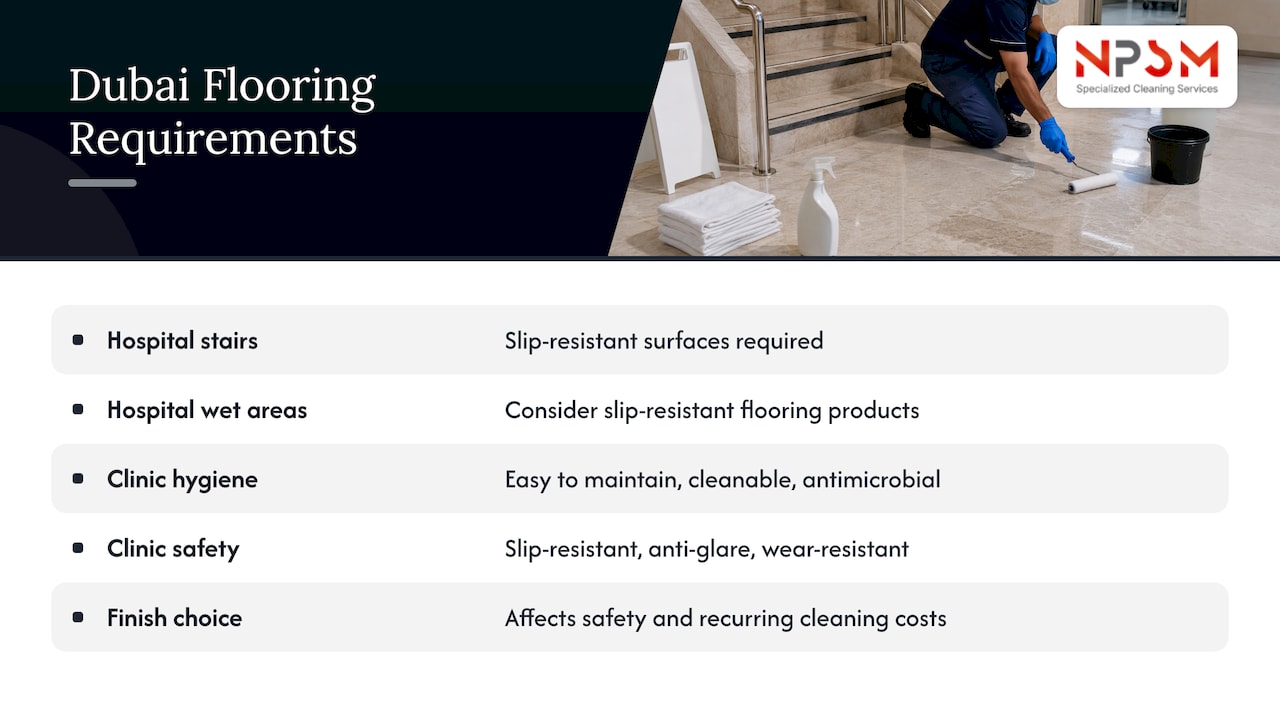
For healthcare and education-related premises, Dubai Health Authority inspection checklists are explicit. The DHA Hospital Inspection Checklist (issued April 2023) requires slip-resistant surfaces on stairway flooring and asks that slip-resistant flooring products be considered in wet areas such as ramps, shower and bath areas. The DHA’s September 2024 checklist for clinics in educational and academic settings requires flooring that is easy to maintain, cleanable, anti-microbial, slip resistant, anti-glare and suitably wear resistant for its location. The DHA Health Facility Guidelines add that the finish chosen directly affects the safety of patients, staff and visitors and the recurring cost of cleaning and maintenance.
If you manage a clinic, a hotel spa or a school, those documents are your starting point. Residential and commercial owners should treat them as a reasonable benchmark and confirm any specific obligations with the building’s management, the developer’s handover documents and the relevant authority.
How long treatment lasts and how to maintain it
Surface-level treatments that work within the floor itself are described by their makers as lasting for years with regular cleaning, while the HSE stresses that any treated surface needs careful maintenance. In practice, three habits protect the result:
-
Clean with neutral, stone-safe products. Acidic or heavily alkaline cleaners can undo a finish or damage marble.
-
Remove oils and residues. Soap film, sunscreen and cooking grease reduce grip faster than foot traffic does. Regular machine cleaning of wet zones keeps the texture open.
-
Seal after treatment. On honed marble and stone, sealing helps protect against stains and water marks. Our marble floor safety measures plan sets out a maintenance routine you can adopt.
When a floor starts to feel slick again in the same places, or a retest drops below the target for its category, it is time to review. For a villa that may be a one-off conversation every few years; for a hotel lobby, it belongs in the planned maintenance calendar.
What affects the price
Anti-slip work is priced by project, and no two floors are the same. The main factors are:
-
Area. Square metres to be treated and how the areas are split between rooms.
-
Material. Marble, granite, terrazzo, travertine and glazed porcelain each need different tooling and care.
-
Starting condition. A floor with etching, scratches or stains needs restoration before or alongside treatment.
-
Scope. Treatment alone, or treatment with honing, polishing, sealing and re-grouting.
-
Access and timing. Occupied hotels, malls and offices often require night or phased work.
Because the starting condition drives so much of the scope, the sensible first step is a site assessment. We do not publish fixed prices for these services, so contact us with your floor type, the rooms involved and photographs.
Our perspective
Most owners who call us about slippery floors expect a product to fix a problem. In our view the better question is what finish the floor should have when the work is finished.
A polished marble floor is a surface we already know how to cut, hone, polish and seal. That is our daily work across villas, apartments, hotels, retail and commercial buildings in Dubai. Grip, sheen and stain protection are all outcomes of how the surface is prepared, so we plan them together rather than as separate jobs.
Our approach is to tailor the work to each floor type and property, using professional-grade equipment and diamond polishing systems, with eco-friendly products and certified professionals. For a villa owner, that means a floor that stays beautiful and becomes safer for children and older family members. For a hotel or building manager, it means a consistent finish across the lobby, corridors and stairs, with a maintenance plan that keeps it that way.
Restoring a floor rather than replacing it also protects the investment you already made in the stone.
Qadir
Plan your anti-slip project with us
If you own or manage a villa, apartment, hotel, office or retail space in Dubai and you want marble, stone, terrazzo or tile that grips when wet and still looks right, start with our marble polishing and restoration services in Dubai. Our work includes honing, polishing, stain removal, sealing and complete restoration, for homes and commercial properties across Dubai and the UAE. For other surfaces, see our full floor polishing and restoration services.
FAQ
Will anti-slip treatment make my marble look dull?
On a high-gloss floor, treatments that roughen the surface reduce shine, and wet-condition grip usually comes with a matte or satin look. The key is an even finish across the area, followed by polishing to a soft sheen and sealing. Planning the finish before the work starts avoids surprises.
Which areas of a villa should be treated first?
Start with the entrance foyer, bathrooms and wet rooms, marble stairs and any floor that meets a pool deck or terrace. These see water and bare feet or smooth-soled shoes most often. Dry living areas can stay polished.
How do I know the treatment worked?
A pendulum test gives a measured Pendulum Test Value for the floor, which you compare with the UAE Universal Design Code target for that type of area. For wet indoor level surfaces the range is 35 to 45, and for showers and pools it is 45 or more. Testing before and after gives you a documented improvement.
Can tiles be treated without replacing them?
Yes. Glazed ceramic and porcelain tiles can be treated, and tired grout can be restored at the same time, which improves both appearance and grip. Replacing tiles is usually a much larger and costlier job than restoring them in place.
Can my cleaning staff apply an anti-slip product to marble?
No. Some etching products are acid-based and can damage marble and seriously injure the person using them. Treatment should be done by trained professionals who select the method for the specific stone and floor.